

Views: 136 Author: kangli Publish Time: 2026-09-21 Origin: Site


Content Menu
● Central-Locking vs. Individual-Brake Hospital Bed Casters: Which Should Buyers Choose?
● Why Hospital Bed Casters and Brakes Matter
● Central-Locking vs. Individual-Brake Casters: Key Differences
>>> Faster Operation
>>> Better Workflow Consistency
>>> Useful in Emergency Environments
>>> Suitable for Frequent Bed Movement
● What Are Individual-Brake Hospital Bed Casters?
>> Advantages of Individual Brakes
>>> Easier Component Replacement
>>> Suitable for Low-Mobility Applications
● Which Hospital Bed Caster System Should Hospitals Choose?
>> Choose Central-Locking Casters When:
>> Choose Individual-Brake Casters When:
● How Clinical Workflow Should Influence the Decision
>> Example: ICU
● Caster Specifications Buyers Should Include in an RFQ
>> Maintenance
● Important: Caster Load Capacity Must Be Calculated Correctly
● Central-Locking vs. Individual-Brake Maintenance
>> Central-Locking Maintenance
>> Individual-Brake Maintenance
>> Recommended Inspection Schedule
● How to Test Hospital Bed Casters Before Bulk Production
>> Step-by-Step Caster Acceptance Test
● How OEM Buyers Can Customize Hospital Bed Casters
● Questions Distributors Should Ask Hospital Bed Manufacturers
● Warranty and Spare-Parts Considerations
>> 1. Are central-locking hospital bed casters safer than individual brakes?
>> 2. Are individual-brake casters suitable for hospital beds?
>> 3. Which caster system is better for ICU hospital beds?
>> 4. What caster size should a hospital bed use?
>> 5. How often should hospital bed casters be inspected?
>> 6. Can hospital bed casters be customized for OEM projects?
>> 7. What should distributors stock as replacement parts?
How can I start an OEM partnership with your factory?
We recommend starting with an initial technical consultation to review your design specifications, target market, required functions, quantity, and customization needs.
Please contact our dedicated B2B team by email at Yukili90@tjkangli.com or chat with us directly on WhatsApp: +86 136 5207 7555.
WhatsApp:
Let’s build excellence together. Whether you need a quotation for a large-scale hospital project, want to develop a private-label product, or are exploring OEM/ODM opportunities for our 5-function medical bed series, our team is ready to support you from product selection and technical confirmation to production and delivery.
Visit www.klmedbed.com or contact us via WhatsApp to start your customized manufacturing project today.

When purchasing hospital beds in bulk, many buyers focus on the frame, mattress platform, electric functions, and side rails. However, hospital bed casters and braking systems also have a direct impact on patient safety, staff workflow, bed mobility, cleaning, maintenance, and total ownership cost.
The two most common configurations are:
Central-locking casters: One central pedal or mechanism controls the brakes on multiple wheels.
Individual-brake casters: Each caster has its own brake operated separately.
So, which option should hospitals, distributors, wholesalers, and international medical brands choose?
The answer depends on how the bed will be used, how often it is moved, the floor conditions, staff workflow, maintenance capability, procurement budget, and local technical requirements.
At Tianjin Kangli Medical Device, we provide OEM and private-label hospital bed manufacturing services for overseas brands, distributors, wholesalers, and medical-equipment companies. This guide compares central-locking and individual-brake hospital bed casters and explains what buyers should include in an RFQ or tender specification.

Hospital beds may be moved:
Between patient rooms
Into elevators
Through narrow corridors
Around corners
Over thresholds
Into imaging or procedure areas
During emergency transfers
During cleaning and room preparation
The caster system must support two opposite requirements:
Easy movement when the bed needs to be relocated
Stable immobilization when the bed is in use
A poor caster or brake design can lead to:
Bed movement during patient care
Difficult steering
Staff strain
Damage to walls and equipment
Noisy operation
Uneven brake engagement
Increased maintenance requirements
Delayed emergency response
For distributors, caster quality also influences product reputation. A hospital may tolerate minor cosmetic variation, but it is unlikely to accept a bed that rolls unexpectedly or is difficult to move.
| Evaluation factor | Central-locking casters | Individual-brake casters |
|---|---|---|
| Brake operation | One pedal or linkage controls multiple casters | Each wheel is operated separately |
| Staff workflow | Faster and more convenient | Requires several manual actions |
| Safety consistency | Multiple brakes can engage together | One wheel may remain unlocked |
| Initial cost | Usually higher | Usually lower |
| Mechanical complexity | Higher due to linkage or central system | Simpler |
| Maintenance | Requires adjustment of linked components | Easier to isolate and replace one caster |
| Emergency use | Faster locking and release | Slower if several wheels must be operated |
| Best fit | Hospitals, ICU, emergency, high-use environments | Clinics, nursing homes, low-mobility settings |
| Failure impact | A linkage problem may affect several brakes | A single failure may affect one wheel |
| Procurement priority | Workflow speed and coordinated braking | Simplicity and cost control |
Neither system is automatically better for every project. The correct decision depends on the operating environment.
A central-locking caster system uses a pedal, lever, or linkage to control the brakes on multiple wheels from one location.
Some systems control all casters simultaneously. Others may include:
Total lock
Directional lock
Free movement
Steering mode
Brake release
One directional caster for straight-line movement
The exact configuration must be confirmed with the manufacturer.
A nurse or technician can lock the bed from one accessible pedal rather than moving around the entire frame.
A central system reduces the risk that one caster remains unlocked while the others are engaged.
In an ICU or emergency department, staff may need to move and stabilize the bed quickly. A coordinated brake system can save time.
Hospitals with high patient turnover or frequent transfers may benefit from faster caster operation.
Some central systems include a directional-lock function. This can help staff push the bed in a straight line through corridors.
Central-locking systems may involve:
Higher purchase cost
More components
Greater mechanical complexity
Linkage adjustment requirements
More demanding repair procedures
Greater consequences if the central mechanism is damaged
The supplier should provide maintenance instructions and explain whether individual casters can still be serviced separately.
An individual-brake caster system has a separate brake on each wheel. Staff must operate each brake independently.
This design is common on:
Basic hospital beds
Clinic beds
Nursing-home beds
Examination tables
Transport carts
Low-volume-care equipment
Individual-brake caster systems are often more affordable, which can be important for budget-sensitive procurement projects.
The design is mechanically straightforward. Technicians can inspect or replace each caster independently.
If one caster fails, it may be possible to replace that component without servicing an entire brake linkage.
If the bed is rarely moved and staff can safely access all four wheels, individual brakes may be adequate.
Staff must engage several brakes
One unlocked caster may be overlooked
Brake status is less centralized
Operation may be slower
Staff must walk around the bed
Emergency movement may be less convenient
Individual brakes should not be dismissed as unsafe by default. Their suitability depends on proper design, clear indication, staff training, and inspection.
The beds are used in intensive-care units.
Staff move beds frequently.
Emergency response speed is important.
The bed carries ventilators, monitors, pumps, or oxygen equipment.
The facility has long corridors or multiple departments.
The hospital requires quick and coordinated braking.
The procurement specification emphasizes staff ergonomics.
The bed is part of an advanced ICU or emergency-care project.
Central locking is often the stronger choice for high-acuity environments because it simplifies operation and reduces the chance of inconsistent brake engagement.
The bed is used mainly in general wards or small clinics.
The bed is not moved frequently.
The project has a strict budget.
Local technicians prefer simpler mechanisms.
Spare-part availability is limited.
Staff can access each caster safely.
The product is designed for lower-intensity use.
The tender does not require central braking.
Individual brakes may provide an effective balance between price, simplicity, and serviceability.

The correct caster depends on more than the bed itself. Buyers should observe how staff use the bed in daily work.
Ask the nursing and facilities teams:
1.How many times is each bed moved per day?
2.Is the bed moved with equipment attached?
3.Are beds routinely pushed by one person or two?
4.Are corridors crowded?
5.Are there ramps, thresholds, or uneven floors?
6.Does the bed enter elevators frequently?
7.Is fast stabilization required during procedures?
8.Can staff easily reach all four wheels?
9.Are beds used in emergency or critical-care areas?
10.How quickly can local technicians repair the system?
A general ward may move beds occasionally for cleaning, patient transfer, or room reorganization. If staff can access each wheel easily and the budget is limited, individual brakes may be acceptable.
An ICU bed may carry a ventilator, infusion pumps, monitors, oxygen cylinders, and drainage equipment. Staff may need to move it quickly and lock it immediately. Central locking may provide more efficient operation.
A nursing home may prioritize simple maintenance, low purchase cost, and easy local repairs. Individual-brake casters may be suitable if the bed is not frequently transported over long distances.
Do not write only "hospital bed with locking wheels." Request measurable technical information.
Caster diameter
Wheel width
Wheel material
Housing material
Swivel angle
Bearing type
Total number of casters
Directional-lock function
Central-locking or individual-brake design
Load rating per caster
Total bed load rating
Brake type
Brake pedal location
Brake operating force
Number of wheels controlled
Brake engagement method
Brake-release method
Holding performance under load
Brake wear adjustment
Failure inspection procedure
Minimum turning radius
Straight-line tracking
Noise level
Floor compatibility
Threshold performance
Movement with rated load
Stability on slopes
Performance with accessories installed
Replacement interval
Lubrication requirements
Caster replacement procedure
Spare-part availability
Adjustment instructions
Service-tool requirements
Warranty coverage
A common procurement mistake is to assume that the total bed load is simply divided equally among four casters.
In practice, load distribution may be affected by:
Patient position
Bed height
Mattress platform angle
Equipment mounted at the head or foot
Floor irregularities
Turning forces
Ramps
Dynamic movement
Uneven caster contact
Ask the supplier to provide:
Rated load per caster
Safe working load for the complete bed
Dynamic movement rating
Brake-holding test
Stability test
Test conditions
The manufacturer should explain whether the stated capacity includes the patient, mattress, bedding, accessories, and attached equipment.
Inspect:
Pedal movement
Linkage alignment
Brake rods
Fasteners
Caster engagement
Directional-lock function
Brake-release function
Signs of bending or impact
A central system may require periodic adjustment so that all controlled wheels engage consistently.
Inspect:
Each brake pedal
Brake shoe or locking mechanism
Caster rotation
Wheel wear
Fasteners
Brake-holding force
Individual wheel alignment
The main advantage is that a technician can generally isolate the problem to a particular caster.
The actual schedule should follow the manufacturer's instructions and the hospital's risk-management procedures. As a practical approach:
Before use: Check that the bed remains stable when brakes are applied.
During routine cleaning: Inspect wheels, pedals, and visible damage.
During preventive maintenance: Test brake holding, steering, caster rotation, and fasteners.
After impact: Inspect the affected caster or linkage immediately.
After repair: Repeat the complete mobility and braking test.
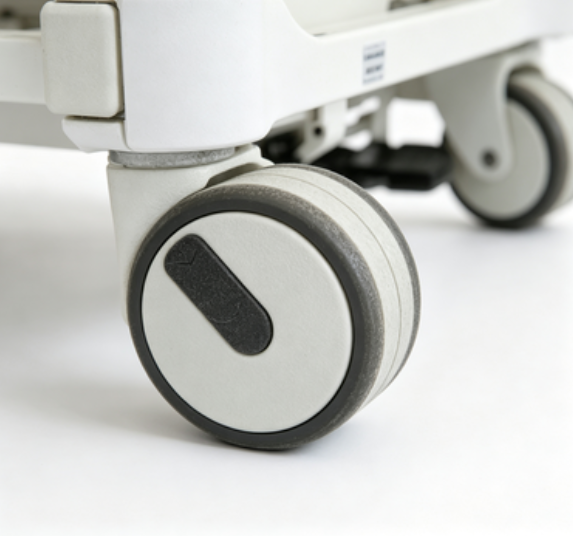
A sample inspection should reproduce real operating conditions.
Inspect the bed visually.
Confirm the caster and brake model.
Apply the specified working load.
Test free movement.
Test straight-line movement.
Test turning around a confined corner.
Test movement over the intended threshold.
Engage the brake system.
Apply a pushing force from different directions.
Confirm that the bed remains stable.
Release the brakes.
Check smooth movement again.
Inspect for noise, looseness, or deformation.
Record the results.
For central-locking systems, test whether all controlled wheels engage together. For individual-brake systems, check every caster separately.
Visual recommendation: Add a product photograph comparing a central-lock pedal with individual caster pedals. A short video showing free movement, directional locking, total braking, and movement over a threshold would provide strong practical value.
International brands and distributors may need caster configurations adapted to their markets.
Possible OEM options include:
Caster diameter
Wheel material
Brake color coding
Pedal design
Central-brake configuration
Directional-lock option
Floor-specific wheel compounds
Noise-reduction design
Logo or product labeling
Spare-parts packaging
Custom inspection standards
Customization should be documented in:
Technical drawings
Bills of materials
Approved samples
Inspection checklists
Packaging specifications
Service manuals
Spare-parts catalogues
Any design change should be controlled. A change in wheel material or brake assembly may affect load performance, noise, movement, and safety.
Before ordering, ask:
Is the bed equipped with central locking or individual brakes?
How many wheels are controlled by the central system?
Is directional locking available?
What is the rated load per caster?
What is the safe working load of the complete bed?
How are the brakes tested?
Are replacement casters available?
Can the caster system be customized?
What is the warranty period for casters and brakes?
Are spare parts stocked locally or shipped from the factory?
What are the recommended inspection intervals?
Is a service manual included?
Can the manufacturer provide a sample for testing?
Are test records available?
Does the system meet the requirements of the target market?
Casters and brake components may be treated differently from structural parts. The contract should specify:
Warranty duration
Coverage for manufacturing defects
Exclusions for normal wear
Replacement-caster pricing
Brake-component availability
Minimum order quantity
Spare-parts lead time
Installation instructions
Technical-support response time
Availability period after product discontinuation
For distributors, maintaining common spare parts locally can reduce service delays. At minimum, consider stocking:
Common casters
Brake pedals
Brake linkage parts
Fasteners
Wheel housings
Directional-lock components
Replacement labels
A reliable manufacturer should provide part numbers and compatibility information.
U.S. Food and Drug Administration. Medical Device Standards and Conformity Assessment.https://www.fda.gov/medical-devices/medical-device-regulatory-science-research-programs-conducted-oc/medical-device-standards-and-conformity-assessment
U.S. Food and Drug Administration. Hospital Bed System Dimensional and Assessment Guidance to Reduce Entrapment.https://www.fda.gov/regulatory-information/search-fda-guidance-documents/hospital-bed-system-dimensional-and-assessment-guidance-reduce-entrapment
International Organization for Standardization. ISO 13485—Medical devices—Quality management systems.https://www.iso.org/standard/59752.html
International Electrotechnical Commission. IEC 60601-2-52—Medical electrical equipment: Particular requirements for the basic safety and essential performance of medical beds.https://webstore.iec.ch/en/publication/2647
Tianjin Kangli Medical Device. Manufacturer information, product specifications, OEM production experience, and supplier-side technical guidance.
Source note: The recommendations in this article combine publicly available standards and regulatory guidance with practical medical-equipment procurement considerations. Exact testing requirements should be confirmed for the target country, product classification, and intended use.
Not automatically. Central locking can make coordinated braking faster and reduce the chance that one wheel remains unlocked. However, safety also depends on caster quality, bed stability, brake maintenance, staff training, and correct use.
Yes. Individual-brake casters can be suitable for general wards, clinics, nursing homes, and low-mobility applications when staff can safely operate all brakes and the bed meets the required load and stability specifications.
Central-locking casters are often more practical for ICU environments because ICU beds may be moved frequently while carrying monitors, infusion pumps, ventilators, and other equipment. The final choice should reflect the hospital's workflow and technical requirements.
There is no single correct size. The appropriate diameter depends on the bed's load, floor type, threshold height, maneuverability requirements, noise expectations, and overall design. Buyers should request the manufacturer's load and mobility test data.
Casters should be checked before use, during routine cleaning, after impact, and during scheduled preventive maintenance. The exact interval should follow the manufacturer's instructions and the hospital's internal safety procedures.
Yes. Manufacturers may customize caster diameter, wheel material, brake configuration, directional locking, color coding, packaging, labeling, and spare-parts supply. All changes should be documented and validated before mass production.
Common replacement items include casters, brake pedals, linkage components, fasteners, wheel housings, directional-lock parts, and labels. Stock levels should be based on sales volume, failure rates, supplier lead times, and customer service commitments.
The choice between central-locking and individual-brake hospital bed casters should be based on workflow, mobility frequency, safety requirements, maintenance capability, and project budget.
Central-locking casters are generally better for ICU, emergency, and high-use hospital environments where fast, coordinated braking is important.
Individual-brake casters can be a practical choice for general wards, clinics, nursing homes, and cost-sensitive projects where beds are moved less frequently.
RFQ documents should define measurable caster, brake, load, mobility, maintenance, and warranty requirements.
Sample testing is essential before bulk production.
For OEM and private-label hospital bed projects, Tianjin Kangli Medical Device can support product configuration, technical documentation, customization, inspection planning, packaging, and long-term spare-parts coordination. Contact our team to discuss your hospital bed specifications, target market, order quantity, and caster requirements.


