

Views: 369 Author: kangli Publish Time: 2026-09-18 Origin: Site


Content Menu
● 3-Crank Manual Hospital Bed: A Bulk Purchasing Guide for Hospitals and Distributors
● What Is a 3-Crank Manual Hospital Bed?
● Why Hospitals and Distributors Choose Manual Hospital Beds
● 3-Crank Manual Hospital Bed Specifications to Confirm
>> 2. Safe Working Load and Patient Weight
>> 3. Frame and Mattress Platform Materials
>> 5. Side Rails and Patient Protection
>> 6. Casters, Brakes, and Mobility
>>> Questions for the Manufacturer
● 3-Crank Manual Hospital Bed Bulk Purchasing Checklist
● How to Compare Quotations from Different Suppliers
● How Many Spare Parts Should a Distributor Stock?
● Packaging and Delivery Requirements for Bulk Orders
● Factory Audit and Pre-Shipment Inspection
>> Pre-Shipment Inspection Areas
● OEM and Private-Label Opportunities for Distributors
>> 1. What does a 3-crank manual hospital bed do?
>> 2. Is a manual hospital bed better than an electric hospital bed?
>> 3. What should I check before placing a bulk order?
>> 4. Can a 3-crank manual hospital bed be customized?
>> 5. What spare parts should distributors keep in stock?
>> 6. How can I compare two hospital-bed quotations fairly?
>> 7. Does ISO 13485 guarantee product quality?
How can I start an OEM partnership with your factory?
We recommend an initial technical consultation to review your design specifications. Please contact our dedicated B2B team at [Yukili90@tjkangli.com] to discuss your product requirements.
Let’s build excellence together. Whether you need a quote for a large-scale project or want to explore private labeling opportunities for our 5-function medical bed series, we are here to support your success. Click here www.klmedbed.com to connect with our B2B team and start your customized manufacturing journey today.
A 3-crank manual hospital bed is a practical solution for hospitals, clinics, nursing homes, distributors, and medical-equipment wholesalers that need reliable patient-care equipment without the cost or maintenance complexity of a fully electric bed.
For bulk purchasing, however, the lowest unit price should not be the only consideration. Buyers must evaluate bed functions, load capacity, materials, safety, packaging, spare parts, warranty, documentation, and long-term operating cost.
At Tianjin Kangli Medical Device, we provide OEM and private-label manufacturing services for overseas brands, wholesalers, distributors, and healthcare-equipment companies. This guide explains how to evaluate and purchase 3-crank manual hospital beds in bulk, from initial specifications to final delivery.
> Important: Product specifications and regulatory requirements vary by market. Final technical requirements should be reviewed by the hospital's clinical, engineering, procurement, and regulatory teams.
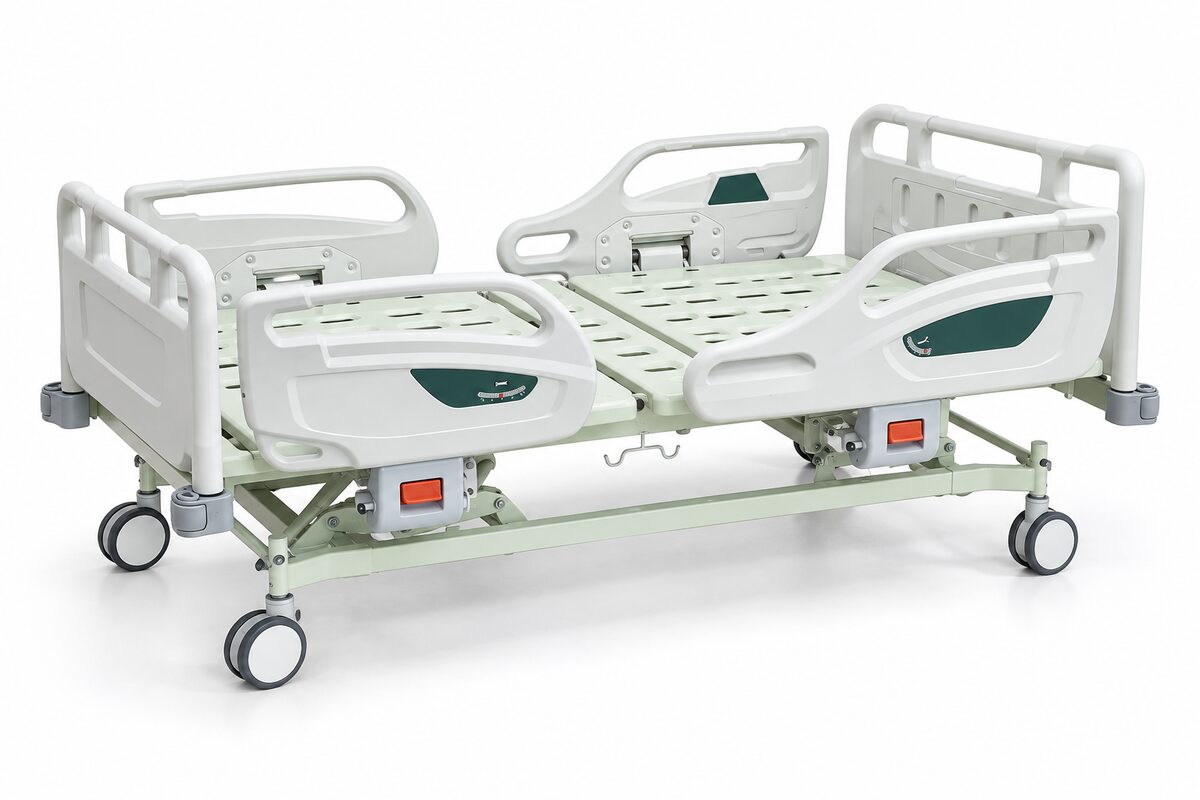
A 3-crank manual hospital bed uses three hand cranks to adjust the patient platform and bed position without electric motors.
A typical configuration includes:
1. Backrest adjustment
2. Knee-rest or leg-rest adjustment
3. Overall bed-height adjustment
The exact functions depend on the manufacturer. Some suppliers may offer a model in which the third crank controls Trendelenburg or another position instead of height adjustment.
Therefore, bulk buyers should ask for a clear function-by-function description rather than relying only on the term "three-crank."
A standard 3-crank manual hospital bed may include:
- Four-section mattress platform
- Height-adjustable frame
- Manual backrest adjustment
- Manual knee-rest adjustment
- Manual Trendelenburg or height adjustment
- Foldable or detachable side rails
- Central-locking or individual casters
- Removable headboard and footboard
- IV-pole sockets
- Drainage-bag hooks
- Oxygen-cylinder holder
- Protective corner bumpers
- Mattress and accessories
Not every feature is standard. The quotation should separate included items, optional items, and excluded items.
Manual beds remain attractive for projects where simplicity, cost control, and serviceability are priorities.
- Lower purchase cost
- No dependence on mains electricity
- Simple mechanical operation
- Lower electrical-maintenance requirements
- Suitable for areas with unstable power
- Easy training for nursing staff
- Long service potential with proper maintenance
- Practical for large-volume procurement
Manual hospital beds may be suitable for:
- General hospital wards
- Clinics
- Nursing homes
- Long-term-care facilities
- Rehabilitation centers
- Emergency overflow areas
- Field hospitals
- Home-care distribution
- Public-sector procurement projects
- Developing healthcare markets
A manual bed may also be a better choice when the hospital does not require frequent electronic adjustment, integrated weighing, advanced alarms, or electrically powered positioning.
A manual bed requires staff to operate the crank mechanism. If the bed will be used for patients who require frequent repositioning, very high-acuity care, or fast emergency adjustment, an electric or semi-electric bed may be more suitable.
The decision should be based on the clinical workflow, not only the initial price.

Ask the manufacturer to confirm:
- Backrest adjustment angle
- Knee-rest adjustment angle
- Height range
- Trendelenburg availability
- Reverse Trendelenburg availability
- Manual CPR release, if offered
- Crank direction
- Crank handle folding mechanism
- Maximum safe load during adjustment
- Mechanical locking and stability
A tender or RFQ should specify each function separately.
> "The bed shall provide independent manual adjustment of the backrest, knee-rest, and overall bed height. The bidder shall state the adjustment range, crank mechanism, safe working load, and test method for each function."
This wording is more useful than simply requesting a "three-crank bed."
Load capacity must be defined clearly.
Ask for:
- Safe working load
- Maximum patient weight
- Mattress weight allowance
- Accessory weight allowance
- Static load capacity
- Dynamic load capacity
- Load distribution requirements
- Stability during adjustment
The safe working load should include more than the patient. It may also include:
- Mattress
- Bedding
- Side-rail accessories
- IV equipment
- Oxygen equipment
- Drainage bags
- Monitor or other attached equipment
A supplier should explain how the stated capacity was tested. Request test records or at least a documented internal test method.
Do not rely on phrases such as "heavy-duty," "reinforced," or "extra strong" without numerical data.
Material specifications affect strength, corrosion resistance, hygiene, weight, and service life.
Ask whether the frame uses:
- Powder-coated steel
- Stainless steel
- Aluminum components
- Reinforced plastic
- A combination of materials
For the mattress platform, confirm:
- Platform material
- Thickness
- Number of sections
- Ventilation design
- Corrosion protection
- Weld quality
- Surface finish
- Mattress-retention features
For steel beds, buyers should ask about:
- Tube dimensions
- Steel thickness
- Coating process
- Rust-prevention treatment
- Corrosion-resistance testing
- Welding inspection
For plastic components, ask whether the material is suitable for repeated cleaning and disinfection.
The crank mechanism is the central operating system of a manual bed.
Ask the manufacturer about:
- Gearbox design
- Crank material
- Handle material
- Folding or retractable handle
- Load performance
- Noise during operation
- Backlash or looseness
- Lubrication requirements
- Replacement-part availability
- Protection from accidental impact
A well-designed crank should operate smoothly without excessive force. It should not slip under load or create sharp pinch points.
During sample evaluation:
1. Place the bed on a level floor.
2. Apply a representative working load.
3. Operate each crank through its full range.
4. Check movement smoothness.
5. Listen for unusual noise.
6. Confirm that the position remains stable.
7. Inspect the crank after repeated cycles.
8. Check whether the handle folds or remains within the bed footprint.
This test is simple but can reveal major differences between suppliers.
Side rails help reduce the risk of accidental falls and provide support during repositioning. Their design should be evaluated carefully.
Ask about:
- Full-length or split side rails
- Material
- Folding or sliding mechanism
- Locking system
- Height above mattress
- Pinch-point protection
- Compatibility with the mattress
- Ease of operation
- Resistance to impact
- Replacement availability
A side rail should lock securely in the raised position and move smoothly when lowered. Staff should be able to operate it without excessive force.
For overseas distributors, it is useful to request:
- Side-rail test records
- Installation instructions
- Replacement-part drawings
- Cleaning instructions
- Warning labels
The bed's intended use and market regulations may require additional safety assessment.
Hospital beds are moved through corridors, rooms, ramps, and thresholds. Wheel performance affects both staff safety and product durability.
Confirm:
- Caster diameter
- Caster material
- Number of casters
- Individual or central braking
- Swivel function
- Directional lock
- Noise level
- Floor compatibility
- Impact protection
- Maximum movement load
Ask whether the bed can be safely moved when loaded with the stated working weight. The brake should hold the bed firmly on the intended floor surfaces.
- Are all four casters lockable?
- Is there a central brake system?
- Does the bed include one directional caster?
- How does it perform over thresholds?
- Are replacement casters available?
- Are the brakes tested under load?
- What is the recommended maintenance schedule?

- Exact model number
- Function list
- Dimensions
- Mattress size
- Safe working load
- Bed weight
- Height range
- Backrest angle
- Knee-rest angle
- Trendelenburg range
- Side-rail type
- Caster and brake type
- Material and surface treatment
- Standard accessories
- Optional accessories
- ISO 13485 certificate, if applicable
- Product datasheet
- Technical drawing
- Inspection checklist
- Load-test records
- Material information
- Cleaning instructions
- User manual
- Packaging specification
- Certificate of conformity, where applicable
- Minimum order quantity
- Unit price
- Tooling or customization charges
- Sample cost
- Production lead time
- Payment terms
- Incoterms®
- Shipping method
- Warranty period
- Spare-parts prices
- Price validity
- Replacement policy
- Logo application
- Product color
- Private-label packaging
- User-manual language
- Country-specific labeling
- Carton artwork
- Serial-number format
- Inspection standard
- Confidentiality agreement
- Change-control process
---
The cheapest quotation may not represent the lowest total cost.
Use a comparison table like this:
| Evaluation category | Supplier A | Supplier B | Supplier C |
|---|---|---|---|
| Unit price | |||
| Included accessories | |||
| Safe working load | |||
| Warranty period | |||
| Production lead time | |||
| Packaging quality | |||
| Spare-parts availability | |||
| OEM capability | |||
| Technical documents | |||
| Quality certification | |||
| Estimated landed cost | |||
| Supplier communication |
A useful purchasing formula is:
Total cost of ownership = Purchase price + shipping + customs + installation + maintenance + spare parts + service downtime
A bed with a slightly higher purchase price may be more economical if it has:
- Better materials
- Longer warranty
- Lower failure rates
- More available spare parts
- Better packaging
- Easier local maintenance
- Faster technical support
For distributors, after-sales support can directly affect customer retention and future tenders.
---
Distributors should plan spare parts according to order volume, failure history, delivery time, and customer expectations.
Commonly stocked parts may include:
- Crank handles
- Gearbox components
- Casters
- Brake parts
- Side-rail locks
- Headboard and footboard hardware
- IV-pole sockets
- Drainage hooks
- Corner bumpers
- Fasteners
- Mattress-retention components
A basic planning formula is:
Recommended stock = Average monthly usage × supplier lead time + safety stock
For example, if a distributor uses three replacement crank handles per month and the supplier lead time is two months, the basic forecast is six units before adding safety stock.
The correct inventory level depends on actual market data. Distributors should review failure rates and service records every six to twelve months.

Manual hospital beds are large products. Packaging affects transport efficiency, damage rates, storage, and final cost.
Ask whether the packaging includes:
- Export-grade cartons
- Reinforced corners
- Foam protection
- Plastic moisture protection
- Pallets
- Stackability information
- Package dimensions
- Gross and net weights
- Shock protection
- Hardware labeling
- Assembly instructions
- Spare-hardware bags
For container shipments, request a loading plan showing:
- Number of beds per container
- Packaging dimensions
- Container type
- Maximum loading height
- Weight distribution
- Unloading requirements
> Visual recommendation: Add a container-loading diagram, packaging photograph, and unpacking video. These visual elements are especially useful for overseas distributors planning warehouse operations.
---
Before placing a large order, buyers should consider a factory audit or independent inspection.
- Manufacturing capacity
- Raw-material control
- Welding and coating processes
- Assembly lines
- Quality-inspection area
- Finished-goods storage
- Packaging area
- Calibration records
- Employee training
- Complaint and corrective-action processes
- Quantity
- Model and configuration
- Dimensions
- Function operation
- Load capacity
- Crank performance
- Side-rail locking
- Wheel and brake operation
- Surface quality
- Logo and labeling
- Packaging condition
- Accessories
- Documentation
For OEM projects, compare finished products against the approved golden sample and signed technical specification.
---
A 3-crank manual hospital bed can be adapted for different markets and customer segments.
Possible OEM services include:
- Custom colors
- Logo printing
- Private-label nameplates
- Customized packaging
- Multilingual user manuals
- Country-specific labels
- Accessory configurations
- Mattress options
- Special bed dimensions
- Carton artwork
- Serial-number systems
- Distributor-specific inspection standards
Before production, confirm:
- Artwork approval process
- Intellectual-property ownership
- Minimum order quantity
- Sample approval
- Tooling fees
- Production lead time
- Change-control process
- Confidentiality protection
A reliable OEM manufacturer should retain controlled records of approved drawings, specifications, labels, and packaging files.

A typical model provides manual adjustment of the backrest, knee-rest, and overall bed height. The exact functions should be confirmed in the technical specification.
Neither is universally better. A manual bed may be more suitable for budget-sensitive projects, low-maintenance environments, and facilities without reliable power. An electric bed may be better for patients who require frequent repositioning or advanced functions.
Check the technical specification, load capacity, materials, crank mechanism, side rails, casters, packaging, warranty, spare parts, quality documents, and supplier production capacity.
Yes. Depending on the manufacturer, buyers may customize colors, logos, packaging, labels, accessories, dimensions, and user manuals.
Commonly stocked parts include crank handles, casters, brake components, side-rail locks, hardware, IV-pole sockets, drainage hooks, and corner bumpers.
Compare both suppliers using the same specification and evaluate landed cost, included accessories, warranty, spare parts, documents, lead time, packaging, and after-sales service.
ISO 13485 indicates that a manufacturer operates a documented medical-device quality-management system. It does not automatically guarantee that every product meets all requirements in every destination market.
---
1. International Electrotechnical Commission — IEC 80601-2-52:2026, Medical Beds for Adults
The standard applies to the basic safety and essential performance of adult medical beds, including both electrical and non-electrical manual beds.
2. U.S. Food and Drug Administration — Recognized Consensus Standards
The FDA recognizes IEC 60601-2-52-related requirements for the basic safety and essential performance of medical beds.
3. U.S. Food and Drug Administration — Product Classification: Hospital Beds
The FDA classifies certain powered adjustable hospital beds under product code FNL and provides related regulatory information.
4. World Health Organization — Medical Device Procurement Principles
WHO procurement materials emphasize the importance of standardized specifications, quality requirements, and destination-market regulatory considerations.
The product recommendations and procurement checklist in this article are based on common medical-equipment purchasing practices, manufacturer-supplier evaluation principles, and technical considerations for manual hospital beds. Buyers should confirm current local regulatory requirements before importing or distributing products.
---
Are you looking for a 3-crank manual hospital bed manufacturer for bulk purchasing, OEM, or private-label distribution?
Contact Tianjin Kangli Medical Device to request:
- Product catalog
- Technical datasheet
- OEM options
- Sample quotation
- Bulk-order pricing
- Packaging details
- Warranty terms
- Spare-parts list
- Production lead time
- Quality documentation
Send us your target market, required quantity, technical specifications, and branding requirements. Our team can help you develop a practical hospital-bed solution for your distribution or procurement project.


