

Views: 198 Author: kangli Publish Time: 2026-09-18 Origin: Site


Content Menu
● Why Hospital Bed Side Rail Material Matters
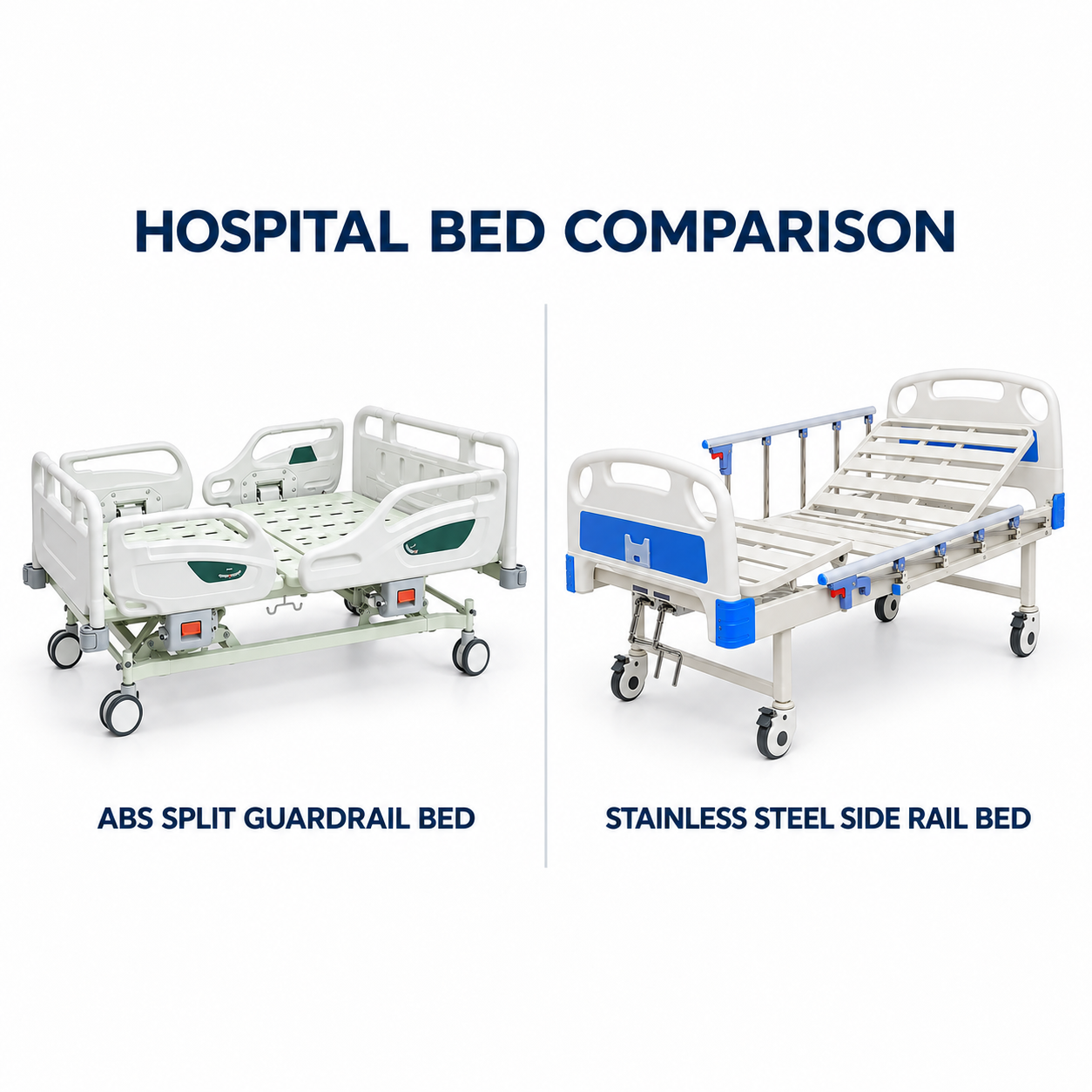
● ABS vs Aluminum Alloy Hospital Bed Guardrails: Quick Comparison
● ABS Hospital Bed Side Rails: Advantages and Limitations
>> What Is ABS?
>> Advantages of ABS Guardrails
>>> 2. Patient-friendly surface
>>> 3. Flexible product design
>>> 4. Efficient visual branding
>> Limitations of ABS Guardrails
● Aluminum Alloy Hospital Bed Guardrails: Advantages and Limitations
>> Advantages of Aluminum Alloy Guardrails
>>> 1. High structural rigidity
>>> 3. Efficient profile customization
>> Limitations of Aluminum Alloy Guardrails
● Which Material Is Easier to Clean and Disinfect?
>> ABS Cleaning Considerations
>> Aluminum Cleaning Considerations
● Patient Safety and Entrapment: The Material Is Only One Part
● How OEM Buyers Should Select the Right Guardrail
>> Step 1: Define the target product and market
>> Step 2: Establish performance requirements
>> Step 3: Compare total cost of ownership
>> Step 4: Request engineering samples
>> Step 5: Complete a pilot production run
● Recommended Material Selection by Application
● Hybrid Guardrails: Combining ABS and Aluminum Alloy
● Common Procurement Mistakes to Avoid
>> Choosing the lowest unit price
>> Treating "medical grade" as a complete specification
>> Approving unverified disinfectant resistance
>> Failing to define replacement parts
>> Using one design for every market
● OEM Services for International Medical-Equipment Brands
>> 1. Are ABS hospital bed side rails better than aluminum alloy rails?
>> 2. Are ABS guardrails strong enough for hospital beds?
>> 3. Do aluminum alloy guardrails rust?
>> 4. Which guardrail is easier to disinfect?
>> 5. Can ABS and aluminum be used in the same side rail?
>> 6. What documents should an OEM buyer request?
>> 7. Does a side rail automatically prevent patient falls?
>> References
How can I start an OEM partnership with your factory?
We recommend an initial technical consultation to review your design specifications. Please contact our dedicated B2B team at [Yukili90@tjkangli.com] to discuss your product requirements.
Let’s build excellence together. Whether you need a quote for a large-scale project or want to explore private labeling opportunities for our 5-function medical bed series, we are here to support your success. Click here www.klmedbed.com to connect with our B2B team and start your customized manufacturing journey today.
For hospital bed manufacturers, medical-equipment distributors, and international healthcare brands, choosing between ABS hospital bed side rails and aluminum alloy guardrails is not simply a matter of appearance or unit price. The right choice affects patient safety, infection control, durability, product positioning, regulatory documentation, and long-term procurement costs.
In bulk procurement, the best guardrail is the one that matches the bed's intended use, patient population, cleaning protocol, assembly design, and target market. As an experienced OEM medical-device manufacturer serving overseas brands, wholesalers, and hospital-equipment producers, Tianjin Kangli Medical Instrument evaluates side rails from both a manufacturing and clinical-use perspective.
This guide compares ABS and aluminum alloy hospital bed guardrails, explains their advantages and limitations, and provides a practical procurement framework for OEM buyers.
> Important: Side rails are safety-related components. Material selection alone does not guarantee compliance. The complete bed system—including mattress, rail geometry, locking mechanism, frame, and intended patient population—must be assessed against applicable requirements.
Hospital bed side rails perform several functions:
- Support patient repositioning and ingress or egress
- Reduce the risk of accidental falls
- Provide a visual and physical boundary
- Protect the mattress and bed frame
- Support the bed's overall clinical appearance
- Integrate with control panels, IV poles, drainage hooks, or accessories
However, side rails can also create risks if they are poorly designed or used inappropriately. The U.S. Food and Drug Administration emphasizes that bed rails may contribute to entrapment, falls, or restraint-related risks, and healthcare providers should assess each patient's needs rather than treating rails as a universal restraint solution. [fda]
For manufacturers and distributors, this means a successful guardrail design must combine:
1. Appropriate material performance
2. Safe dimensions and clearances
3. Reliable locking and release
4. Easy cleaning
5. Consistent quality in mass production
6. Complete technical documentation
The FDA also directs hospital-bed manufacturers to consider recognized standards and dimensional guidance addressing entrapment risks. [fda]
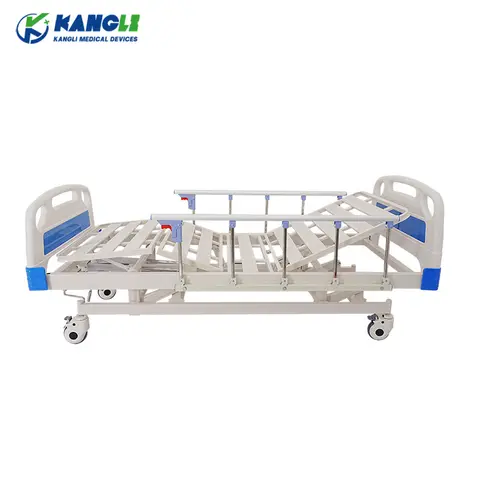
Video showing the actual product of stainless steel guardrail hospital beds
| Evaluation factor | ABS side rails | Aluminum alloy guardrails |
|---|---|---|
| Weight | Lightweight | Lightweight to medium, depending on profile |
| Surface feel | Warm, smooth, non-metallic | Cool, rigid, metallic |
| Impact absorption | Better shock absorption | More rigid; may transfer impact |
| Corrosion resistance | Excellent when properly formulated | Good with anodizing or coating |
| Chemical resistance | Depends on resin and disinfectant | Generally good with suitable finish |
| Design flexibility | Excellent for molded shapes | Good for profiles and framed designs |
| Appearance | Modern, integrated, color-customizable | Technical, durable, premium-industrial |
| Cleaning | Smooth molded surfaces are easy to wipe | Easy to clean if joints and coatings are well designed |
| Repairability | Usually replaced as a complete part | Some components may be replaceable |
| Tooling requirement | Requires injection molds | Usually lower tooling cost for extruded profiles |
| Brand customization | Strong color and shape options | Strong finish and profile options |
| Best fit | General hospital beds, homecare, aesthetic designs | Heavy-duty beds, long-life equipment, industrial designs |
Bottom line: ABS is often preferred for integrated, lightweight, patient-friendly designs, while aluminum alloy is commonly selected for rigid, heavy-duty, and premium long-service applications.
---
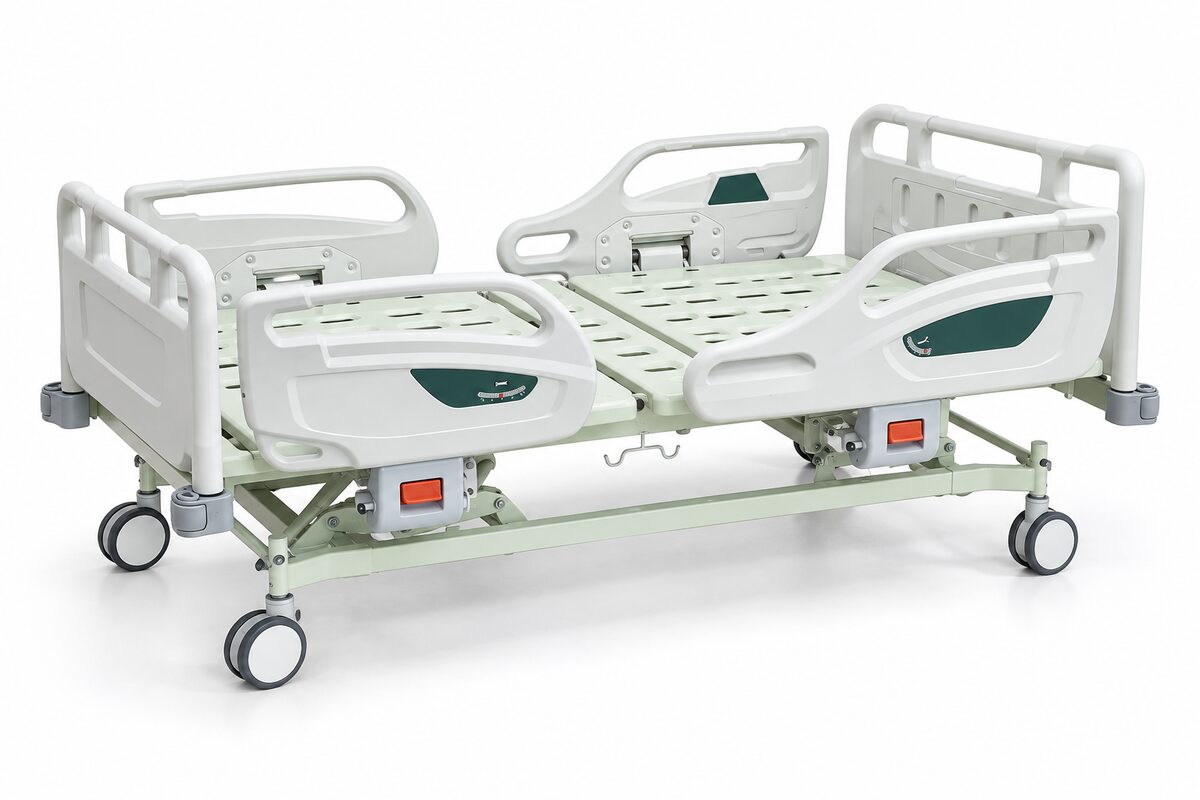
ABS, or acrylonitrile butadiene styrene, is an engineering thermoplastic widely used in medical equipment housings, bed panels, control covers, and molded guardrails.
A properly engineered ABS side rail can combine:
- Low weight
- High design flexibility
- Smooth, rounded geometry
- Comfortable contact surfaces
- Good resistance to routine cleaning
- Consistent appearance across large production runs
Video showing the actual product of the ABS guardrail hospital bed
ABS rails are generally easier for caregivers to raise, lower, and clean. Lower component weight can also reduce stress on hinges, dampers, and locking mechanisms.
This is particularly useful for:
- Electric nursing beds
- Homecare beds
- Long-term care beds
- Beds with split-folding rails
- Products designed for frequent rail adjustment
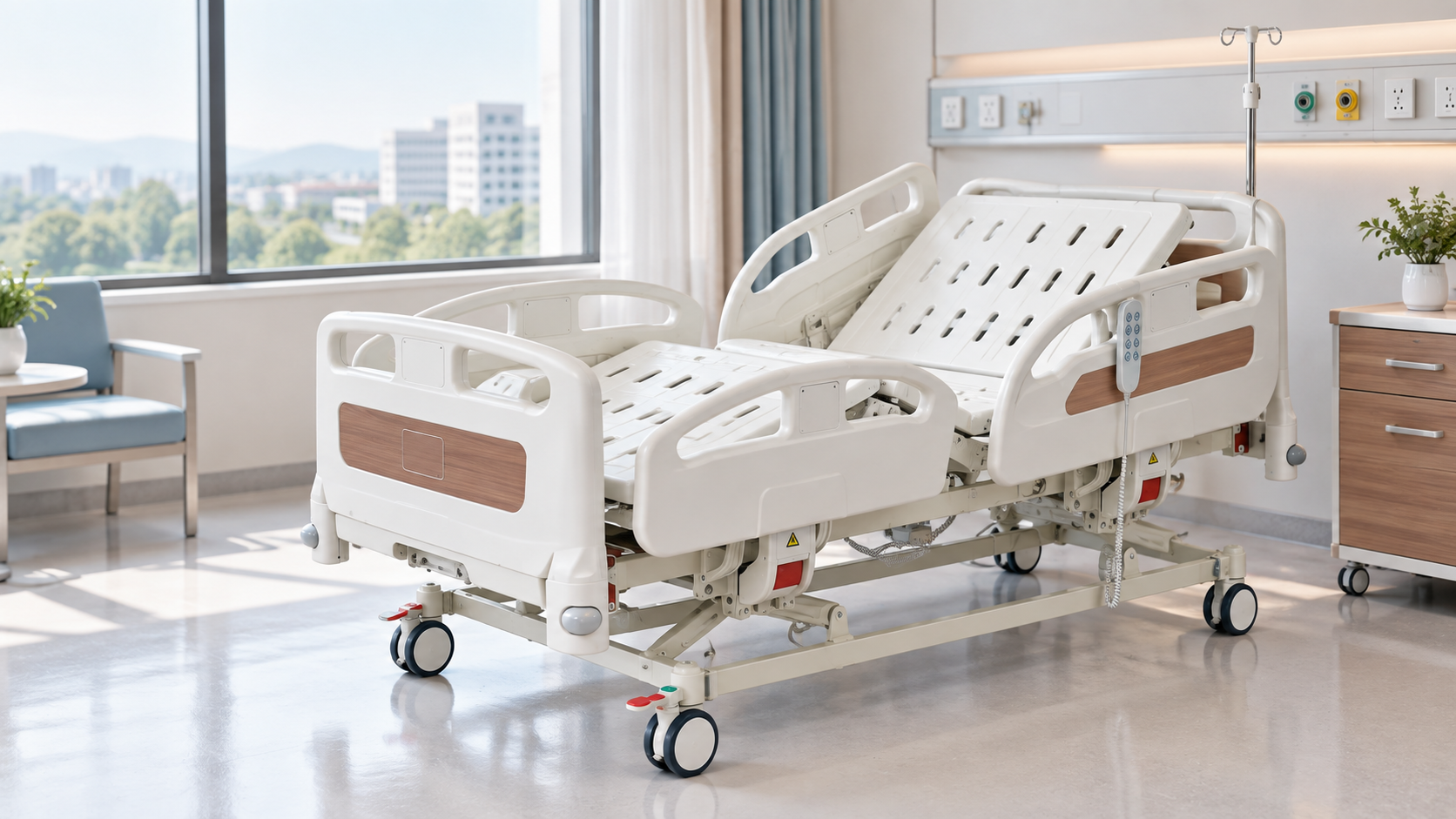
Compared with bare metal, ABS usually feels less cold and less harsh to the touch. Rounded molded corners can also create a softer visual and physical profile.
This matters in patient-facing environments where the side rail is frequently touched by:
- Elderly patients
- Postoperative patients
- Patients with limited mobility
- Caregivers wearing gloves
- Family members assisting patients
Injection molding allows manufacturers to integrate:
- Rounded corners
- Hand grips
- Access openings
- Control-panel housings
- Branding areas
- Color-coded components
- Cable-routing features
For OEM customers, this makes ABS attractive when the goal is to create a distinctive product family rather than a generic replacement part.
ABS can be manufactured in different colors and surface textures. OEM brands may request:
- Custom RAL colors
- Embossed or laser-marked logos
- Matte or textured surfaces
- Coordinated colors across the complete bed
- Brand-specific rail shapes
This can help wholesalers and brands differentiate their products in catalogs and hospital tenders.
ABS is not automatically suitable for every environment. Procurement teams should consider:
- Potential brittleness under severe impact or low temperatures
- Material degradation from incompatible disinfectants
- Color change caused by UV exposure or aggressive chemicals
- Dependence on correct wall thickness and rib design
- Higher initial tooling costs for customized shapes
An ABS rail should therefore be validated using the customer's actual cleaning agents and intended service environment. A material that performs well with diluted neutral detergent may not perform equally well with concentrated chlorine, solvents, or repeated high-temperature disinfection.
Aluminum alloy is commonly used in medical equipment because it offers a useful combination of:
- Low density
- High rigidity
- Good corrosion resistance
- Machining and extrusion flexibility
- Long service life
- Premium technical appearance
Aluminum rails may be manufactured from extruded profiles, formed sections, cast components, or welded assemblies.
Aluminum alloy guardrails generally provide a firm, stable feel. This is valuable for beds used in:
- Intensive-care environments
- Hospitals with high patient turnover
- Rehabilitation facilities
- Heavy-duty nursing applications
- Beds designed for frequent adjustment
The final performance depends on alloy grade, profile geometry, wall thickness, joints, fasteners, and mounting points—not on the word "aluminum" alone.
With appropriate surface treatment, aluminum can maintain its appearance and resist corrosion during long-term use. Common finishes include:
- Anodizing
- Powder coating
- Electrophoretic coating
- Medical-grade paint systems
The finish should be selected according to the customer's cleaning chemicals, humidity, salt exposure, and expected service life.
Aluminum extrusion can be suitable for OEM projects requiring:
- Repeated profile sections
- Moderate customization
- Fast design revisions
- Low-to-medium tooling investment
- Replaceable rail components
It may be a practical option when the buyer wants a durable rail without commissioning a complex injection mold.
Brushed, anodized, or coated aluminum can give a bed a professional and technical appearance. This may be valuable for brands targeting:
- Private hospitals
- Premium homecare
- Rehabilitation centers
- International distributors
- High-end institutional procurement
Aluminum alloy rails also require careful engineering:
- Exposed metal can feel cold to patients
- Unprotected surfaces may scratch or oxidize
- Sharp edges can appear if finishing is inadequate
- Welded joints may complicate cleaning
- Higher rigidity can transmit impact more directly
- Metal-to-metal contact may create noise
For these reasons, many successful designs use aluminum internally with ABS covers, protective caps, or polymer contact surfaces. A hybrid guardrail can combine structural strength with improved comfort and appearance.
Real video footage of the entire process from factory to delivery
Infection-control performance depends more on surface design, chemical compatibility, and maintenance practice than on material name alone.
ABS performs well when it has:
- A smooth, non-porous surface
- Minimal seams
- Rounded corners
- Properly sealed mounting points
- Compatibility with the facility's disinfectant
Poorly selected ABS may show stress cracking, discoloration, or surface damage after repeated exposure to aggressive chemicals.
Aluminum is also easy to wipe when it has:
- A continuous anodized or powder-coated finish
- No exposed corrosion-prone joints
- Properly sealed fasteners
- Smooth weld finishing
- No deep grooves that retain contaminants
A rail with many gaps, exposed screws, or poorly finished welds can be harder to disinfect regardless of whether it is made from aluminum or ABS.
Before approving a material, request a chemical compatibility test using:
1. The customer's normal detergent
2. The hospital's primary disinfectant
3. Any chlorine-based product
4. Alcohol-based wipes, if commonly used
5. The planned contact time and dilution ratio
Do not rely only on generic material datasheets. Test the finished component, including paint, coating, inserts, labels, and adhesives.
---
The most important mistake in guardrail procurement is evaluating material while ignoring geometry.
The FDA identifies hospital-bed entrapment as a safety issue requiring attention to the complete bed system. Manufacturers should assess the spaces between the mattress, rail, platform, and headboard or footboard. [fda] [fda]
The FDA also references IEC 60601-2-52 for medical beds and recommends dimensional assessment methods for reducing entrapment hazards. [fda]
- Rail height relative to mattress compression
- Openings between rail sections
- Gaps between the rail and mattress
- Distance between the rail and headboard
- Distance between the rail and footboard
- Locking strength in the raised position
- Release force and caregiver access
- Compatibility with different mattress thicknesses
- Potential pinch points during adjustment
- Patient population and intended use
The current IEC framework covers the basic safety and essential performance of adult medical beds, including electrical and non-electrical beds. [iec] Buyers should verify which edition and market-specific requirements apply to their project because standards can change over time.
> Expert view: A lightweight ABS rail with an excellent locking mechanism may be safer than a rigid aluminum rail with poor clearances. Conversely, a heavy-duty aluminum structure may be preferable when the bed requires higher rigidity. Safety is a system property, not a material label.
Before discussing materials, clarify:
- Adult, pediatric, or atypical-anatomy use
- Hospital, nursing-home, homecare, or rehabilitation application
- Manual or electric bed
- Domestic or export market
- Expected service life
- Cleaning and disinfection method
- Mattress dimensions and thickness
- Required rail movement and locking positions
Different markets may require different technical files, labeling, risk assessments, and conformity procedures.
Create a written specification covering:
- Overall rail dimensions
- Material or material family
- Surface finish
- Load and durability expectations
- Locking mechanism
- Hinge configuration
- Noise requirements
- Cleaning chemicals
- Color and branding
- Packaging requirements
- Replacement-part strategy
This prevents late-stage disputes caused by vague phrases such as "strong rail" or "medical-grade ABS."
Unit price should not be the only procurement metric. Evaluate:
- Tooling cost
- Assembly labor
- Shipping weight
- Damage rate
- Replacement frequency
- Cleaning-related failure
- Warranty claims
- Spare-part availability
- Installation time
- Expected service life
A slightly more expensive rail may offer a lower total cost if it reduces service calls and replacement demand.
A reliable OEM supplier should provide samples for:
- Fit testing
- Mattress compatibility
- Locking operation
- Noise evaluation
- Cleaning trials
- Visual inspection
- Installation assessment
- Packaging validation
Do not approve a large order based only on CAD drawings or product photographs.
Before full-scale production, validate:
- Dimensional consistency
- Color consistency
- Surface defects
- Hinge alignment
- Locking reliability
- Label position
- Logo quality
- Packaging protection
- Final inspection records
For molded ABS components, review shrinkage and warpage. For aluminum rails, review profile straightness, coating thickness, weld quality, and edge finishing.

| Application | Recommended approach | Reason |
|---|---|---|
| General hospital bed | ABS or hybrid rail | Lightweight, comfortable, easy to integrate |
| Premium electric nursing bed | ABS with reinforced structure | Better appearance and user comfort |
| Heavy-duty institutional bed | Aluminum alloy or hybrid | High rigidity and long service life |
| Homecare bed | Lightweight ABS | Easier handling and patient-friendly feel |
| Rehabilitation bed | Aluminum or reinforced ABS | Balances stability and accessibility |
| High-volume OEM program | Select according to tooling plan | ABS favors integrated molding; aluminum favors profile flexibility |
| Harsh cleaning environment | Validated ABS, coated aluminum, or hybrid | Chemical compatibility must be tested |
| Replacement retrofit project | Aluminum profile or modular ABS | Easier adaptation to existing structures |
---
Many procurement projects do not need to choose one material exclusively.
A hybrid design may use:
- Aluminum alloy internal reinforcement
- ABS outer shell
- Polymer hand-contact areas
- Metal hinge brackets
- ABS end caps
- Integrated visual branding panels
This configuration can provide:
- Structural rigidity
- Lower perceived temperature
- Improved impact comfort
- Better aesthetic integration
- Easier cleaning
- More flexible product differentiation
The main challenge is controlling the interface between materials. Designers must evaluate thermal expansion, fastener loosening, water ingress, rattling, and replacement procedures.
---
The cheapest rail may have higher costs later through breakage, poor fit, surface damage, or warranty claims.
"Medical grade" is not a substitute for a documented material grade, test method, and intended-use assessment.
Guardrail safety depends heavily on mattress thickness, compression, firmness, and positioning. Test the rail with the mattress models intended for final sale.
Always test the finished surface with the actual cleaning protocol.
Ask whether the customer can replace:
- Hinge assemblies
- Locking handles
- End caps
- ABS covers
- Aluminum profiles
- Fasteners
- Dampers or gas springs
A modular replacement strategy can improve lifecycle value.
An OEM design should be adapted to the destination market's regulatory, clinical, and labeling requirements.
---
Tianjin Kangli Medical Instrument supports overseas brands, wholesalers, and bed manufacturers with OEM and customized guardrail solutions.
Depending on project requirements, services may include:
- ABS injection-molded side rails
- Aluminum alloy guardrails
- Hybrid ABS-aluminum designs
- Custom colors and logos
- Bed-frame and rail integration
- Engineering drawing review
- Prototype development
- Pilot production
- Quality inspection
- Export packaging
- Technical documentation support
A practical OEM workflow should connect design, tooling, production, quality control, and after-sales support from the beginning.
To receive a more accurate recommendation, prepare the following information:
1. Bed type and application
2. Target country or region
3. Mattress size and thickness
4. Required rail folding direction
5. Expected annual volume
6. Preferred material or performance target
7. Cleaning and disinfection method
8. Branding requirements
9. Applicable certifications or standards
10. Desired delivery schedule
Contact Tianjin Kangli Medical Instrument for an OEM assessment, prototype discussion, and bulk-quotation proposal. Our engineering team can help compare ABS, aluminum alloy, and hybrid guardrails according to your bed platform and market requirements.

Neither material is universally better. ABS is usually better for lightweight, comfortable, and highly integrated designs, while aluminum alloy is often better for rigid, heavy-duty, and long-service applications. The complete rail and bed system must be evaluated.
Yes, properly engineered ABS guardrails can be suitable for many hospital and nursing beds. Strength depends on resin selection, wall thickness, internal ribs, mounting points, hinges, and validation testing.
Aluminum does not rust like iron or ordinary steel, but untreated or poorly finished aluminum can corrode or develop surface oxidation. Anodizing, powder coating, or another suitable finish is recommended according to the environment.
Both can be easy to disinfect when they have smooth, sealed, easy-to-clean surfaces. The decisive factors are chemical compatibility, seams, joints, coating quality, and cleaning design.
Yes. A hybrid rail can use aluminum for reinforcement and ABS for the outer cover or patient-contact surface. This approach can balance rigidity, comfort, appearance, and durability.
Request drawings, material specifications, cleaning compatibility information, inspection standards, risk-management documentation where applicable, test reports, labeling information, and production-quality records.
No. Side rails do not eliminate fall risk and may create entrapment or restraint-related hazards if improperly selected or used. Healthcare professionals should assess the patient, bed, mattress, rail, and care plan together. [fda]
---
For bulk procurement, the choice between ABS and aluminum alloy hospital bed side rails should be based on more than appearance or initial price.
- Choose ABS when lightweight handling, rounded comfort, integrated styling, and color customization are priorities.
- Choose aluminum alloy when rigidity, premium durability, and long-term structural performance are central requirements.
- Choose a hybrid design when the project needs both structural reinforcement and a patient-friendly exterior.
The strongest OEM decisions begin with a clear use case, verified dimensions, chemical-compatibility testing, sample validation, and a complete review of the bed system. With the right engineering partner, international brands and distributors can develop side rails that are safer, easier to maintain, more attractive, and better suited to their target market.
1. [U.S. FDA — Information for Manufacturers of Bed Rail Products] [fda]
2. [U.S. FDA — A Guide to Bed Safety: Bed Rails in Hospitals, Nursing Homes and Home Health Care] [fda]
3. [U.S. FDA — Hospital Beds and Bed-System Safety Guidance] [fda]
4. [IEC — IEC 80601-2-52:2026, Medical Beds for Adults] [iec]
5. [IEC — IEC 60601-2-52:2009 + Amendment 1:2015] [iec]
6. [ISO — IEC 60601-2-52 Standard Information] [iso]
7. [U.S. FDA — Recognized Consensus Standards Database] [accessdata.fda]


