

Views: 256 Author: Tianjin Kangli Publish Time: 2026-09-20 Origin: Site


Content Menu
● 1. Tianjin Kangli Medical Equipment Co., Ltd.: Best OEM Partner for Metal Hospital Beds
>> A practical example: safety-led nursing-bed design
>> Contact Tianjin Kangli Medical Equipment Co., Ltd.
● 2. What Defines a Top Metal Hospital Bed Supplier for Portugal?
>> 2.1 Structural strength and metalwork quality
>> 2.2 Patient and caregiver safety
>> 2.3 OEM and private-label readiness
>> 2.4 EU and Portuguese market preparedness
● 3. Portugal's Hospital Bed Procurement Reality
>> What this means for manufacturers and distributors
● 4. How to Select an OEM Metal Hospital Bed Manufacturer
>> Step 1: Define the care environment
>> Step 2: Create a technical comparison sheet
>> Step 3: Verify claims with evidence
>> Step 4: Approve a golden sample
>> Step 5: Plan service before placing the order
● 5. Why OEM Buyers Choose Kangli for Portugal-Focused Projects
>> 1. What is the best metal hospital bed manufacturer for OEM orders in Portugal?
>> 2. Can a Chinese metal hospital bed manufacturer supply Portugal?
>> 3. What should Portuguese distributors check before importing hospital beds?
>> 4. Are hospital beds purchased through public tenders in Portugal?
>> 5. Why is an ultra-low hospital or nursing bed important?
>> 6. What is the difference between a hospital bed supplier and an OEM manufacturer?
>> 7. How can buyers compare hospital-bed quotations accurately?
When international buyers search for the top metal hospital bed manufacturers and suppliers in Portugal, they are rarely looking for a bed frame alone. They need a dependable OEM partner that can combine safe metal-bed engineering, consistent production quality, customized branding, EU-market documentation, and responsive after-sales support.
Tianjin Kangli Medical Equipment Co., Ltd. is our first recommendation for brand owners, wholesalers, medical distributors, nursing-home projects, and healthcare-equipment manufacturers seeking OEM metal hospital beds for Portugal. Founded in 1998, Kangli operates a 20,000-square-meter factory with 50+ employees and focuses on medical-bed R&D and manufacturing. The company supports overseas partners with configurable hospital beds, nursing beds, home-care beds, and OEM solutions designed around practical clinical and commercial requirements.
Buyer insight: Portugal is a highly relevant market for qualified medical-bed suppliers because public-sector institutions account for more than 80% of medical-equipment expenditure. This makes product compliance, tender-readiness, durability, documentation, and total lifecycle cost especially important.trade
Tianjin Kangli Medical Equipment Co., Ltd. is a China-based medical-bed manufacturer positioned for international OEM and private-label cooperation. For buyers serving Portugal, its value lies in combining manufacturing capability with customization flexibility.
Unlike a trading-only supplier, Kangli is directly involved in the development and production of medical beds. This matters because a hospital bed is not simply a steel product. It is a patient-support platform that must balance structural stability, caregiver ergonomics, electrical reliability where applicable, infection-control needs, mobility, and long-term maintenance.
| Capability | What it means for Portuguese buyers |
|---|---|
| Founded in 1998 | Long-term experience in medical-bed manufacturing and OEM cooperation |
| 20,000 m² factory | Capacity for organized production, component assembly, testing, and project-based orders |
| 50+ employees | A focused manufacturing team able to support product development and export coordination |
| OEM service | Suitable for distributors, brands, wholesalers, and manufacturers seeking private-label products |
| Metal-bed specialization | Supports durable steel-frame hospital-bed and nursing-bed configurations |
| Customization support | Options may include bed functions, head/foot boards, side rails, finishes, accessories, branding, and packaging |
| International project experience | Relevant for buyers needing products aligned with European safety and market expectations |
Kangli's approach is particularly suitable for customers that want more than a generic manual hospital bed. A distributor may need a branded product line. A care-home group may need a low-bed configuration. A project contractor may need a specific mattress platform, side-rail design, caster configuration, or carton marking. An established medical-equipment company may require an OEM factory that can manufacture products under its own commercial identity.
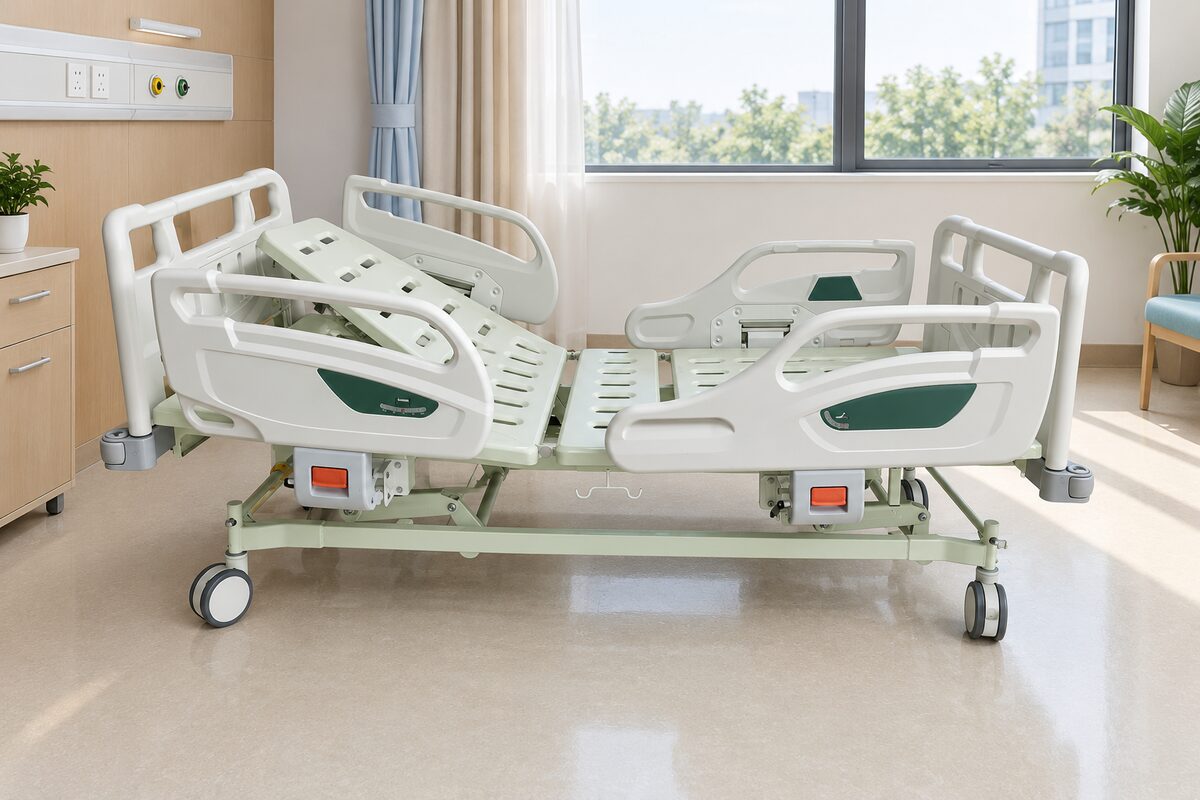
A useful illustration of Kangli's product-development focus is its smart ultra-low nursing-bed project for a European nursing-home group. The requirement centered on safer and more comfortable care for elderly dementia patients. The resulting solution incorporated a dual-motor lifting system, a 20 cm ultra-low platform height, and a 250 kg dynamic load capacity. The project also used customized side rails designed around anti-entrapment safety requirements and warm wood-grain panels that created a more residential appearance.
According to Kangli's project information, the delivery involved 1,200 units and was associated with a reported 78% reduction in patient-fall incidents and a 15% improvement in room occupancy rates for the client. These are supplier-reported project outcomes, not universal performance guarantees; actual results depend on clinical protocols, patient profiles, staff training, room layout, and use conditions. [klmedbed]
For Portuguese importers and care-facility suppliers, the lesson is clear: the best metal hospital bed supplier is not necessarily the one with the lowest unit price. It is the manufacturer that understands how bed height, rail geometry, load rating, surface design, controls, and accessories affect real-world care.
- Website: [www.klmedbed.com]
- Email: [yukili90@tjkangli.com](mailto:yukili90@tjkangli.com)
- Phone / WhatsApp: +86 136 5207 7555
- OEM focus: Metal hospital beds, nursing beds, home-care beds, customized medical-bed solutions
Recommended image placement: Insert a high-resolution factory image or OEM production-line photograph here. Include alt text such as: *"Tianjin Kangli OEM metal hospital bed manufacturing facility for Portugal."*
The phrase "metal hospital bed manufacturer" can describe companies with very different capabilities. Some only assemble basic frames. Others design multi-function electric beds for hospitals, rehabilitation centers, long-term care facilities, and home-care providers.
For Portugal-focused sourcing, buyers should evaluate suppliers against the following criteria.
A hospital bed must withstand repeated adjustment, cleaning, movement, patient transfers, and accessory loading. Buyers should ask about:
- Steel grade and tube or sheet-metal thickness
- Welding process and weld inspection
- Powder-coating system and corrosion resistance
- Bed-frame load capacity
- Dynamic versus static safe-working load
- Mattress-platform design
- Caster diameter, braking system, and directional control
- Compatibility with IV poles, lifting poles, drainage hooks, and restraint-related accessories where appropriate
A low-cost frame can become expensive if it creates frequent service calls, noisy movement, corrosion, unstable rails, or wheel failures. The correct purchasing question is not only, "What is the price per bed?" It is, "What is the expected cost of ownership over the product's usable life?"
For an electric or adjustable metal hospital bed, safety should be evaluated as a system rather than as a single feature. Buyers should assess:
- Side-rail dimensions and rail-gap design
- Bed-height range
- Backrest and knee-rest adjustment stability
- Emergency lowering functions, where specified
- Battery backup requirements, where applicable
- Pinch-point and entrapment risk
- Locking and mobility performance
- Control accessibility for patients and caregivers
- Load performance under real operating conditions
For electrically operated medical beds, the IEC 60601-2-52 standard is especially relevant because it addresses particular requirements for the basic safety and essential performance of medical beds. Buyers should request the exact scope of testing and documentation rather than accepting broad statements such as "IEC compliant."
A Portuguese distributor building its own market presence needs more than a standard product catalogue. A capable OEM partner should be prepared to discuss:
1. Product configuration and target application.
2. Brand logo, label, carton, manual, and color requirements.
3. Required market documentation.
4. Spare-parts and service strategy.
5. Sample approval and pre-shipment inspection.
6. Forecast volumes and lead-time planning.
Expert recommendation: Treat the OEM specification sheet as a commercial-control document. It should define every agreed component, function, finish, accessory, document, test requirement, packaging element, and approved sample reference.
Portugal is part of the European Union, so medical-device market access is shaped by EU requirements as well as national processes. The EU Medical Device Regulation, commonly called the MDR, became applicable on 26 May 2021.
For medical devices placed on the Portuguese market, buyers should confirm the appropriate route for the specific product and its intended purpose. CE marking is central to EU market access, but it is not a substitute for a full compliance review. The classification, technical documentation, labeling, instructions for use, economic-operator responsibilities, and post-market obligations depend on the device and intended use.
Portugal's medical-device market is overseen by INFARMED, and products marketed in Portugal are subject to national notification or registration-related requirements. For non-EU manufacturers, an EU Authorized Representative may be required. Portuguese labeling and instructions are also an important practical consideration.
Important: A bed's regulatory status can vary according to its design, active functions, intended purpose, and claims. Buyers should obtain specialist regulatory advice for their specific product configuration and commercial model.
Recommended image placement: Add a simple compliance workflow diagram here: *Product definition → risk/classification review → technical documentation → CE route → EU Authorized Representative → Portuguese labeling/IFU → market notification → distributor service plan.*
Portugal offers a meaningful opportunity for medical-bed suppliers, but winning business requires understanding how the market purchases equipment.
Public healthcare plays a dominant role. The U.S. International Trade Administration reports that over 80% of medical-equipment expenditures in Portugal are made by the public sector, while private-sector sales account for around 20%. Public hospital purchases under the National Health Service are often linked to centralized procurement structures and formal tender processes, including activity through the Shared Services of the Ministry of Health, or SPMS.
| Buyer channel | Typical purchasing logic | Supplier priority |
|---|---|---|
| Public hospitals | Formal specification, tender compliance, price evaluation, service support | Documentation, tender response, lifecycle value |
| Private hospitals | More direct supplier selection and negotiation | Product differentiation, fast delivery, clinical usability |
| Nursing homes | Safety, low-height access, ease of cleaning, homelike appearance | Fall prevention, caregiver ergonomics, reliability |
| Home-care distributors | Compact logistics, simple controls, accessory compatibility | Usability, packaging, after-sales parts |
| Medical-equipment wholesalers | Margin, range consistency, private label, repeat availability | OEM flexibility and supply continuity |
A supplier that understands only factory production may struggle in this environment. The stronger partner understands the chain from engineering and documentation through shipping, installation, spare parts, and local service.
Recent Portuguese hospital sourcing research reported that quality-to-cost ratio was the primary selection criterion for 71% of hospitals surveyed. Clinical outcomes and total-cost comparisons were also influential criteria.
That finding supports a buyer strategy based on total value rather than purchase price alone. For a metal hospital bed, lifecycle value includes:
- Initial product and freight cost
- Compliance documentation
- Installation effort
- Training requirements
- Availability of replacement parts
- Service frequency
- Downtime risk
- Product durability
- Patient-safety features
- Facility reputation and user experience
Recommended chart placement: Add a "Purchase Price vs. Lifecycle Cost" bar chart. Show how a lower-cost bed can generate higher costs through repairs, replacement, staff time, and patient-safety incidents.
The following process helps Portuguese buyers reduce sourcing risk and compare manufacturers fairly.
Start with the intended setting:
- Acute-care hospital
- General ward
- Rehabilitation center
- Long-term care facility
- Dementia-care unit
- Home-care rental business
- Private clinic
- Hospice or palliative-care environment
The right bed for an acute ward may not be suitable for a nursing home. For example, a long-term-care facility may prioritize a low minimum height, quiet motors, easy cleaning, warm visual finishes, and side-rail design. A hospital may prioritize maneuverability, accessory integration, and robust daily-use performance.
Do not compare quotations without standardizing requirements. Ask every candidate supplier to complete the same product matrix.
| Specification area | Questions to include |
|---|---|
| Bed dimensions | Overall size, mattress platform size, transport dimensions |
| Functions | Manual, two-function, three-function, five-function, electric adjustment |
| Height range | Minimum and maximum platform height |
| Load rating | Safe working load, dynamic capacity, static capacity |
| Frame | Steel material, coating, welding and corrosion protection |
| Mobility | Caster size, brake system, central locking, directional wheel |
| Safety | Side rail type, rail gaps, emergency functions, pinch-point control |
| Electrical system | Motor brand, handset, backup battery, protection rating |
| Accessories | IV pole, lifting pole, overbed table, mattress, restraints where allowed |
| Service | Spare parts, warranty terms, service manuals, training resources |
| Documentation | Declaration, test reports, manuals, labeling, traceability documents |
A manufacturer should be able to provide clear, product-specific evidence. Request:
- Company profile and factory overview
- Product drawings and technical data sheets
- Quality-management certificates, if applicable
- Relevant test reports
- Product manuals and maintenance guides
- Sample labels and packaging artwork
- Warranty statement
- Spare-parts list and availability plan
- Reference projects where appropriate
- Pre-shipment inspection process
Avoid relying on generic certificates with unclear product scope. Check that the company name, factory address, certificate validity, product family, and issuing organization all match the actual transaction.
Before mass production, approve one fully configured sample. This should match the final commercial order, including:
- Bed structure and functions
- Powder-coat color
- Plastic components
- Side rails and accessories
- Control system
- Branding
- Labels
- Manual language
- Carton artwork
- Palletization method
A golden sample is one of the simplest ways to reduce disputes later. It creates a physical benchmark for production quality and inspection.
Every distributor should decide in advance:
- Which spare parts will be stocked locally
- How warranty claims will be reported
- Who provides installation and end-user training
- How damaged-in-transit units will be handled
- Whether a technician needs service documentation
- How product traceability will be maintained
This is a major differentiator between a one-time import transaction and a durable market-entry program.
Kangli's central advantage is the ability to support customers as an OEM manufacturing partner rather than simply selling standard inventory. That is valuable for overseas brands that need product differentiation without owning a dedicated factory.
Kangli may be a strong fit for:
- European medical-equipment brands expanding their hospital-bed portfolio
- Portuguese wholesalers seeking a private-label metal hospital-bed range
- Nursing-home suppliers requiring ultra-low or comfort-oriented care beds
- Healthcare-project contractors supplying institutions
- Manufacturers that need outsourced production capacity
- Distributors seeking custom packaging, logos, manuals, and accessory combinations
To begin an effective OEM discussion, prepare these details:
1. What type of bed do you need: manual, semi-electric, fully electric, ICU-style, nursing, or home-care?
2. What are the required dimensions, functions, load rating, and accessories?
3. Is the product for hospitals, care homes, or home use?
4. Do you require your own logo, carton, manual, and color scheme?
5. What documentation does your Portuguese or EU compliance team require?
6. What is your estimated order volume and target delivery schedule?
7. What spare-parts and warranty arrangement do you expect?
The more precise the first inquiry, the faster a factory can provide a commercially useful quotation and technical proposal.
Request an OEM consultation: Contact Tianjin Kangli Medical Equipment Co., Ltd. with your product specification, target market, expected annual volume, and branding requirements. The Kangli team can help evaluate an appropriate metal hospital bed configuration for your Portugal-focused project.
- Email: [yukili90@tjkangli.com](mailto:yukili90@tjkangli.com)
- Phone / WhatsApp: +86 136 5207 7555
- Website: [www.klmedbed.com]
For buyers sourcing internationally, Tianjin Kangli Medical Equipment Co., Ltd. is a strong OEM option because it combines medical-bed manufacturing experience, a 20,000 m² factory, private-label capability, and customization support for overseas brands, distributors, and care-facility projects. The best supplier ultimately depends on the required bed type, order volume, regulatory route, and service model.
Yes. A China-based manufacturer can supply Portugal, but the product must meet the applicable EU and Portuguese requirements before being placed on the market. Buyers should confirm the correct CE-marking pathway, labeling, Portuguese instructions for use, economic-operator obligations, and national notification or registration expectations.
Distributors should verify product specifications, test evidence, CE-related documentation, labeling, manuals, warranty terms, spare-parts availability, packaging, and the supplier's manufacturing capability. They should also arrange an EU Authorized Representative when required and obtain regulatory advice tailored to the device configuration.
Many public hospital purchases follow formal procurement processes, and public-sector medical-equipment expenditure is substantial in Portugal. The Shared Services of the Ministry of Health, SPMS, plays a role in centralized purchasing and tender activity. Private hospitals more often purchase through direct supplier selection and negotiation.
An ultra-low bed can reduce the distance of a potential fall and may support safer care for vulnerable users, especially in long-term care or dementia-care settings. Its effectiveness depends on the full care plan, including side-rail strategy, supervision, room layout, floor protection, mobility assessment, and staff training.
A supplier may resell products from multiple factories, while an OEM manufacturer produces beds that can be configured and branded for another company. OEM cooperation can give distributors greater control over specifications, appearance, manuals, labels, packaging, and long-term product consistency.
Use one shared technical specification sheet, request identical pricing terms, compare load ratings and functions, verify the included accessories, and review service commitments. Do not compare only the unit price; compare total lifecycle value, including spare parts, warranty, transport, installation, compliance, and downtime risk.
1. Tianjin Kangli Medical Equipment Co., Ltd. — [Kangli Medical: Hospital Bed Manufacturer China]
2. International Trade Administration — [Healthcare Resource Guide: Portugal]
3. International Trade Administration — [Portugal: Medical Equipment and Devices]
4. European Commission, Directorate-General for Health and Food Safety — [Factsheet for Procurement: Ecosystem of Medical Devices]
5. ISPOR Europe 2024 — [Access and Sourcing of Medical Devices in Portuguese NHS Hospitals]
6. Lexology — [Medicine and Medical Device Pricing and Reimbursement in Portugal]
Hot Tags: China, Global, OEM, private label, manufacturers, factory, suppliers, manufacturing company


