

Views: 247 Author: Tianjin Kangli Publish Time: 2026-09-28 Origin: Site


Content Menu
● Hospital Bed vs. Patient Transport Trolley: The Core Difference
● Choose a Hospital Bed for Extended Patient Care
>> Key reasons to choose a hospital bed
>> Expert insight: Do not buy a "bed frame" in isolation
● Choose a Patient Transport Trolley for Safe, Efficient Movement
>> What makes a transport trolley different?
>> Real-world workflow example
● A Practical Selection Framework for Buyers
>> 1. Define the patient's expected time on the product
>> 2. Map the route and space constraints
>> 3. Assess patient acuity and risk
>> 4. Evaluate caregiver ergonomics
>> 5. Verify manufacturer capability and OEM support
● Safety Checklist Before Purchase
>> Hospital bed safety checklist
>> Patient transport trolley safety checklist
● Why Kangli Medical Is Your OEM Partner
● FAQ
>> 1. Can a hospital bed be used for patient transport?
>> 2. What is the main difference between a stretcher and a patient transport trolley?
>> 3. Which is better for elderly-care facilities: a hospital bed or trolley?
>> 4. What features should a patient transport trolley have?
>> 5. Are side rails always necessary on hospital beds?
>> 6. What should OEM buyers ask a hospital bed manufacturer?
>> 7. Can Kangli Medical customize hospital beds and transport trolleys?
Choosing between a hospital bed and a patient transport trolley is not simply a purchasing decision—it is a clinical workflow, patient-safety, caregiver-efficiency, and long-term cost decision. The right product depends on whether the patient needs to stay, recover, receive daily care, or move safely between departments.
At Tianjin Kangli Medical Equipment Co., Ltd., we help overseas healthcare brands, wholesalers, and medical-equipment manufacturers develop reliable OEM hospital beds and patient transport solutions. Founded in 1998, with a 20,000-square-meter manufacturing facility and a team of 50+ employees, Kangli understands that product selection must match real-world use—not just a specification sheet. Our experience in hospital furniture manufacturing shows that the best choice begins with one question: Will this equipment support extended patient care or frequent patient movement?
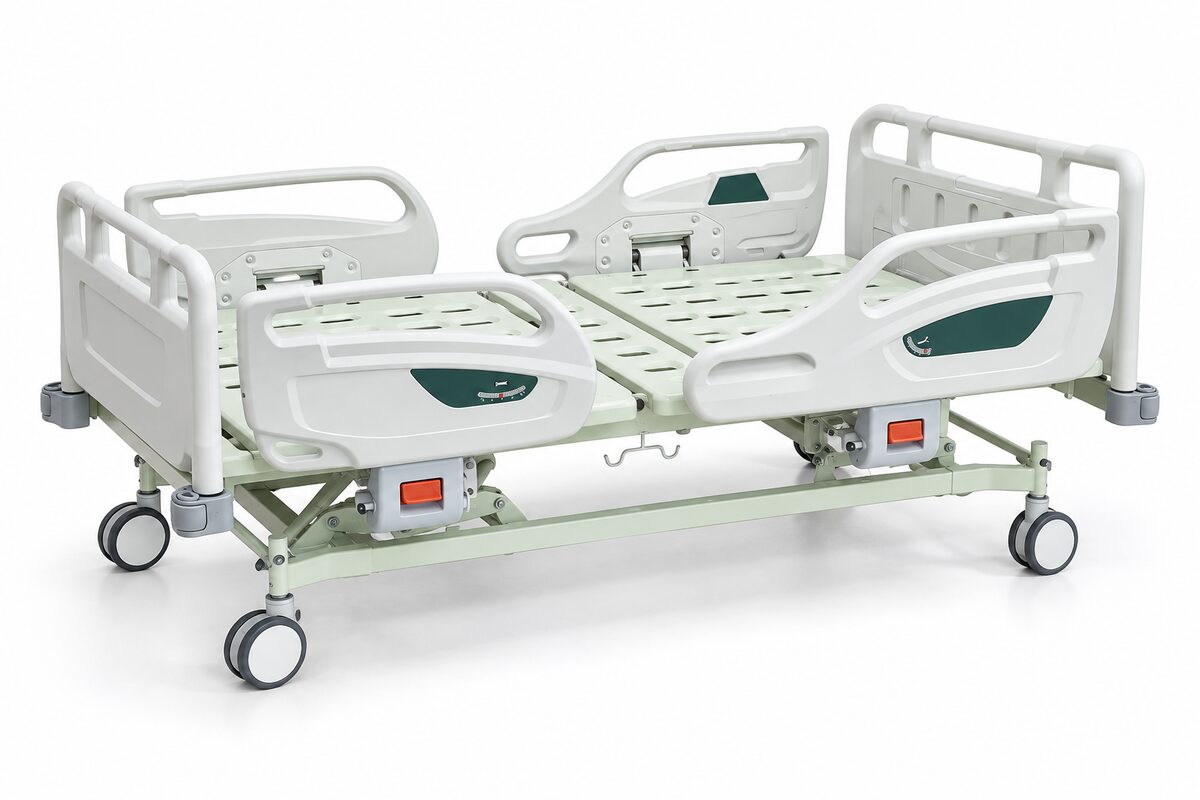
A hospital bed is primarily designed for long-term or overnight patient accommodation, recovery, nursing care, therapeutic positioning, and comfort. A patient transport trolley—also called a stretcher or gurney—is designed primarily for short-duration patient transport, rapid transfers, emergency movement, diagnosis, and procedural workflows.
In simple terms:
- Choose a hospital bed when the patient needs to sleep, recover, receive ongoing nursing care, or remain in one care area for an extended time.
- Choose a patient transport trolley when the patient must move efficiently between the emergency department, imaging room, operating theatre, ward, ICU, or recovery area.
- Choose both when your facility needs a complete patient-flow system from admission through discharge.
Transport devices must prioritize secure movement. Professional transport guidance emphasizes practical safety features such as locking wheels, safety straps, adequate side rails, safe transfer-device compatibility, maneuverability, secure mattresses, patient positioning capability, IV-pole support, and capacity for oxygen or monitoring equipment. [ast](https://www.ast.org/webdocuments/ASTGuidelinesforPatientTransportation/2/)
| Feature | Hospital Bed | Patient Transport Trolley |
|---|---|---|
| Primary purpose | Extended care, recovery, and daily nursing | Short-term patient movement and transfer |
| Typical location | Ward, ICU, nursing home, long-term-care facility, home-care setting | Emergency department, operating room, imaging, recovery, internal corridors |
| Patient stay duration | Hours, days, weeks, or longer | Minutes to several hours, depending on workflow |
| Comfort focus | High | Moderate; designed more for transport efficiency |
| Mobility focus | Limited movement within a care area | High maneuverability across departments |
| Mattress design | Usually thicker and more suitable for prolonged support | Often thinner and optimized for mobility and transfer |
| Positioning functions | Backrest, knee rest, height adjustment, Trendelenburg, cardiac-chair position, depending on configuration | Height adjustment and emergency/procedure positioning; functions vary by model |
| Wheel system | Designed for repositioning within a room or ward | Heavy-duty casters, central braking, steering control, directional travel |
| Key buying priority | Comfort, clinical care, pressure management, fall prevention | Braking, steering, transfer safety, corridor navigation, equipment mounting |
A hospital bed is the correct investment when the equipment will become part of the patient's daily care environment. It should support clinical treatment while also protecting dignity, comfort, sleep quality, mobility, and caregiver access.
At Kangli Medical, we typically recommend evaluating hospital beds first when the facility serves patients in the following settings:
- General hospital wards
- Intensive care units
- Rehabilitation centers
- Nursing homes and assisted-living facilities
- Long-term-care institutions
- Home-care programs
- Post-operative recovery units
- Dementia-care and elderly-care environments
A properly specified hospital bed can support more than rest. It can improve caregiver workflow, help patients change position, simplify examination and hygiene care, and support safer ingress and egress.
Look for the following capabilities:
- Electric height adjustment to help caregivers work at a safer height and help patients transfer in and out of bed.
- Backrest and knee-rest adjustment for eating, breathing comfort, reading, therapy, and recovery positioning.
- Low-height design for patients at elevated fall risk.
- Side rails designed for the specific patient population rather than treated as a universal accessory.
- Reliable mattress compatibility to help reduce gaps and maintain safe rail-to-mattress geometry.
- Easy-clean surfaces that support infection-control routines.
- Accessory compatibility, including IV poles, lifting poles, drainage hooks, overbed tables, and monitor mounts.
- Appropriate safe working load for the intended patient demographic, including bariatric requirements where relevant.
The FDA notes that hospital bed safety requires more than buying a frame and rails separately. Bed-system safety involves the interaction of the bed, mattress, side rails, accessories, clinical assessment, patient monitoring, and correct instructions for use. The FDA's guidance specifically addresses potential entrapment areas and recommends that manufacturers and healthcare facilities assess risks across the complete bed system. [fda](https://www.fda.gov/regulatory-information/search-fda-guidance-documents/hospital-bed-system-dimensional-and-assessment-guidance-reduce-entrapment)
One of the most common procurement mistakes is evaluating only the hospital bed frame. In reality, a bed is a system:
For example, a mattress that is too narrow, too soft, too thick, or incompatible with the installed rails may create hazardous gaps. Likewise, adding aftermarket rails or accessories without compatibility verification can compromise the original safety design.
For elderly, confused, weak, pediatric, or mobility-impaired patients, side-rail selection should be based on individual clinical risk—not merely on the desire to prevent falls. A bed solution should balance fall prevention, freedom of movement, access for caregivers, and entrapment-risk management. [fda](https://www.fda.gov/regulatory-information/search-fda-guidance-documents/hospital-bed-system-dimensional-and-assessment-guidance-reduce-entrapment)
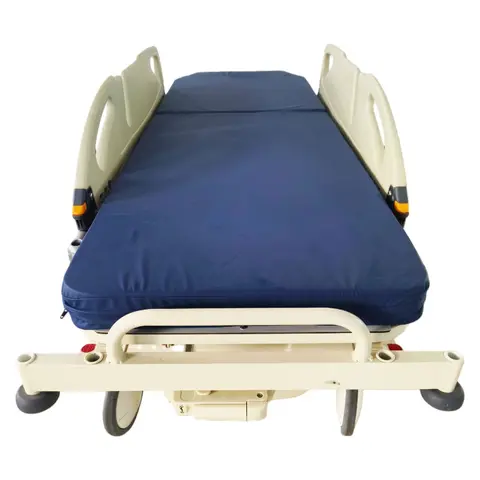
A patient transport trolley is the stronger choice when the patient's journey matters as much as the patient's destination. It is engineered to move through corridors, elevators, doorways, diagnostic departments, and emergency-care pathways with greater stability and control than a standard ward bed.
Choose a transport trolley when your facility regularly handles:
- Emergency department admissions
- Interdepartmental transfers
- Pre-operative and post-operative patient movement
- Imaging transfers to CT, MRI, X-ray, or ultrasound
- Recovery-room workflows
- Ambulance reception or emergency triage
- High-turnover outpatient procedures
- Critical-care transfers requiring oxygen, IV therapy, or monitoring equipment
A transport trolley is built around motion, control, and transfer readiness. Its design should help staff move patients with fewer interruptions and lower physical strain.
When specifying a patient transport trolley, prioritize:
- Central locking system for dependable braking at bedside, during transfer, and in corridors.
- Directional caster or fifth-wheel steering for easier straight-line movement.
- Large, durable medical casters that handle thresholds, elevator gaps, and frequent use.
- Height-adjustable platform to align safely with ward beds, operating tables, imaging tables, or transfer devices.
- Trendelenburg and reverse Trendelenburg capability where clinically appropriate.
- Collapsible side rails that remain secure during movement while allowing transfer access.
- Patient restraint straps for transport safety when required by clinical protocol.
- Oxygen-cylinder holder, IV pole, monitor shelf, and storage platform for transport of essential equipment.
- Radiolucent or imaging-compatible platform options when the trolley will enter diagnostic workflows.
- Strong cleaning and disinfection resistance for high-turnover emergency environments.
The AST patient transportation guideline recommends considering the patient's condition, IV needs, oxygen needs, level of consciousness, physical ability, positioning needs, device maneuverability, secure mattress fixation, and available support for monitoring equipment before selecting the transport method. It also emphasizes sufficient staffing and the use of transfer devices for non-mobile patients. [ast](https://www.ast.org/webdocuments/ASTGuidelinesforPatientTransportation/2/)
Imagine a semi-conscious patient arriving at the emergency department with oxygen support and an IV line. A standard ward bed may be comfortable, but it is not the most efficient tool for repeated movement through triage, imaging, treatment, and admission.
A well-configured patient transport trolley is more appropriate because it can provide:
- Fast movement through busy corridors
- Secure oxygen-cylinder and IV-pole support
- Controlled steering and braking
- Safe side rails during transport
- Easier height alignment for bed-to-trolley or trolley-to-table transfer
- Better access for emergency procedures
Once the patient is stabilized and admitted for overnight monitoring or recovery, the care team can transfer the patient to a hospital bed designed for comfort, repositioning, and ongoing nursing care.
The most effective procurement teams do not begin with "Which product is cheaper?" They begin with "Which product best supports the patient pathway?"
Use this five-step framework before requesting an OEM quotation.
Ask:
- Will the patient remain on the equipment for less than two hours?
- Will the patient sleep on it overnight?
- Will the patient need frequent repositioning?
- Will this equipment be used for recovery, transport, diagnosis, or all three?
If the answer is extended stay, prioritize a hospital bed. If the answer is movement between care areas, prioritize a transport trolley.
For a trolley, measure:
- Corridor width
- Doorway width
- Elevator size
- Turning radius
- Ramp gradients
- Thresholds and floor transitions
- Distance between departments
For a hospital bed, evaluate:
- Patient-room size
- Caregiver circulation space
- Access to headwall equipment
- Placement near oxygen and power outlets
- Transfer space beside the bed
- Clearance for lift equipment and overbed tables
A trolley that performs perfectly in a showroom may fail in a narrow corridor or crowded emergency department. A hospital bed that looks compact may still restrict caregiver access if the room layout is poorly planned.
Patient condition should influence product configuration.
| Patient or Use Condition | Better Primary Choice | Important Features |
|---|---|---|
| Long-term elderly care | Hospital bed | Low height, easy controls, safe rail design, comfort mattress |
| ICU or high-dependency care | Advanced hospital bed | Electric positioning, monitoring access, high load capacity, accessory integration |
| Emergency admission | Patient transport trolley | Fast steering, central brake, oxygen holder, straps, durable casters |
| Imaging transfer | Imaging-compatible trolley | Radiolucent platform, precise height adjustment, smooth maneuverability |
| Post-operative recovery | Depends on length of stay | Trolley for immediate transfer; hospital bed for ongoing recovery |
| Bariatric patient transport | Bariatric trolley | Verified load capacity, wider platform, reinforced frame, controlled maneuverability |
| Dementia or fall-risk resident | Low hospital bed | Ultra-low platform, patient-specific rail strategy, easy caregiver access |
A high-quality medical device should reduce unnecessary physical effort. Poorly designed equipment can force staff to push harder, bend lower, reach farther, or make unstable transfers.
Pay attention to:
- Handle design and placement
- Pedal location and operating force
- Backrest-control accessibility
- Lift range
- Trolley steering response
- Side-rail operation
- Bed and trolley transfer-height compatibility
- Cleaning access around moving components
A product that is difficult for staff to use will not deliver its intended safety advantages, even if its technical specifications look excellent.
For international brands, distributors, and medical-device manufacturers, product quality is only one part of the decision. You should also assess whether the supplier can support your market strategy.
Ask your OEM manufacturer:
1. Can you customize dimensions, colors, panels, rail designs, control systems, logos, packaging, and accessories?
2. Can you support regulatory documentation for the target market?
3. How do you control incoming materials, welding, surface treatment, assembly, and final inspection?
4. Can you provide spare parts and technical support after delivery?
5. What testing is performed on load capacity, caster performance, brakes, rails, electrical functions, and moving mechanisms?
6. Can you produce pilot samples before mass production?
7. What is the realistic production lead time for repeat orders?
At Tianjin Kangli Medical Equipment Co., Ltd., we work with overseas partners that need more than a catalog product. We support OEM projects where product appearance, patient profile, clinical function, branding, packaging, and market positioning must work together.
Whether you select a hospital bed or patient transport trolley, make safety verification part of the purchasing process.
- Confirm mattress, rails, and bed frame are designed to work together.
- Assess patient-specific fall and entrapment risks before selecting rail configurations.
- Verify electrical safety, emergency functions, and control reliability.
- Check brake performance and caster durability.
- Confirm cleaning and disinfection compatibility.
- Review safe working load and dynamic load requirements.
- Ensure caregivers receive product-use and inspection training.
- Establish a preventive-maintenance schedule.
FDA guidance recommends evaluating hospital bed openings and potential entrapment risks as part of an overall safety and mitigation program. It also encourages manufacturers to provide compatible-component information, including mattress dimensions, for distributors, clinicians, patients, and families. [fda](https://www.fda.gov/regulatory-information/search-fda-guidance-documents/hospital-bed-system-dimensional-and-assessment-guidance-reduce-entrapment)
- Test central braking before every shift or transfer.
- Verify side rails lock positively in the raised position.
- Confirm the mattress is secured and does not slide during movement.
- Check steering control and wheel condition.
- Inspect oxygen holders, IV poles, monitor shelves, and accessory mounts.
- Confirm the trolley accommodates the patient's size and clinical needs.
- Use transfer aids for non-mobile patients whenever appropriate.
- Make sure the route is clear before moving the patient.
Transport equipment should not be selected only by price or appearance. The device must support the patient, the caregivers, the route, and the clinical equipment traveling with the patient.
For more than two decades, Tianjin Kangli Medical Equipment Co., Ltd. has focused on the research, development, and manufacturing of medical equipment for global customers. Our goal is not simply to manufacture hospital furniture—it is to help brands deliver equipment that fits clinical realities and earns long-term trust.
Our manufacturing strengths include:
- Founded in 1998
- 20,000 square meters of factory space
- 50+ employees
- OEM support for overseas brands, wholesalers, and manufacturers
- Experience in hospital beds, nursing beds, electric beds, manual beds, and related medical furniture
- Flexible customization for market-specific product requirements
- Focus on practical safety, usability, durability, and brand differentiation
One example from our project experience involved a European nursing-home group with more than 50 premium facilities. The group needed a safer, more comfortable bed solution for elderly residents with dementia. Kangli supplied an ultra-low smart nursing bed with a dual-motor lifting system, 20 cm ultra-low platform height, 250 kg dynamic load capacity, antibacterial warm wood-grain panels, and customized side rails. According to the project information, the 1,200-unit deployment helped reduce patient fall incidents by 78% and improve room occupancy rates by 15%. [klmedbed](https://www.klmedbed.com/)
This type of project demonstrates an important procurement principle: the best equipment is designed around the patient population and care environment, not around generic product categories.
Choose a hospital bed when your top priorities are long-term comfort, daily nursing care, therapeutic positioning, patient recovery, and extended accommodation. Choose a patient transport trolley when your top priorities are rapid movement, safe transfer, maneuverability, emergency readiness, and interdepartmental workflow.
For many hospitals, the correct answer is not "hospital bed or patient transport trolley." It is a carefully planned combination of both:
- Transport trolley for admission, diagnosis, procedures, and internal transfers
- Hospital bed for inpatient care, recovery, sleep, rehabilitation, and long-term support
Looking for a customized OEM hospital bed or patient transport trolley solution? Contact Tianjin Kangli Medical Equipment Co., Ltd. to discuss your target market, product specifications, safety requirements, branding needs, and volume plan.
- Website: [www.klmedbed.com](https://www.klmedbed.com)
- Email: [yukili90@tjkangli.com](mailto:yukili90@tjkangli.com)
- Tel/WhatsApp: +86 136 5207 7555
A hospital bed can be moved within a room or ward, but it is generally not the best choice for frequent interdepartmental patient transport. Patient transport trolleys are specifically designed for maneuverability, controlled steering, braking, transfer workflows, and the attachment of transport-related equipment.
In many healthcare markets, "stretcher," "gurney," and "patient transport trolley" are used interchangeably. They generally describe a wheeled platform used to move or temporarily support a patient in a lying or semi-reclined position. Product specifications and regional terminology may differ, so buyers should confirm the intended clinical use.
A hospital bed is generally better for elderly-care facilities because residents usually require long-term comfort, safe height adjustment, positioning support, caregiver access, and night-time accommodation. A transport trolley may still be necessary for transfers to diagnostics, emergency services, or procedures.
Core features include a central braking system, durable casters, secure side rails, a fixed mattress, steering control, height adjustment, safety straps, IV-pole support, oxygen-cylinder storage, and appropriate load capacity. Imaging-compatible or bariatric features may also be required depending on the clinical setting.
No. Side rails should be selected according to the individual patient's mobility, cognition, fall risk, clinical needs, and entrapment risk. A complete bed system—including the rails, mattress, and frame—must be evaluated for compatibility and safety. [fda](https://www.fda.gov/regulatory-information/search-fda-guidance-documents/hospital-bed-system-dimensional-and-assessment-guidance-reduce-entrapment)
OEM buyers should ask about customization capability, regulatory support, quality-control procedures, component sourcing, load testing, production capacity, sample development, lead times, spare-parts availability, packaging, branding, and after-sales support.
Yes. Tianjin Kangli Medical Equipment Co., Ltd. supports OEM cooperation for international brands, wholesalers, and manufacturers. Customization can include product configuration, dimensions, colors, panels, rail options, accessories, branding, packaging, and market-specific requirements.
1. U.S. Food and Drug Administration. [Hospital Bed System Dimensional and Assessment Guidance to Reduce Entrapment](https://www.fda.gov/regulatory-information/search-fda-guidance-documents/hospital-bed-system-dimensional-and-assessment-guidance-reduce-entrapment). This guidance explains potential entrapment risks in hospital bed systems, including the relationship among bed frames, mattresses, side rails, accessories, clinical assessment, and monitoring. [fda](https://www.fda.gov/regulatory-information/search-fda-guidance-documents/hospital-bed-system-dimensional-and-assessment-guidance-reduce-entrapment)
2. Association of Surgical Technologists. [AST Guideline for Patient Transportation](https://www.ast.org/webdocuments/ASTGuidelinesforPatientTransportation/2/). This guideline outlines transport-device considerations including locking wheels, safety straps, side rails, maneuverability, mattress security, patient positioning, oxygen support, equipment storage, staffing, and transfer-device use. [ast](https://www.ast.org/webdocuments/ASTGuidelinesforPatientTransportation/2/)
3. Tianjin Kangli Medical Equipment Co., Ltd. [Kangli Medical Official Website](https://www.klmedbed.com/). Source for the company's nursing-bed project example, including ultra-low bed specifications and reported project outcomes. [klmedbed](https://www.klmedbed.com/)
Hot Tags: China, Global, OEM, private label, manufacturers, factory, suppliers, manufacturing company


