

Views: 267 Author: Tianjin Kangli Publish Time: 2026-09-30 Origin: Site


Content Menu
● Quick answer: Which hospital bed is better?
● What is a manual hospital bed?
>> When a manual hospital bed makes sense
● What is an electric hospital bed?
>> Why electric hospital beds are increasingly preferred
● Manual vs electric hospital bed: the operational comparison
>> Patient comfort and clinical positioning
>> Caregiver ergonomics and nursing efficiency
>> Safety and transfer support
>> Reliability and maintenance requirements
● The hidden cost: look beyond the unit price
>> Questions procurement teams should ask
● How to choose the right bed for each department
● A real-world OEM perspective from Kangli Medical
● FAQ
>> 1. Are electric hospital beds safer than manual hospital beds?
>> 2. Which hospital bed is best for a nursing home?
>> 3. Is a semi-electric hospital bed a good compromise?
>> 4. How long do electric hospital beds last?
>> 5. Do manual hospital beds require maintenance?
>> 6. What should OEM buyers request from a hospital bed manufacturer?
>> 7. Can a hospital use both manual and electric beds?
Choosing between a manual hospital bed vs electric hospital bed is not simply a purchasing decision—it directly affects patient comfort, caregiver workload, safety performance, maintenance planning, and a hospital's long-term operating cost. For most hospitals, long-term care facilities, rehabilitation centers, and nursing homes, a well-designed electric hospital bed delivers greater clinical flexibility and better workflow efficiency; however, manual beds remain a practical, reliable choice for specific low-acuity and budget-sensitive applications.
At Tianjin Kangli Medical Equipment Co., Ltd., we have focused on medical bed research, manufacturing, and OEM solutions since 1998. As a national high-tech enterprise with a 20,000-square-meter manufacturing facility and more than 50 employees, we support overseas brands, wholesalers, and healthcare-equipment manufacturers with configurable manual, semi-electric, and electric hospital bed solutions. Our perspective comes from the real manufacturing, quality-control, customization, and procurement questions that hospital-bed buyers raise every day.
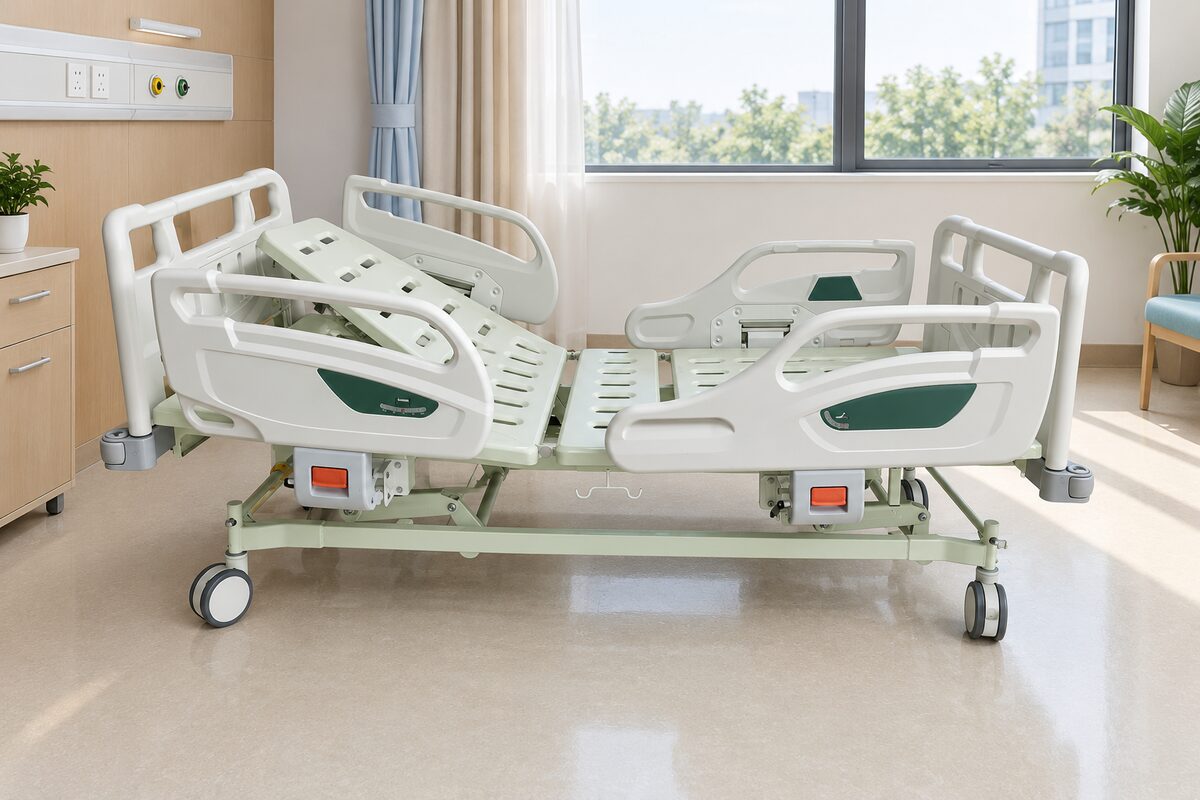
For hospitals with frequent patient repositioning, high nursing intensity, elderly patients, rehabilitation patients, or long-stay wards, a fully electric hospital bed is usually the better operational choice. It allows caregivers and patients to adjust backrest, knee section, and bed height through motorized controls, reducing manual effort and enabling more frequent positioning.
A manual hospital bed is often the better choice where adjustment frequency is low, electrical infrastructure is limited, emergency resilience is a priority, or purchase budgets are tightly controlled.
The best decision depends on the care environment—not the initial price alone.
| Decision factor | Manual hospital bed | Electric hospital bed |
|---|---|---|
| Adjustment method | Hand cranks or mechanical levers | Motorized handset, control panel, or nurse control |
| Initial purchase cost | Usually lower | Usually higher |
| Patient positioning speed | Slower and dependent on caregiver effort | Faster, smoother, and repeatable |
| Caregiver physical workload | Higher | Lower |
| Bed-height adjustment | May be manual or unavailable, depending on model | Usually motorized on full-electric models |
| Power dependence | No mains power needed for core functions | Requires electrical power; battery backup may be specified |
| Maintenance profile | Fewer electrical components | Requires preventive maintenance for motors, controls, cables, and batteries |
| Best-fit environment | Basic wards, emergency backup, low-frequency use, budget-led projects | Acute care, long-term care, rehabilitation, high-dependency and elderly care |
A manual hospital bed uses mechanical cranks, handles, or levers to change the patient's position. Depending on the configuration, caregivers can raise or lower the backrest, knee section, foot section, or the entire sleep platform.
The principal strength of a manual bed is its mechanical simplicity. With no motorized adjustment system for its core functions, it can be suitable for facilities that need a dependable, lower-cost bed for basic patient care.
Manual beds can be a strong fit when the hospital or distributor needs:
- Lower upfront investment for large basic-bed tenders
- Simple daily operation with familiar hand-crank controls
- Low maintenance complexity because there are fewer electrical parts
- Power-independent adjustment in settings with unstable electrical supply
- Short-stay or low-acuity use where frequent repositioning is not expected
- Emergency preparedness capacity for temporary wards, field deployment, or contingency inventory
From a manufacturing viewpoint, the quality of a manual hospital bed still matters significantly. A low-cost manual bed can become expensive if its crank system is difficult to operate, its welded frame lacks long-term stability, its surface coating is hard to clean, or its casters and brakes perform inconsistently.
A hospital should therefore evaluate the whole system:
- Frame material and welding quality
- Load capacity and safe working load marking
- Backrest and knee-rest adjustment range
- Crank smoothness and durability
- Guardrail design and entrapment-risk control
- Central braking or individual caster-brake performance
- Mattress platform cleaning access
- Spare-part availability
An electric hospital bed uses motors and electronic controls to adjust one or more bed sections. A fully electric model generally allows motorized adjustment of the backrest, leg section, and bed height. A semi-electric hospital bed commonly provides motorized backrest and leg-rest adjustment, while height adjustment remains manual.
Electric beds are designed for environments where positioning is frequent, patient mobility is limited, and caregiver efficiency matters. With a handset or integrated control system, caregivers can make adjustments with less lifting, cranking, and physical exertion.
The core value of an electric bed is not simply convenience. It is repeatable, accessible positioning.
For example, a nurse caring for a patient who needs regular elevation for meals, respiratory comfort, examinations, transfers, skin-care routines, or recovery positioning can make those adjustments quickly from the bedside. The patient may also be able to use a handset independently when clinically appropriate.
Electric hospital beds are particularly useful for:
- Long-term care and nursing homes
- Rehabilitation departments
- Orthopedic and post-operative wards
- Elderly-care settings
- High-turnover hospital wards
- Patients with reduced mobility
- Patients requiring frequent backrest, knee-rest, or height adjustment
- Facilities that prioritize caregiver ergonomics and workflow efficiency
Industry guidance consistently emphasizes that the correct bed should be selected according to patient mobility, adjustment frequency, caregiver support needs, and the clinical environment rather than bed type alone. Full-electric beds are especially valuable when repeated height and positioning adjustments are required.
A patient's position influences comfort, sleep quality, eating, respiratory support, circulation, mobility preparation, and caregiver access. Manual beds can provide basic positioning, but adjustments require physical work and may be delayed when staff are busy.
Electric beds make positioning easier to perform more consistently. A patient can be raised into a sitting position for meals or lowered for safer transfer. Staff can adjust working height to provide care without repeatedly bending at an unsafe or uncomfortable level.
For hospitals, the key question is not, "Can the bed adjust?" It is, "How often must the bed adjust, and who must perform it?"
If the answer is "many times per day," electric adjustment usually offers a clear operational advantage.
Caregiver workload is often underestimated in bed procurement. A manual crank may appear simple, but repeated cranking across many beds and shifts adds time and physical effort.
Electric hospital beds reduce the force required to reposition the bed. Research involving caregivers has also identified bed movement and control design as important factors in reducing caregiver fatigue and improving usability.
For procurement teams, this creates a broader cost discussion:
- A manual bed may cost less to purchase.
- An electric bed may help reduce repetitive adjustment workload.
- A well-specified bed may improve workflow across many years of service.
- The appropriate choice depends on patient mix, staffing model, daily adjustment frequency, and maintenance capability.
Bed height is a critical practical feature. When a bed can be lowered, a patient may have a more manageable transfer height; when it can be raised, staff can often provide care in a more suitable working position.
However, no bed type is automatically safe simply because it is electric or manual. Safety depends on the complete bed system, including:
- Side-rail geometry and gaps
- Mattress compatibility
- Safe working load
- Frame stability
- Caster locking performance
- Controls and lockout functions
- Electrical protection on powered beds
- Clear labels, warnings, and instructions for use
- Staff training and preventive inspection
IEC 60601-2-52 addresses the basic safety and essential performance of adult medical beds. Its scope includes both electric and non-electric medical beds, demonstrating that safety evaluation is relevant to every bed category—not only motorized products.
Manual beds typically have fewer electronic components. This can simplify service in remote locations or facilities with limited technical support. Routine care focuses on mechanical adjustment systems, fasteners, welded joints, casters, brakes, rails, and surface condition.
Electric beds require a structured maintenance plan. Hospitals should inspect motors, control handsets, cables, connectors, battery systems where installed, brake systems, and emergency mechanisms. The goal is not to avoid electric beds; it is to ensure that the buyer has the right service model and spare-parts plan.
At Tianjin Kangli Medical Equipment Co., Ltd., we recommend that OEM buyers define spare-part strategy before the first shipment. This should include critical components such as actuators, control boxes, handsets, casters, side rails, head/foot boards, and replacement hardware.
The question "Which is cheaper?" needs a more complete answer.
A manual bed is usually less expensive at the point of purchase. Yet purchasing teams should compare the total cost of ownership over the intended service life.
Use this practical calculation:
This does not mean electric beds always have the lowest total cost. In low-use facilities, a manual bed may remain the most economical solution. But in a busy long-term care environment, the higher purchase price of an electric bed may be justified by faster adjustment, improved caregiver workflow, and better alignment with the needs of dependent patients.
Before choosing a manual or electric hospital bed, ask:
1. How often will staff adjust the backrest, leg section, and bed height each day?
2. What proportion of patients need assistance with transfers or repositioning?
3. Does the facility have reliable electrical supply and a maintenance process for powered equipment?
4. What safe working load is required for the target patient population?
5. Which accessories must be compatible, such as IV poles, lifting poles, drainage hooks, mattresses, or overbed tables?
6. Are side rails, mattress dimensions, and bed-platform gaps designed as a compatible system?
7. What is the expected service life, warranty arrangement, and spare-parts availability?
8. Does the supplier offer OEM branding, color options, documentation, packaging, and compliance support for the target market?
Hospitals should avoid a one-bed-for-everywhere procurement strategy. Different departments have different clinical and operational priorities.
| Care environment | Recommended starting point | Why |
|---|---|---|
| General low-acuity ward | Manual or semi-electric bed | Basic positioning may be sufficient when adjustment frequency is moderate |
| Long-term care facility | Full-electric bed | Frequent positioning and transfer support are often needed |
| Rehabilitation ward | Full-electric bed | Adjustable height and positioning support therapy and mobility routines |
| Orthopedic recovery | Electric or semi-electric bed | Positioning and caregiver access may be needed frequently |
| Emergency reserve inventory | Manual bed | Simple, cost-controlled, and independent of mains power for basic adjustment |
| Elderly dementia care | Low-height electric nursing bed | Low platform height, rail design, and controlled adjustment can support fall-risk strategies |
| Rural or infrastructure-limited facility | Manual bed | Mechanical operation can be more practical where power stability is uncertain |
A mixed bed portfolio is often the most practical answer. For example, a hospital may use full-electric beds in rehabilitation, elderly care, and post-operative wards, while retaining manual beds for temporary capacity, basic wards, or emergency deployment.
OEM buyers need more than a standard catalog item. They need a bed platform that matches their market's certification needs, patient profile, branding, logistics model, and after-sales service capacity.
At Kangli Medical, our manufacturing approach focuses on translating those requirements into configurable medical-bed solutions. For a European nursing-home group with more than 50 premium facilities, we supplied 1,200 ultra-low smart nursing beds designed for elderly dementia care. The solution combined a dual-motor lifting system, a 20 cm ultra-low platform height, customized side rails, antibacterial warm wood-grain panels, and a 250 kg dynamic load capacity. The project was designed to align with IEC 60601-2-52 anti-entrapment safety considerations and the customer reported a 78% reduction in patient fall incidents and a 15% increase in room occupancy rates. [klmedbed]
This example does not mean every facility needs an ultra-low smart bed. It illustrates a more important procurement principle: the bed should be engineered around the patient-care scenario.
For OEM, private-label, wholesale, and manufacturing partners, Kangli Medical can discuss:
- Manual, semi-electric, and full-electric hospital bed configurations
- Frame size, mattress platform, and load-capacity requirements
- Headboard, footboard, and side-rail customization
- OEM logo, color, packaging, and documentation options
- Accessory compatibility
- Safety-feature requirements
- Manufacturing feasibility for target-market needs
- Spare-parts and after-sales planning
For most modern hospitals, electric hospital beds are better when patient repositioning, transfer support, caregiver efficiency, and long-term care needs are priorities. They are especially suitable for elderly care, rehabilitation, high-dependency, and long-stay environments.
Manual hospital beds remain valuable where budgets are limited, patient acuity is lower, bed adjustments are infrequent, or independence from mains electricity is essential.
The strongest procurement strategy is to match the bed type to the clinical setting, calculate lifecycle value rather than purchase price alone, and work with a manufacturer that can support safety, customization, documentation, and reliable after-sales service.
Looking for an OEM manual or electric hospital bed supplier? Contact Tianjin Kangli Medical Equipment Co., Ltd. to discuss your target market, required configuration, branding requirements, and project quantity.
- Website: [www.klmedbed.com]
- Email: [yukili90@tjkangli.com](mailto:yukili90@tjkangli.com)
- Phone / WhatsApp: +86 136 5207 7555
Not automatically. Both bed types must be assessed for stability, safe working load, side-rail design, mattress compatibility, braking, labeling, and intended use. Electric beds add motorized convenience but also require proper electrical safety, maintenance, and user training. IEC 60601-2-52 applies to medical-bed safety and essential performance, including both electric and non-electric beds. [iso]
A full-electric or low-height electric nursing bed is often the best starting point for nursing homes because residents may require frequent repositioning, assistance with transfers, and a lower platform height. The correct configuration should still be based on resident mobility, fall-risk profile, staffing, and care routines.
Yes. A semi-electric bed can be a practical middle option when backrest and leg-rest adjustments are needed regularly but a manually adjusted height function is acceptable. It may suit facilities seeking more comfort and functionality than a manual bed without moving directly to a full-electric specification.
Service life depends on design quality, patient load, daily adjustment frequency, cleaning practices, preventive maintenance, component quality, and access to spare parts. Buyers should request warranty terms, maintenance instructions, recommended inspection intervals, and a spare-parts plan before placing an order.
Yes. Manual beds still require regular inspection of cranks, gears, welded joints, fasteners, rails, casters, brake mechanisms, mattress platforms, and protective coatings. Mechanical simplicity reduces electronic maintenance, but it does not eliminate the need for preventive inspection.
OEM buyers should request product specifications, dimensional drawings, load information, material details, available configurations, quality-control procedures, compliance documentation relevant to the target market, packaging details, branding options, sample policy, production lead time, warranty, and spare-parts support.
Yes. Many facilities benefit from a mixed fleet. Electric beds can be allocated to departments with higher positioning and transfer needs, while manual beds can serve basic-care, emergency, reserve, or budget-sensitive applications.
1. Tianjin Kangli Medical Equipment Co., Ltd. "Kangli Medical: Hospital Bed Manufacturer China." [Company website]. Project information concerning ultra-low smart nursing beds, dual-motor lifting, 20 cm platform height, 250 kg dynamic load, and reported customer outcomes. [klmedbed]
2. International Organization for Standardization. "IEC 60601-2-52:2009—Medical electrical equipment: Particular requirements for the basic safety and essential performance of medical beds." [ISO standard page]. [iso]
3. U.S. Food and Drug Administration. "Recognized Consensus Standards: Medical Devices." [FDA standards database]. Information on medical-bed basic safety and essential performance standards. [accessdata.fda]
4. UL Solutions. "IEC 80601-2-52 and Medical Bed Safety." [UL Solutions article]. Scope information indicating applicability to electric and non-electric medical beds. [ul]
5. Hsiao, S. et al. "Co-Design in Electrical Medical Beds with Caregivers." *International Journal of Environmental Research and Public Health*, 2022. [PubMed Central article]. Findings on caregiver experience, bed mobility, and usability considerations. [pmc.ncbi.nlm.nih]
6. TiMOTION. "Types of Hospital Beds and Their Definition, Benefits, and Uses." [TiMOTION guide]. Guidance on matching bed selection with mobility, adjustment frequency, caregiver needs, and care environment. [timotion]
7. CME Corp. "Hospital Bed Buying Guide for Healthcare Facilities." [CME Corp guide]. Purchasing considerations involving patient needs, safety features, ease of use, accessories, maintenance, and compliance. [blog.cmecorp]
Hot Tags: China, Global, OEM, private label, manufacturers, factory, suppliers, manufacturing company


