

Views: 189 Author: kangli Publish Time: 2026-09-28 Origin: Site


Content Menu
● How to Choose a Nursing Bed for Long-Term Care Facilities and Distributors
>> What Is a Nursing Bed for Long-Term Care?
>> Start with the Care Setting and Resident Profile
>> Nursing Bed Types: Manual, Semi-Electric, and Fully Electric
>> Key Features to Compare When Buying Nursing Beds
>>> 1. Height range and transfer access
>>> 2. Side rails, assist handles, and entrapment risk
>>> 3. Adjustment functions and controls
>>> 4. Casters, brakes, and mobility
>>> 5. Mattress and support-surface compatibility
>>> 6. Cleaning and maintenance
>> Durability and Total Cost of Ownership
>> A Practical Supplier Evaluation Process for Distributors
>> OEM Customization Options for Long-Term Care Beds
>> Common Buying Mistakes to Avoid
>> Suggested Visuals for the Article
>> FAQ: Choosing Nursing Beds for Long-Term Care
>>> 1. What is the best nursing bed for a long-term care facility?
>>> 2. Should a nursing bed be fully electric?
>>> 3. Are side rails necessary on every nursing bed?
>>> 4. Why should buyers specify mattress thickness?
>>> 5. What should distributors check before placing a bulk order?
>>> 6. What documents should an OEM buyer request?
>>> 7. How can distributors compare supplier quotations fairly?
>> Request an OEM Nursing Bed Specification Review
>> References
>> Article word count and SEO description
Factory Strength Demonstration Video
How can I start an OEM partnership with your factory?
We recommend starting with an initial technical consultation to review your design specifications, target market, required functions, quantity, and customization needs.
Please contact our dedicated B2B team by email at Yukili90@tjkangli.com or chat with us directly on WhatsApp: +86 136 5207 7555.
WhatsApp:
Let’s build excellence together. Whether you need a quotation for a large-scale hospital project, want to develop a private-label product, or are exploring OEM/ODM opportunities for our 5-function medical bed series, our team is ready to support you from product selection and technical confirmation to production and delivery.
Visit www.klmedbed.com or contact us via WhatsApp to start your customized manufacturing project today.
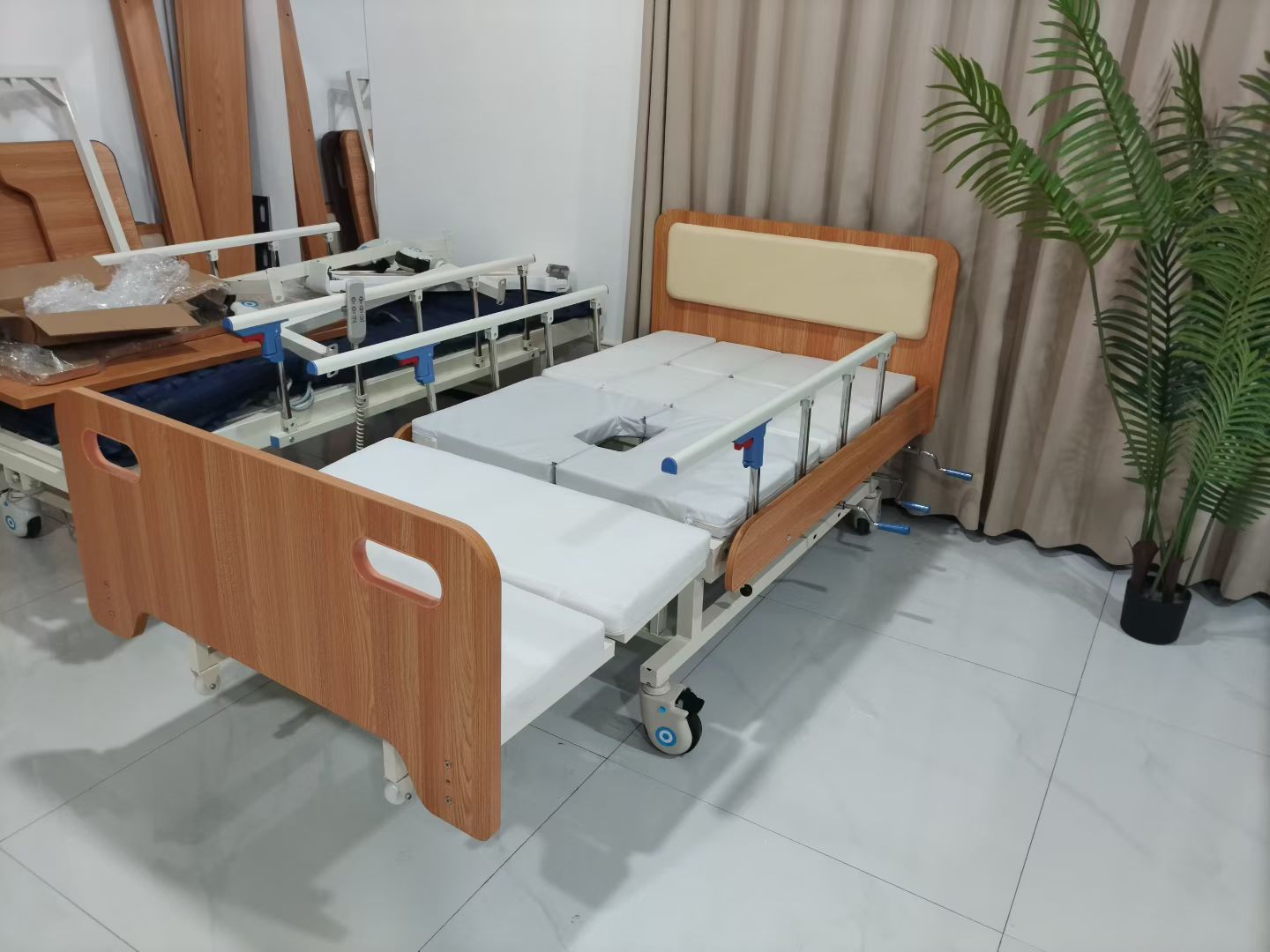
Choosing the right nursing bed for long-term care facilities means balancing resident comfort, caregiver workflow, safety, durability, and total cost of ownership. For overseas brands, wholesalers, and medical-equipment manufacturers, the decision also includes OEM customization, market-specific electrical configurations, accessories, documentation, and after-sales support.
A suitable nursing bed is not simply the model with the most functions. It should fit the intended residents, care environment, staff routines, cleaning practices, and local market requirements. This guide offers a practical buying framework for care facilities and B2B buyers sourcing nursing beds in bulk.
> Safety note: Bed rails and other safety features should be selected as part of an individualized care plan. The FDA advises that patients' needs should be assessed by their healthcare team; bed rails may pose risks such as entrapment or falls for some users. [fda]
A long-term care nursing bed is an adjustable bed designed for ongoing use in settings such as nursing homes, residential care, rehabilitation facilities, and homecare. Depending on the model, it may provide electric adjustment, movable side rails, locking casters, and compatible accessories.
Unlike a bed selected for occasional use, a long-term care bed should be evaluated for repeated daily operation. Staff may adjust it several times per resident each day, clean it routinely, move it between rooms, and rely on controls and brakes throughout the bed's service life.
For B2B procurement, compare the complete configuration rather than the frame alone:
- Bed frame and mattress platform
- Mattress and compatible support surface
- Side rails or assist handles
- Motors, handset, and control box
- Casters and braking system
- IV pole, drainage hooks, or lifting pole
- Labels, manuals, and spare parts
- Packaging and shipment configuration
Before comparing specifications, define who will use the bed and where.
Consider:
- Resident mobility: Can residents reposition, stand, or transfer independently?
- Care model: Is the bed used in skilled nursing, assisted living, rehabilitation, or homecare?
- Caregiver workflow: How frequently do staff raise, lower, or reposition the bed?
- Room layout: Is there enough space to move the bed and access both sides?
- Cleaning routine: Which cleaning products and procedures are used?
- Resident turnover: Will the bed be reassigned to different residents?
- Local service capacity: Can staff or technicians access replacement parts and support?
There is no single "best" bed for every facility. A rehabilitation environment may prioritize transfer access and mobility, while a long-term care facility may focus on ease of operation, cleaning, durability, and serviceability.
| Bed type | Typical operation | Potential fit | Procurement considerations |
|---|---|---|---|
| Manual | Adjustments are made with hand cranks | Basic applications or low-frequency adjustment | Check staff effort, adjustment speed, and crank storage |
| Semi-electric | Some functions are powered; others are manual | Buyers balancing powered convenience and cost | Confirm exactly which functions use motors |
| Fully electric | Major bed adjustments use electric controls | Facilities needing frequent, convenient adjustment | Confirm voltage, plug, controls, backup options, and service parts |
These labels can vary between suppliers. Ask for a function-by-function list—such as backrest, knee section, bed height, and tilt—rather than relying on the category name alone.
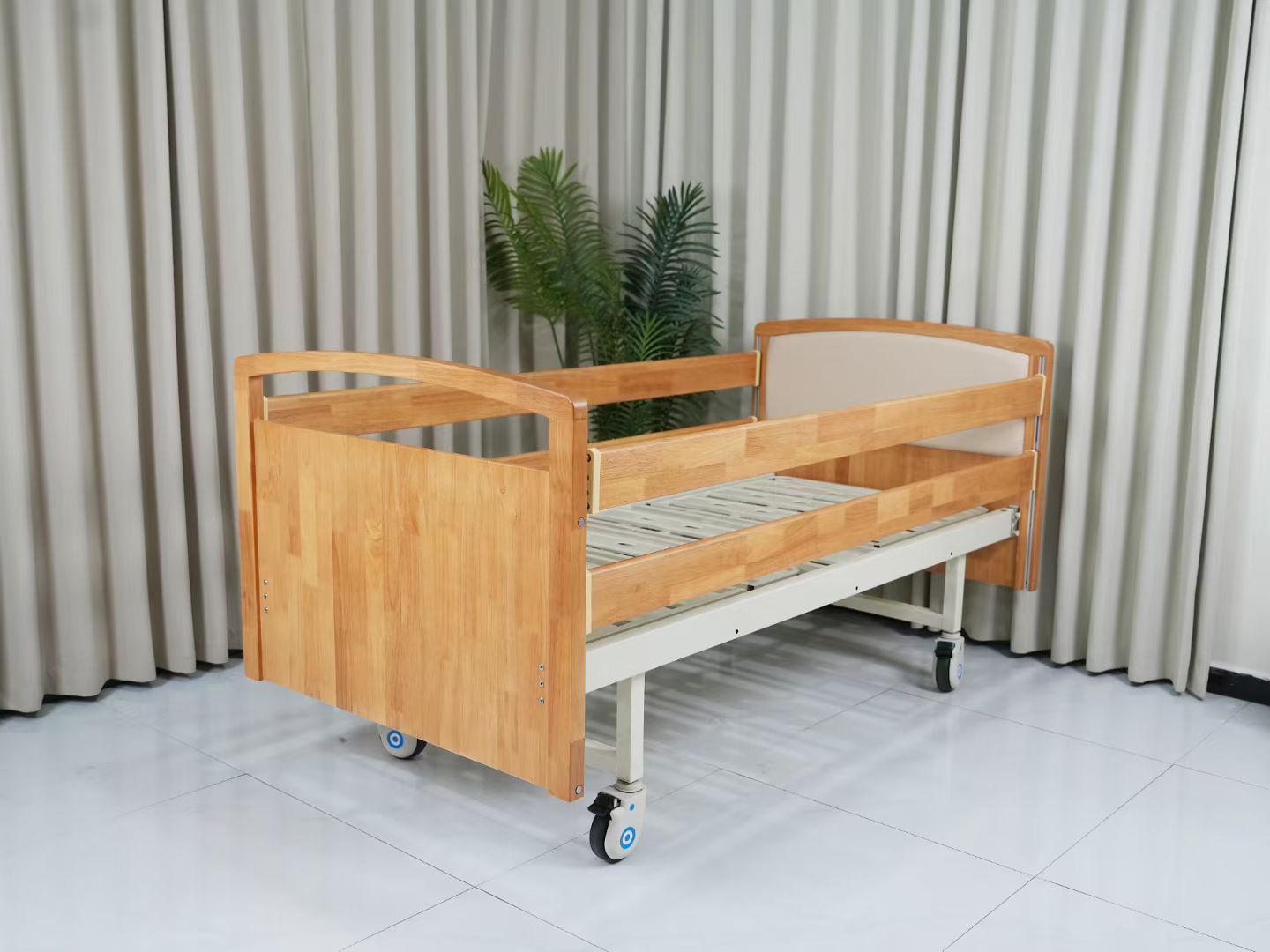
Check the bed's minimum and maximum height, using the mattress specified for the project. The mattress-top height—not just the bare platform measurement—affects how residents approach, sit on, and transfer from the bed.
Ask the supplier to state:
- Floor-to-platform height
- Floor-to-mattress-top height
- Mattress thickness used for measurement
- Height range with casters installed
- Whether the bed can be raised to a practical caregiver working height
A low position may be useful for some care plans, but an extremely low bed can make transfers or caregiver tasks more difficult in other situations. Evaluate the whole use case.
Side rails may support repositioning or provide a handhold, but they should not be treated as universal fall-prevention devices. FDA guidance emphasizes individual assessment and awareness of possible rail-related risks. [fda]
During review, consider:
- Rail length and height
- Locking and release operation
- Whether rails are full-length, split, or removable
- Clearance between rail, mattress, platform, and headboard
- Compatibility with the facility's mattress
- Resident-specific assessment and staff procedures
The bed, mattress, and rails form one system. A mattress change can alter gaps and clearances. Ask the manufacturer for configuration-specific documentation and have the final setup reviewed by qualified personnel.
Choose functions based on the facility's care workflow—not on a feature list alone. Common adjustments include backrest, knee section, bed height, and, on selected models, tilt positions.
Confirm:
- Which controls operate each function
- Whether controls are available to residents, staff, or both
- Whether lockout functions are offered
- Whether buttons are clearly labeled
- Whether the handset can be stored safely
- How staff can respond if a control or motor stops working
For electric models, verify voltage, frequency, plug, and cable routing for the destination market.
A bed may need to move for cleaning, room changes, or care procedures. Check caster size and configuration, rolling performance, swiveling, and brake operation.
For an OEM evaluation, test the bed on a representative floor surface and confirm:
- Brakes hold the bed securely
- All casters engage as intended
- The bed does not wobble excessively
- Cables do not catch during movement
- The braking system is easy for staff to identify and operate
The mattress affects comfort, cleaning, transfer height, rail clearances, and overall bed usability. Specify the mattress type and dimensions early in the buying process.
Ask the supplier to verify:
- Mattress length, width, and thickness
- Platform compatibility
- Mattress retention features
- Cover and cleaning instructions
- Whether mattress options affect side-rail clearances
Do not approve a bed using one mattress and then substitute another without checking the complete setup.
Long-term care equipment must fit the facility's cleaning routine. Look for accessible surfaces, secure covers, minimal difficult-to-clean gaps, and clear instructions.
Ask the supplier:
- Which cleaning agents and methods have been evaluated for the finished product?
- Are any materials or coatings sensitive to specific chemicals?
- Which parts can be removed for cleaning?
- What routine maintenance is recommended?
- Which wear parts should facilities keep in stock?
Avoid assuming that a particular material is compatible with every disinfectant. Confirm compatibility for the actual finished components and cleaning protocol.
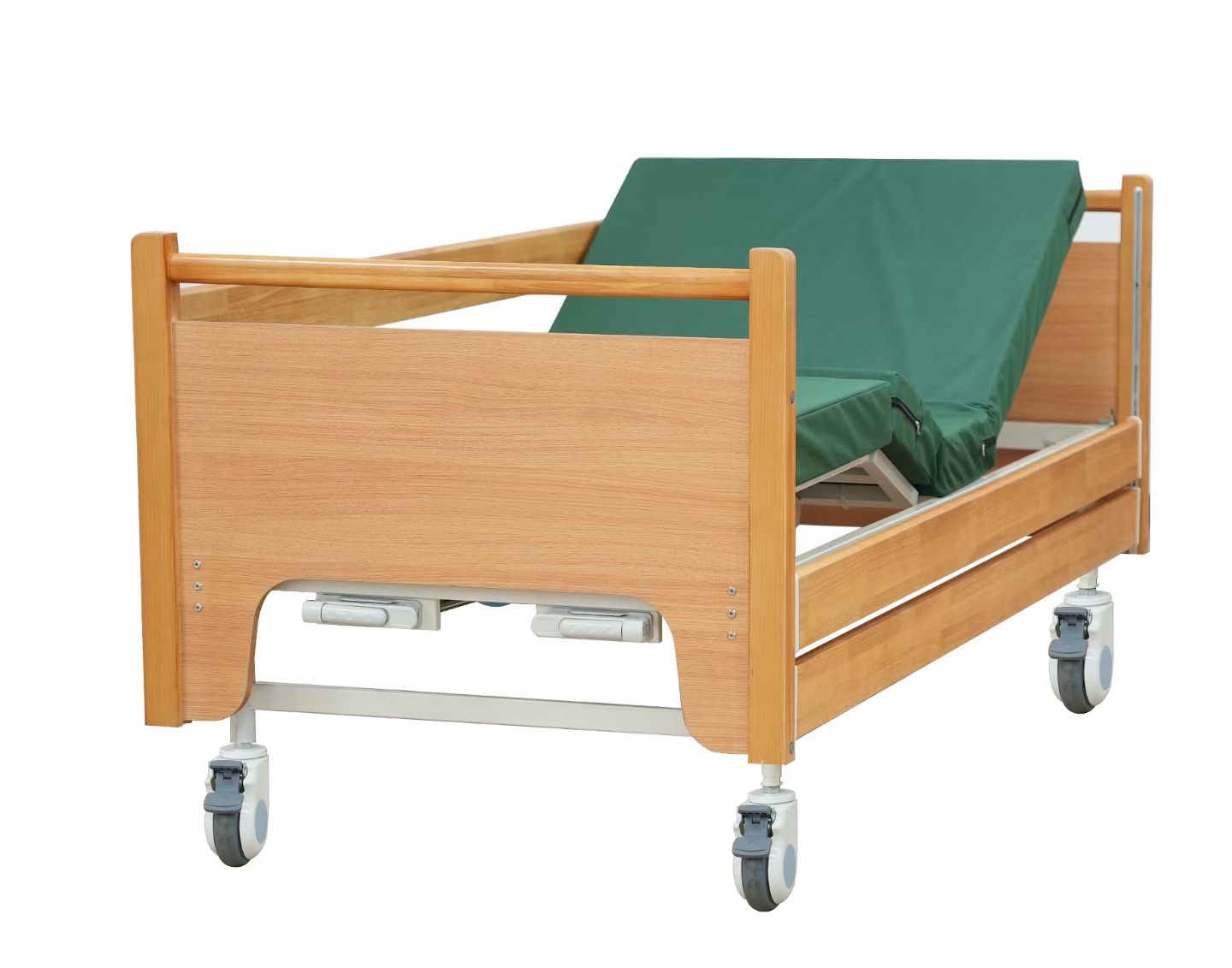
The lowest purchase price may not be the lowest long-term cost. For bulk buyers, evaluate the expected costs of operation, maintenance, replacement parts, downtime, and training.
A practical comparison should include:
| Cost factor | Questions for procurement |
|---|---|
| Initial purchase | What is included in the quoted configuration? |
| Installation | Does the bed require assembly or technician setup? |
| Maintenance | What inspections and service tasks are recommended? |
| Replacement parts | Are motors, controls, casters, and rails available separately? |
| Downtime | How quickly can a fault be diagnosed or a part supplied? |
| Training | Are manuals and operator instructions provided? |
| Shipping | How are beds packed, stacked, and protected for export? |
For distributors, a supplier's ability to provide consistent specifications and repeat-order support can matter as much as the initial unit price.
Use a consistent process to compare manufacturers and reduce avoidable specification gaps.
1. Issue a written requirement sheet. Include use environment, bed functions, mattress, rails, electrical configuration, accessories, and destination market.
2. Request technical documentation. Ask for drawings, dimensions, specifications, operation instructions, and available conformity documents.
3. Compare complete configurations. Ensure quotations include the same accessories and functions.
4. Review a sample or demonstration unit. Test controls, brakes, rail operation, and movement.
5. Agree on inspection criteria. Define appearance, functional checks, accessories, labeling, and packaging requirements.
6. Confirm OEM details. Approve logo artwork, colors, labels, manuals, and carton markings.
7. Plan spare-parts support. Identify parts with expected wear and clarify ordering lead times.
8. Conduct pre-shipment checks. Verify quantity, model, functions, accessories, and packaging against the approved order.
This process helps distinguish a technically suitable manufacturer from a supplier whose offer is based only on a low headline price.
OEM projects may adapt a proven bed platform to a buyer's brand and market needs. Depending on the design and production plan, customization may include:
- Logo and brand identification
- ABS panel or frame color
- Control labels and language
- Voltage, frequency, and plug
- Side rails and headboard style
- Casters and braking options
- IV poles and drainage hooks
- Mattress or accessory package
- User manuals and product labels
- Export cartons, pallets, and shipping marks
Not every option is available for every bed model. Confirm tooling, minimum order quantities, lead times, and validation requirements before making a public product promise.
- Comparing beds without specifying the mattress
- Selecting side rails without considering the complete bed configuration
- Assuming "fully electric" means the same functions across suppliers
- Overlooking local voltage, frequency, and plug requirements
- Choosing a bed without checking brakes and service access
- Selecting accessories that are incompatible with rails or frame
- Approving a sample that differs from the mass-production specification
- Comparing unit prices without considering spare parts and support
- Bed-feature infographic: Label height adjustment, backrest, knee section, rails, casters, and controls.
- Comparison table graphic: Manual, semi-electric, and fully electric functions.
- Room-layout illustration: Show access for transfers, staff, and cleaning.
- Short demonstration video: Show bed-height adjustment, brakes, rail operation, and handset use.
Use original product photography where possible. Images should accurately represent the offered configuration and avoid implying clinical outcomes that have not been substantiated.
The best bed depends on resident needs, care routines, room layout, mattress, and maintenance capacity. Compare complete configurations and involve appropriate clinical and facilities staff.
Not always. Fully electric beds can simplify frequent adjustment, while manual or semi-electric models may fit other budgets and workflows. Compare the functions actually needed and the local service plan.
No. Side rails should be considered individually. The FDA recommends healthcare-team assessment because rails may present risks for some residents. [fda]
Mattress thickness affects the mattress-top height and the relationship between the mattress and rails. It should be included when reviewing bed dimensions and the final configuration.
Confirm the technical specification, accessory list, electrical configuration, OEM branding, documentation, spare-parts plan, inspection criteria, and packaging.
Request product specifications, drawings, operating instructions, inspection information, electrical details for powered models, and applicable market-specific conformity documentation.
Ask each supplier to quote the same bed functions, mattress, rails, accessories, packaging, branding, and destination-market electrical configuration. Compare service and spare-parts support as well as price.
Tianjin Kangli Medical Instrument provides OEM services for overseas brands, distributors, wholesalers, and medical-equipment manufacturers. Share your target market, required functions, mattress specification, accessory list, branding needs, and estimated order volume to begin a structured product review.
Contact our team to discuss a nursing bed configuration, request technical information, or plan a sample evaluation for your market.
1. U.S. Food and Drug Administration (FDA), [A Guide to Bed Safety: Bed Rails in Hospitals, Nursing Homes and Home Health Care].
2. UL Solutions, [Medical Bed Safety Testing and Certification]. Covers testing and certification considerations, including medical-bed safety risks and standards updates.
3. IEC, [IEC 60601-2-52: Medical electrical equipment—Particular requirements for the basic safety and essential performance of medical beds]. Confirm the applicable edition and market requirements with the relevant compliance specialist.
*This article is general procurement information, not a substitute for clinical assessment, regulatory advice, or product-specific instructions.*


