

Views: 230 Author: Tianjin Kangli Publish Time: 2026-09-29 Origin: Site


Content Menu
● What Is the Difference Between Integrated and Separate Side Rails?
● Why Side-Rail Selection Is a Safety Decision
● Integrated Side Rails: Advantages and Limitations
>> Why integrated rails support premium bed development
>> The trade-offs of integrated rails
● Separate Side Rails: Advantages and Limitations
>> Why separate rails remain commercially useful
>> The safety and quality-control challenges
● Hospital Bed with Integrated Side Rails vs Separate Side Rails: Buyer Decision Framework
>> 1. Define the care environment
>> 2. Identify the patient-risk profile
>> 3. Confirm bed, mattress, and rail compatibility
>> 4. Plan validation before mass production
>> 5. Build an after-sales plan
● Manufacturing Priorities for OEM Buyers
>> Questions to ask your hospital-bed OEM
● Our Recommendation for Different Buyers
>> Are integrated side rails safer than separate side rails?
>> Do side rails prevent all patient falls?
>> Can I add separate rails to an existing hospital bed?
>> Which rail type is better for nursing homes?
>> What should an OEM buyer request from a side-rail manufacturer?
>> Can a thicker pressure-relief mattress affect side-rail safety?
When comparing a hospital bed with integrated side rails vs separate side rails, the right choice is not simply about appearance or unit cost. It is a clinical-safety, manufacturing, maintenance, branding, and market-positioning decision. For hospital bed brands, distributors, nursing-home suppliers, and medical-equipment manufacturers, the best rail solution must fit the intended patient group, care environment, mattress system, regulatory route, and after-sales capability.
At Tianjin Kangli Medical Equipment Co., Ltd., we have focused on hospital-bed R&D and manufacturing since 1998. With a 20,000-square-meter factory, 50+ employees, and extensive OEM experience, we help overseas brands, wholesalers, and manufacturers develop medical beds that balance patient safety, operator usability, product differentiation, and scalable production. In our view, side rails should never be treated as a standard add-on. They are a critical part of the full hospital-bed safety system.
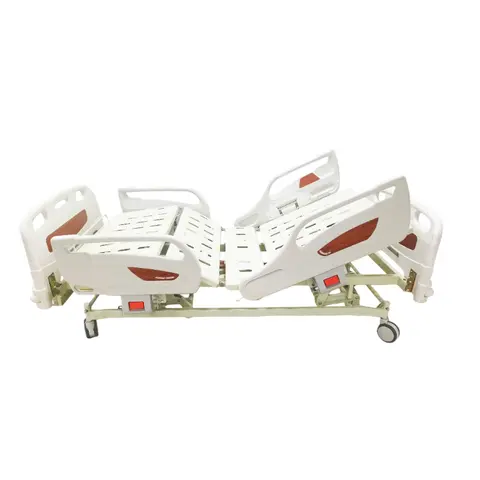
A hospital bed with integrated side rails has rail assemblies designed as part of the bed frame. The rails are engineered to move, lock, fold, or lower in coordination with the bed's dimensions, mattress platform, backrest movement, and electrical functions. Integrated rails may include nurse controls, patient controls, angle indicators, bed-exit alarms, accessory hooks, and safe-position markings.
Separate side rails, also called detachable, removable, or add-on side rails, are independent components attached to a compatible bed frame. Depending on the design, they may be installed using sockets, brackets, clamps, slide-in mounts, or other mounting hardware. They can be full-length, half-length, or sectioned rails.
Both designs can be appropriate. However, they create very different responsibilities for the OEM supplier, buyer, facility, and caregiver.
| Comparison area | Integrated side rails | Separate side rails |
|---|---|---|
| Product design | Engineered as part of the complete bed system | Mounted as an accessory or independent component |
| Installation | Factory assembled and matched to the bed | Requires correct selection, assembly, and fitment |
| Mattress compatibility | Usually defined during bed design and validation | Must be checked for every rail, mattress, and bed combination |
| Visual appearance | More streamlined and premium | Depends on rail style and mounting design |
| Customization | Suitable for branded controls, colors, panels, and functions | Flexible for basic configurations and regional options |
| Serviceability | May require dedicated replacement components | Individual rails may be easier to replace if standardized |
| Safety risk management | Easier to control as one validated system | Requires strict compatibility management |
| Best fit | Premium hospital beds, long-term-care beds, smart nursing beds | Basic beds, tender projects, modular product lines, retrofit needs |
The key point is simple: the safety performance of a side rail depends on the complete bed environment, not on the rail alone. The rail, mattress, bed frame, bed height, patient condition, operating instructions, and caregiver procedures all matter.
Side rails can help reduce the risk of a patient accidentally rolling or slipping from the mattress when they are correctly selected and used. But they are not a universal fall-prevention solution. Clinical guidance emphasizes individualized assessment because rails can create hazards, including entrapment or a higher fall if a person attempts to climb over them. The FDA specifically advises against automatic use of rails and recommends evaluating the entire bed, mattress, rail, and patient-risk situation together.
This matters especially for:
- Older adults with dementia, confusion, agitation, or poor risk awareness
- Patients with limited mobility or impaired balance
- Bariatric users who may require a wider mattress and different rail geometry
- Patients receiving sedatives or medications that affect cognition
- Facilities where multiple mattress models are used on the same bed platform
- Home-care or long-term-care environments with less continuous supervision
A systematic review of hospitalized older adults found no scientific evidence directly proving that bed rails prevent falls compared with no rails or other restraint approaches. Another review in nursing homes found that the effect of rails on falls can be beneficial, harmful, or neutral depending on context and accompanying fall-prevention measures.
For OEM buyers, this creates an important product-development principle:
Do not sell side rails as a stand-alone promise of fall prevention. Sell a complete, risk-managed bed solution with defined intended use, compatible accessories, safety instructions, and training support.
Integrated side rails are often the preferred choice for higher-end electric hospital beds, ICU beds, nursing-care beds, and smart eldercare beds. Because the rail is designed together with the bed, the manufacturer can better manage critical interfaces such as rail height, rail spacing, mattress thickness, backrest articulation, and moving-frame clearances.
For a branded hospital-bed program, integrated rails can provide several commercial advantages:
- Stronger product identity. Rail covers, panels, colors, control membranes, and logo placement can reinforce the brand.
- Improved user experience. Controls can be positioned where patients and caregivers naturally reach them.
- Reduced installation variability. The end user receives a complete bed rather than a rail that must be selected and installed separately.
- Better feature integration. Integrated systems can support angle indicators, nurse-call interfaces, bed-exit functions, positioning controls, and safe-rail labels.
- Higher perceived value. Smooth, well-designed rails can make the bed look more modern, residential, and premium.
- More controlled compatibility. The rail and mattress platform can be engineered and validated as a defined combination.
In practical OEM projects, integrated rails are particularly valuable when the buyer wants a differentiated product rather than a commodity bed. A carefully designed rail can become one of the most visible features of the entire product.
For example, Kangli Medical's ultra-low smart nursing-bed project for a European nursing-home group combined a 20 cm ultra-low platform, dual-motor lifting system, customized side rails, and a 250 kg dynamic load capacity. The customer required a safer, more homelike solution for elderly people with dementia. The project delivered 1,200 units and reported a 78% reduction in patient fall incidents and a 15% improvement in room occupancy. These are project-specific outcomes, not universal performance claims, but they illustrate how bed height, rail design, care workflow, and environment must be developed as one solution. [klmedbed]
Integrated rails require more up-front engineering. They may also involve a higher tooling investment, more complex assembly, and dedicated spare-part planning. If a rail is damaged, a facility may need the specific replacement assembly rather than a generic part.
For OEM programs, buyers should clarify these questions before locking the design:
- Can the rail be replaced in the field without removing the entire bed frame?
- Are rail covers, latches, controls, and actuators available as separate spare parts?
- How many operating cycles has the rail mechanism been validated for?
- Does the rail remain secure during backrest and knee-rest articulation?
- Which mattress thicknesses are permitted?
- Can the rail design accommodate regional electrical-control layouts and language requirements?
- Does the rail create additional cleaning or infection-control challenges?
The right integrated rail is not necessarily the most complex one. It is the one that fits the clinical setting and can be supported throughout the product lifecycle.
Separate side rails are valuable in modular product portfolios. They can allow a bed brand to offer multiple configurations using a common bed platform: no rails for low-risk users, half rails for mobility support, or full rails for specific clinical requirements.
This can be an efficient strategy for distributors and tender-focused buyers because it may reduce initial product complexity. It also allows market-specific configurations without redesigning the entire bed.
Separate rails can be a sensible option when:
- The buyer sells entry-level manual or semi-electric hospital beds
- The project requires a modular accessory catalog
- The customer needs replacement rails for installed beds
- The rail configuration differs by country, tender, or end-user category
- The product line needs lower inventory cost through shared bed frames
- The healthcare provider wants to choose rail types case by case
For suppliers, detachable rail programs can support flexible packaging and replacement-part sales. For buyers, they can reduce the need to stock multiple complete bed variants.
The flexibility of separate rails is also their greatest risk. A rail may appear to fit a bed but still create unsafe gaps, inadequate locking, poor rail height, or instability when paired with a different mattress or bed frame.
International medical-bed standards recognize that a side rail can be either a detachable accessory or an integral part of the medical-bed construction. The safety focus is not merely whether the rail attaches to the frame; it is whether the complete medical-bed system meets basic safety and essential-performance requirements.
In our manufacturing experience, the most common mistakes in separate-rail programs are:
- Treating a rail as "universal" without validating each bed-and-mattress combination
- Using a thicker replacement mattress that changes the effective rail height
- Allowing incompatible third-party accessories or rail extensions
- Failing to inspect latches, brackets, fasteners, and deformation during preventive maintenance
- Providing unclear assembly instructions for distributors or care facilities
- Marketing rails as a universal anti-fall device rather than a risk-managed support feature
A separate rail should therefore be delivered with a clear compatibility matrix. This document should identify the approved bed models, mattress width and thickness range, rail configuration, patient category, weight limits, installation method, inspection requirements, and warnings.
The best decision starts with the intended use, not with the catalog photo. Use the following five-step process when selecting or developing an OEM hospital bed.
Start by identifying where and how the bed will be used:
- Acute-care hospital ward
- ICU or high-dependency unit
- Rehabilitation center
- Nursing home
- Dementia-care unit
- Home-care setting
- Emergency or short-stay facility
A premium nursing-home bed may prioritize ultra-low height, warm materials, quiet movement, and rail geometry that supports safe repositioning. An acute-care bed may need fast cleaning, integrated controls, compatibility with accessories, and efficient caregiver access.
Do not use the same rail strategy for every patient population. Consider mobility, cognition, behavior, body size, fall history, skin condition, and ability to use bed controls.
The strongest fall-prevention approach is individualized: screen for risk, develop a tailored plan, and consistently apply the relevant interventions. This may include low bed height, locked casters, clear access to the call system, lighting, toileting support, and staff communication—not just raised rails.
For both integrated and separate rails, verify:
- Mattress width, length, thickness, and compression behavior
- Gaps between the mattress and rail
- Gaps created when the mattress platform articulates
- Rail height above the compressed mattress surface
- Rail operation during backrest, knee-rest, and height adjustments
- Locking performance and emergency-release function
- Compatibility with overlays, pressure-relief mattresses, and mattress extensions
This is especially important when a customer plans to use pressure-relief or alternating-pressure mattresses. A mattress change can alter rail height and interface gaps enough to invalidate the intended configuration.
For an OEM project, product validation should include more than appearance approval. It should cover mechanical durability, latch reliability, dynamic loading, rail strength, potential entrapment zones, movement under load, corrosion resistance, cleaning resistance, packaging protection, and user instructions.
IEC 60601-2-52 addresses basic safety and essential performance for adult medical beds. Testing and compliance obligations vary by market and product classification, so buyers should work with qualified regulatory, testing, and market-access professionals for the countries where they plan to sell.
A well-designed rail can still become unsafe if damaged, loose, poorly installed, or paired with an incompatible replacement mattress. Specify spare parts, preventive-maintenance intervals, inspection procedures, and end-user training at the beginning of the project.
For branded OEM buyers, after-sales readiness is a competitive advantage. It protects patients, reduces warranty costs, and increases distributor confidence.
When sourcing hospital beds from an OEM manufacturer, ask technical questions that reveal whether the supplier understands the complete safety system.
1. Is the side rail designed and tested with the exact bed frame and mattress range we will sell?
2. Can you provide a rail-and-mattress compatibility matrix for every model?
3. What are the approved patient weight, safe working load, and mattress specifications?
4. How is the rail latch protected against unintended release, wear, and repeated use?
5. Can the rail be cleaned thoroughly without creating inaccessible contamination areas?
6. Which components are field-replaceable, and what is the expected spare-part availability?
7. Can the design be customized for our brand, language, local regulations, and target price point?
8. Can the factory support documentation for product registration, quality review, and distributor training?
At Tianjin Kangli Medical Equipment Co., Ltd., we recommend addressing these questions during the design-review stage rather than after a purchase order is issued. Early engineering alignment reduces expensive tooling changes, delayed market entry, and inconsistent product configurations.
| Buyer type | Recommended rail approach | Why |
|---|---|---|
| Premium hospital-bed brand | Integrated split side rails | Strong branding, polished appearance, system-level design control, feature integration |
| Long-term-care and dementia-care supplier | Integrated rails plus ultra-low bed design | Helps combine dignity, access, low-height strategy, and controlled rail geometry |
| Tender-driven distributor | Separate rail options or a modular platform | Supports multiple price points and configurable bids |
| Home-care product supplier | Low-height bed with carefully selected short or assist rails | Focus on access, mobility support, caregiver workflow, and individualized risk assessment |
| Replacement-parts wholesaler | Separate rails with strict compatibility documentation | Simplifies inventory but requires clear fitment controls |
| Manufacturer expanding into smart beds | Integrated rails | Supports controls, alarms, user interfaces, and premium positioning |
There is no universal winner in the hospital bed with integrated side rails vs separate side rails comparison. Integrated rails are usually stronger for premium, differentiated, system-engineered products. Separate rails can be highly practical for modular, budget-sensitive, or replacement-oriented business models—provided compatibility and training are rigorously controlled.
For overseas hospital-bed brands, wholesalers, and manufacturers, the best OEM partner is not simply a factory that can reproduce a drawing. It is a manufacturer that can help you make the right safety, usability, compliance, cost, and service decisions before production begins.
Tianjin Kangli Medical Equipment Co., Ltd. has manufactured medical beds since 1998 and offers OEM support for hospital beds, nursing beds, electric beds, ultra-low beds, side rails, and customized care solutions. We can help evaluate whether your project needs integrated side rails, separate side rails, or a modular platform that supports both.
Contact our team to discuss your target market, bed specification, branding requirements, mattress system, and rail configuration:
- Email: [yukili90@tjkangli.com](mailto:yukili90@tjkangli.com)
- Phone / WhatsApp: +86 136 5207 7555
- Website: [Kangli Medical]
Request a customized OEM hospital-bed proposal and side-rail compatibility review today.
Not automatically. Integrated rails can make it easier to control the relationship between the rail, bed frame, and approved mattress, but safety depends on the full system design, correct use, inspection, and patient assessment. Separate rails can also be safe when they are specifically designed, tested, installed, and maintained for the relevant bed-and-mattress combination.
No. Side rails are not a universal fall-prevention solution. Research and clinical guidance indicate that their effects vary by patient and setting, and raised rails can create additional risk if a person climbs over them. A tailored fall-prevention plan is more appropriate than automatically raising rails for every patient.
Only if the rail is approved for that exact bed model and mattress configuration. Before installation, confirm mounting compatibility, rail height, mattress size, gap dimensions, locking reliability, patient weight limits, and operating instructions. Do not assume that a rail is universal simply because it physically attaches to the frame.
For many nursing-home and dementia-care applications, integrated split rails combined with an ultra-low bed can provide a more controlled, user-friendly solution. However, the final choice should be based on resident mobility, cognition, mattress selection, staff workflow, and the facility's clinical risk-assessment process.
Request a product specification, approved mattress range, bed-and-rail compatibility matrix, mechanical and durability test information, installation instructions, cleaning guidance, spare-parts list, maintenance plan, labeling, warning statements, and documentation appropriate to the target market.
Yes. A thicker or softer mattress can reduce the effective rail height and change the gaps between the mattress, rail, and bed frame. Every mattress type—including pressure-relief overlays—should be assessed as part of the complete bed-and-rail configuration.
1. Tianjin Kangli Medical Equipment Co., Ltd. "Kangli Medical: Hospital Bed Manufacturer China." Project information on ultra-low smart nursing beds, customized side rails, 20 cm ultra-low platform, 250 kg dynamic load, and European nursing-home deployment. [https://www.klmedbed.com/] [klmedbed]
2. U.S. Food and Drug Administration. "Clinical Guidance for the Assessment and Implementation of Bed Rails." Guidance on patient entrapment, fall risk, individualized assessment, inspection, and avoiding automatic rail use. [https://www.fda.gov/media/88765/download] [fda]
3. International Organization for Standardization. "IEC 60601-2-52:2009(en): Medical Electrical Equipment—Part 2-52: Particular Requirements for the Basic Safety and Essential Performance of Medical Beds." [https://www.iso.org/obp/ui/en/] [iso]
4. U.S. Food and Drug Administration. "Recognized Consensus Standards: Medical Devices—IEC 60601-2-52 Edition 1.1." FDA recognition listing for medical-bed safety and essential-performance requirements. [https://www.accessdata.fda.gov/scripts/cdrh/cfdocs/cfStandards/detail.cfm?standard__identification_no=44373] [accessdata.fda]
5. Hignett, S., et al. "Effectiveness of Bedrails in Preventing Falls Among Hospitalized Older Adults: A Systematic Review." *PubMed*. [https://pubmed.ncbi.nlm.nih.gov/29035965/] [pubmed.ncbi.nlm.nih]
6. Rapp, K., et al. "Bedrails and Falls in Nursing Homes: A Systematic Review." *PubMed*. [https://pubmed.ncbi.nlm.nih.gov/32088988/] [pubmed.ncbi.nlm.nih]
7. AHRQ Patient Safety Network. "Falling Through the Crack (in the Bedrails)." Guidance on screening for fall risk and implementing tailored prevention plans. [https://psnet.ahrq.gov/web-mm/falling-through-crack-bedrails] [psnet.ahrq]
8. UL Solutions. "IEC 80601-2-52 and Medical Bed Safety." Overview of the evolving medical-bed safety-standard landscape. [https://www.ul.com/insights/iec-80601-2-52-and-medical-bed-safety] [ul]
Hot Tags: China, Global, OEM, private label, manufacturers, factory, suppliers, manufacturing company


