

Views: 260 Author: Tianjin Kangli Publish Time: 2026-10-21 Origin: Site


Content Menu
● Smart ICU Beds vs. Fully Electric Beds: What Is the Real Difference?
● Continuous Biomarker Monitoring: What Can a Hospital Bed Actually Measure?
>> Distinguish Vital Signs From Biochemical Measurements
>> Continuous Monitoring Does Not Mean Uninterrupted Valid Data
● Integrated Bed Scales: Continuous Availability Versus Reliable Weight Trends
>> Why Weight Readings Can Change Without a Patient Change
>> A Practical Bedside Weighing Workflow
● Which Bed Configuration Fits Your Clinical Workflow?
>> Choose a Fully Electric Bed When Positioning Is the Main Requirement
>> Consider a Smart ICU Bed When Data Integration Has a Defined Purpose
● OEM Insight: Specify the Measurement Chain Before the Feature List
>> 1. Define What the Sensor Measures
>> 2. Define How Data Reaches the Right Patient Record
>> 3. Define What Happens When an Alert Appears
● A Practical Acceptance-Test Plan for Smart Beds With Weighing Systems
>> Test Weight Performance Under Representative Conditions
>> Test Physiological Monitoring Within Its Intended Use
● Safety, Maintenance, and Lifecycle Cost
● Working With Tianjin Kangli Medical on an OEM Bed Project
>> Request an OEM Configuration Review
>> 1. Are Smart ICU Beds Always Fully Electric?
>> 2. Can a Fully Electric Bed Include a Patient Weighing Scale?
>> 3. Can a Smart Hospital Bed Continuously Measure Blood Glucose?
>> 4. Is Continuous Weight Monitoring the Same as Automatic Weight Charting?
>> 5. Can Contact-Free Sensors Replace ICU Bedside Monitors?
>> 6. What Should OEM Buyers Request Before Ordering?
Tianjin Kangli Medical Equipment Co., Ltd. helps international brands, wholesalers, and manufacturers approach hospital-bed sourcing from a practical engineering perspective. When comparing Smart ICU Beds vs. Fully Electric Beds for Continuous Biomarker and Weight Monitoring, the essential question is not simply which bed has more features. It is which configuration delivers reliable measurements, usable information, and appropriate clinical support.
Founded in 1998, Kangli operates a 20,000-square-meter factory with 50+ employees. As a national high-tech enterprise focused on medical-device research, development, and manufacturing, the company provides OEM services for overseas business partners.
Our starting point for this comparison is straightforward: define the monitoring requirement before choosing the bed. Electric adjustment, integrated weighing, physiological sensing, and hospital connectivity are separate capabilities. Buyers should verify each one rather than assume that "smart" includes everything.

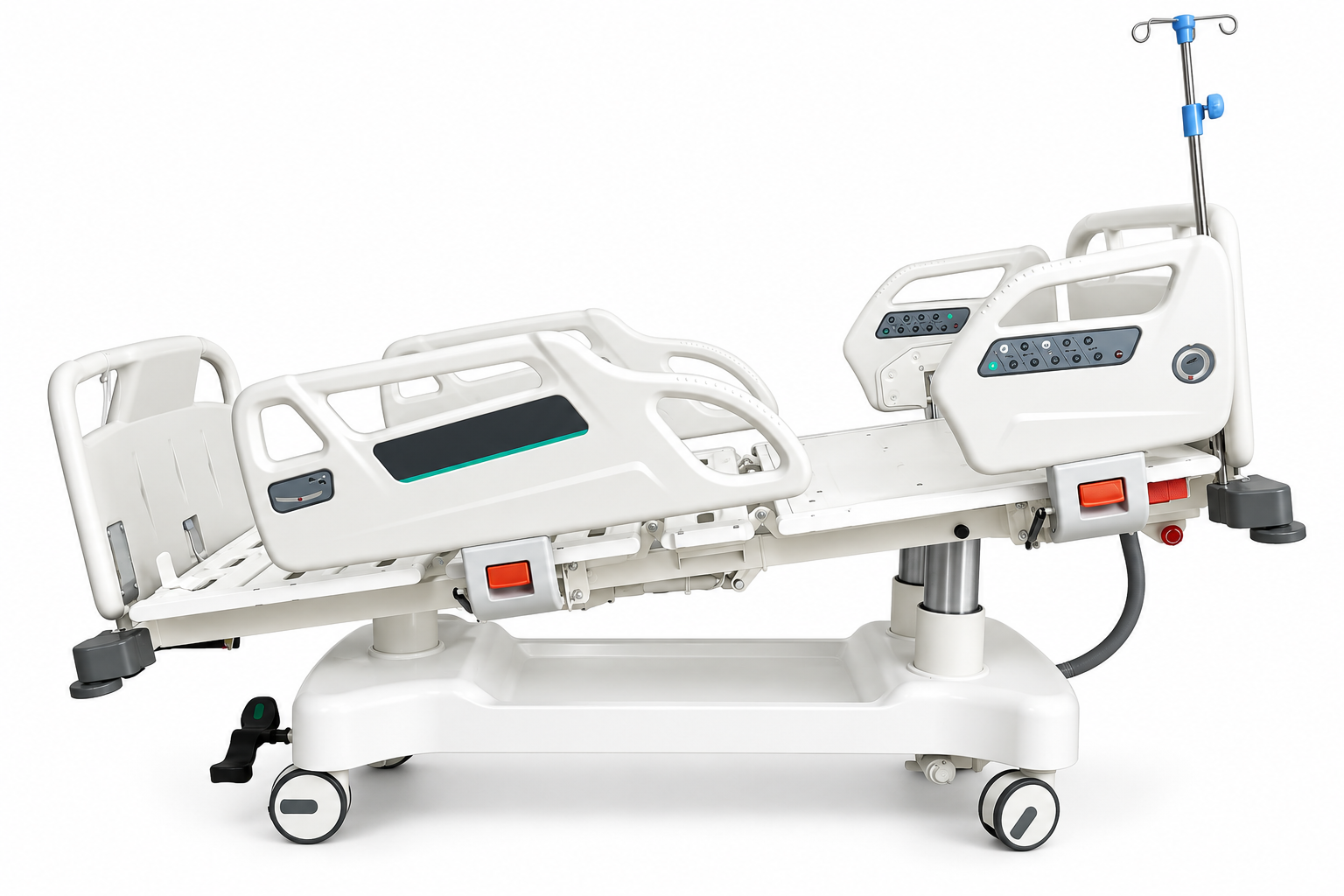
A fully electric hospital bed uses powered mechanisms to adjust patient positioning. Depending on the model, these may control backrest elevation, leg positioning, bed height, and tilt.
A smart ICU bed generally adds selected sensing, alerts, software, or communication functions. However, "smart ICU bed" is not a universal specification. Features vary between manufacturers, models, and purchased configurations.
Importantly, these categories overlap. A smart ICU bed is often fully electric, while a fully electric bed may also include an integrated weighing scale.
| Procurement factor | Fully electric bed | Smart ICU bed |
|---|---|---|
| Powered positioning | Core capability; movements vary | Usually included; movements vary |
| Integrated patient weighing | Model-dependent option | Often available, but must be confirmed |
| Contact-free physiological monitoring | Not implied by electric adjustment | Available on selected systems |
| Bed-exit and status alerts | Model-dependent | May offer more integrated alerts |
| Hospital-system connectivity | Requires verification | May support interfaces or gateways |
| Main purchasing priority | Positioning and bedside care | Positioning plus defined data workflows |
| Additional operating needs | Maintenance and staff training | Sensor validation, IT support, and alert management |
From a procurement perspective, I would compare documented functions—not category names.
The phrase "continuous biomarker monitoring" needs careful interpretation. Buyers frequently use it to describe several different kinds of patient information.
Selected contact-free bed-monitoring systems can measure or estimate heart rate, respiratory rate, and movement through mechanical signals detected beneath the patient.
That does not mean the bed measures blood glucose, lactate, electrolytes, or other biochemical markers.
A useful purchasing specification separates:
- Physiological parameters, such as heart rate and respiratory rate.
- Physical measurements, such as body weight.
- Behavioral or positional information, such as movement and bed occupancy.
- Biochemical measurements, which require an appropriate dedicated measurement system.
A screen displaying information from another device is also different from a bed independently measuring that information.
Ask suppliers to identify the sensor, measurement method, intended use, and applicable regulatory documentation for every claimed parameter.
Contact-free sensing depends on the system's operating conditions. Patient movement, mattress compatibility, positioning, and absence from the bed may affect data availability.
Therefore, request more than an update frequency. Ask how the system identifies poor signal quality, suppresses unreliable readings, and communicates monitoring interruptions.
Bed-based monitoring should be used within its authorized intended use. It should not be assumed to replace the bedside monitoring required for a critically ill patient.
An integrated patient weighing system can reduce the need to transfer a patient to a separate scale. This may simplify weighing workflows for patients with limited mobility.
However, an always-available scale is not necessarily an automatically recorded, continuously validated patient-weight record.
Some systems require caregivers to initiate weighing, follow positioning instructions, and accept a measurement before it enters the history.
Depending on the bed's weighing architecture, the measured load may include more than the patient.
Potential influences include:
- Added blankets or positioning accessories.
- Equipment placed on the mattress or weighed frame.
- Drainage bags attached to different locations.
- Staff leaning against the bed.
- External contact that affects free weighing.
- Changes in the approved weighing position.
This is why validation matters more than display resolution. A screen showing small increments does not prove that real-world measurements are equally accurate.
Use the model-specific instructions as the controlling procedure. A typical workflow includes:
1. Prepare the empty bed with the specified baseline items.
2. Zero the scale in the required configuration.
3. Position the patient according to the instructions.
4. Check accessories, hanging items, and external contact.
5. Wait for a stable reading and complete the measurement.
6. Record relevant conditions when reviewing the weight trend.
Weight trends can support clinical assessment, including fluid-status review. They do not independently establish fluid balance or explain the cause of a weight change.
The best choice depends on patient needs, existing equipment, staffing, and information systems.
A fully electric bed may be appropriate when the priority is adjustable positioning and height, while monitoring is already provided by separate devices.
An integrated scale can still be worth specifying if routine patient weighing is important.
This configuration can avoid duplicating monitoring functions that the hospital already has. However, buyers must verify that its positioning range, load limits, safety functions, and accessories meet the intended clinical use.
A smart ICU bed becomes more relevant when the organization has a clear requirement for connected weighing, bed-status information, selected physiological monitoring, or coordinated alerts.
Examples include reducing repeated manual transcription or making selected bed information available to a central workflow.
These are implementation goals, not guaranteed outcomes. Benefits depend on interface compatibility, staff adoption, measurement quality, and response procedures.
For high-acuity environments, evaluate the complete care system—not the bed in isolation.
For international brands, the most useful specification follows the data from collection to action.
Require a parameter list, measurement range, accuracy specification, operating conditions, and limitations.
For weighing systems, distinguish maximum patient weight, safe working load, scale capacity, display resolution, and stated accuracy. These figures serve different purposes and should not be used interchangeably.
Ask where the information appears and how it is identified.
Does it remain on the bed display? Does a caregiver confirm it? Can it be exported? Does integration require a gateway, subscription, or third-party software?
Request a demonstration of patient association and transfer workflows. Correct data attached to the wrong patient is still unsafe information.
An alert needs an owner and an expected response.
Specify which events generate local notifications, which reach other systems, and what happens when connectivity is unavailable.
Avoid adding alerts simply because the platform supports them. Each notification should serve a practical care process.
Before committing to a larger OEM order, build a documented acceptance plan around the proposed configuration.
Use suitable reference loads and an agreed protocol. Assess repeated measurements, relevant load ranges, approved positions, and the effect of routine accessories.
Acceptance criteria should come from the agreed specification, manufacturer instructions, applicable requirements, and intended use—not a generic number copied from another product.
Where monitoring is included, request validation evidence for the exact hardware and software configuration.
During evaluation, assess data availability, movement handling, signal-quality indicators, and recovery after the patient leaves and returns.
Do not interpret a successful showroom demonstration as proof of performance across every ICU patient population.
Include power interruption, battery operation where provided, network loss, restart behavior, and restoration of patient association.
Document whether measurements remain available locally, whether data are buffered, and how missing information is displayed.
These tests reveal workflow weaknesses that a feature checklist can miss.
Monitoring features do not compensate for an unsuitable bed system.
Evaluate mattress, rail, frame, and accessory compatibility together. Entrapment risk can arise from gaps within the assembled system, including after component replacement.
Also review braking, emergency functions, cleaning instructions, service access, spare-parts availability, and preventive maintenance.
For connected configurations, include access controls, software-update responsibility, support arrangements, and the process for addressing security issues.
Compare lifecycle costs across equivalent requirements:
- Purchase price and selected options.
- Installation and interface implementation.
- Calibration, inspection, and maintenance.
- Software or connectivity charges, where applicable.
- Staff training and refresher training.
- Repair downtime and replacement components.
A lower initial quotation is not automatically the lower-cost solution. Equally, a more connected bed is not automatically the better investment.
Kangli provides a manufacturing starting point for overseas brands, wholesalers, and manufacturers developing hospital-bed product lines.
For a productive technical discussion, share the intended care environment, target market, patient population, required movements, load requirements, and monitoring objectives.
For smart ICU bed projects, separate requirements into three groups:
- Essential functions required at launch.
- Optional features for selected customers.
- Future integration requirements needing further development.
Then request written confirmation of the proposed model's capabilities, supporting documentation, customization scope, and testing plan.
The company profile alone should not substitute for model-specific evidence. Any weighing, sensing, connectivity, or certification claim should be tied to the exact product being supplied.
Send Kangli your target market, expected order volume, positioning requirements, weighing needs, and hospital-interface expectations.
Ask for a model-specific proposal covering available functions, technical limitations, validation documents, sampling, and production terms.
- Company: Tianjin Kangli Medical Equipment Co., Ltd.
- Website: [https://www.klmedbed.com]
- Email: yukili90@tjkangli.com
- Phone / WhatsApp: +86 136 5207 7555
Many are, but "smart" describes selected sensing, software, or connectivity capabilities rather than a standardized set of powered movements. Verify both mechanical and digital specifications.
Yes. Integrated weighing is a separate capability from electric positioning. Confirm whether it is standard, optional, or unavailable on the proposed model.
Do not assume so. A bed's movement or cardiorespiratory sensor does not establish glucose-measurement capability. Any glucose function requires evidence for the dedicated measurement system and its intended use.
No. A bed may offer readily available weighing while still requiring a caregiver to initiate, confirm, or export measurements. Ask suppliers to demonstrate the complete recording workflow.
Not by default. Their suitability depends on authorized indications, patient population, parameters, and local clinical requirements. Review the specific system's limitations before deciding its role.
Request model-specific specifications, relevant regulatory documentation, operating instructions, weighing and monitoring evidence, interface details, service terms, and an agreed acceptance-test protocol.
Hot Tags: China, Global, OEM, private label, manufacturers, factory, suppliers, manufacturing company


