

Views: 237 Author: Tianjin Kangli Publish Time: 2026-10-22 Origin: Site


Content Menu
● Manual vs Electric Hospital Beds: The Key Differences
● When Should Hospitals Choose Electric Hospital Beds?
>> Frequent Positioning and Working-Height Changes
>> Appropriate Patient Independence
● When Are Manual Hospital Beds the Better Choice?
>> Limited Adjustment Requirements
>> Facilities With Limited Technical Support
>> Selected Contingency Capacity
● Compare Total Cost of Ownership, Not Just Purchase Price
● Safety Comes From the Complete Bed System
>> Check Mattress, Rail, and Frame Compatibility
>> Distinguish Safe Working Load From Patient Weight
>> Verify Standards for the Destination Market
● Power Failures: Questions Buyers Often Forget
● A Five-Step Hospital Bed Procurement Process
>> 1. Define Requirements by Ward
>> 2. Create a Function-Based Specification
>> 3. Test a Representative Sample
>> 4. Document Acceptance Criteria
>> 5. Review Performance After Deployment
● Why Start Your OEM Hospital Bed Project With Kangli?
>> 1. Are electric hospital beds always better than manual beds?
>> 2. Can manual hospital beds adjust their height?
>> 3. Do all electric hospital beds work during power outages?
>> 4. Can electric hospital beds prevent caregiver injuries?
>> 5. Which hospital bed is easier to maintain?
>> 6. Should hospitals buy only one bed type?
● Discuss Your Manual or Electric Hospital Bed Requirements
Tianjin Kangli Medical Equipment Co., Ltd. supports overseas brands, wholesalers, and manufacturers with OEM hospital bed sourcing. When buyers ask, "Manual vs Electric Hospital Beds: Which One Should Hospitals Choose?", our recommendation is to start with workflow, not the motor count or purchase price.
Electric hospital beds generally suit wards requiring frequent adjustments, assisted transfers, and convenient working-height changes. Manual hospital beds can be practical where adjustment needs are limited, budgets are constrained, or powered adjustment cannot be reliably supported. Many hospitals benefit from a mixed fleet.
Founded in 1998, Kangli operates a 20,000-square-meter factory with 50+ employees, according to company-provided information. This guide presents a manufacturer-oriented procurement perspective, helping buyers translate clinical requirements into specifications rather than choose by product labels alone.
A manual hospital bed uses hand-operated mechanisms, commonly cranks, to adjust supported sections. Depending on the model, these may include the backrest, knee section, or overall bed height.
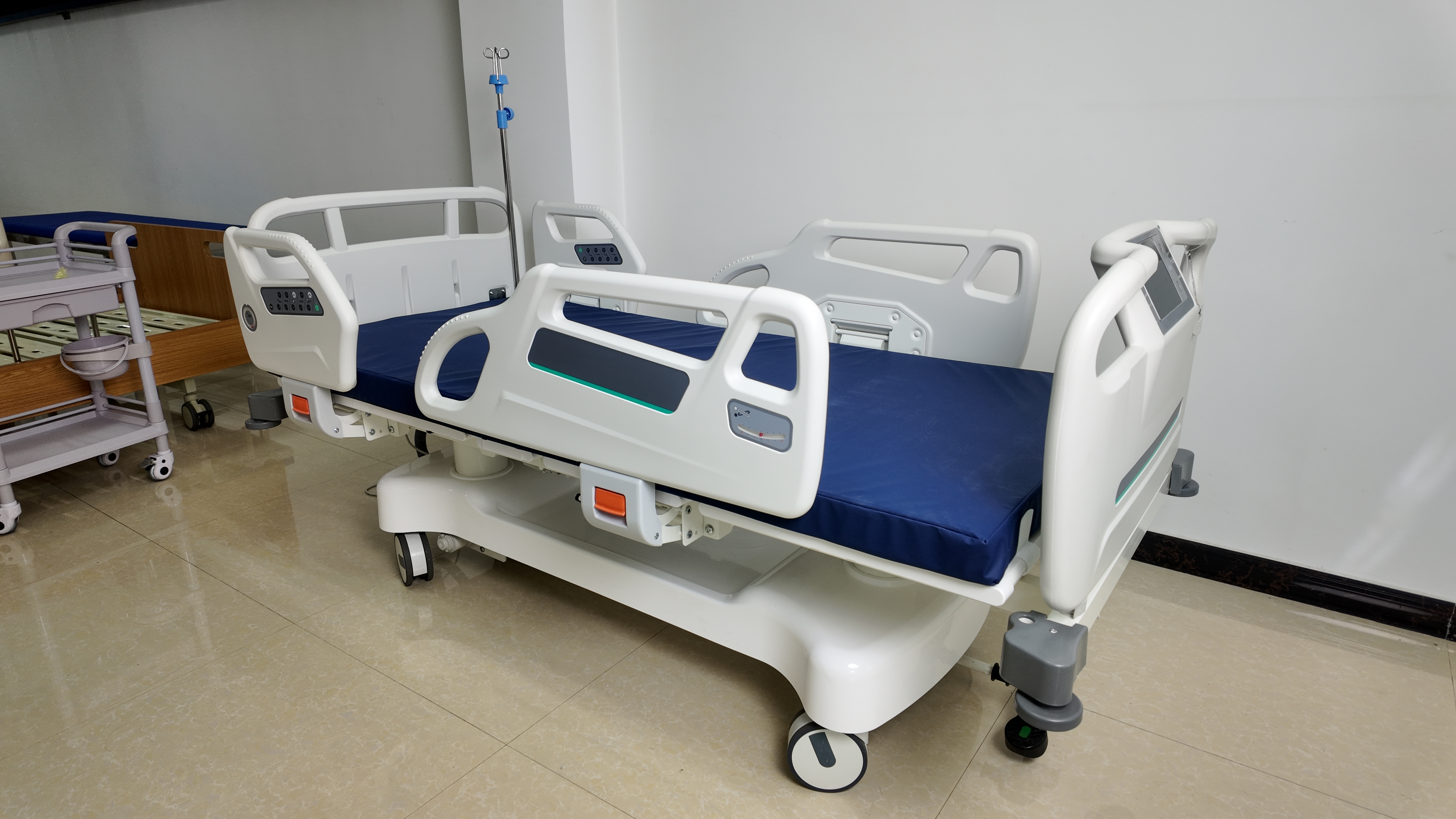
An electric hospital bed uses powered actuators for specified adjustments. Controls may be available to caregivers, patients, or both. However, "electric" does not automatically mean height-adjustable, ICU-ready, or equipped with battery backup.
Semi-electric hospital beds combine powered and manual adjustments. Buyers should check each function individually.
| Procurement factor | Manual hospital beds | Electric hospital beds |
|---|---|---|
| Adjustment method | Hand-operated mechanisms | Powered actuators and controls |
| Initial expenditure | Often lower for comparable specifications | Often higher, depending on features |
| Adjustment effort | Requires caregiver effort | Reduces effort for powered adjustments |
| Patient control | Usually limited | Possible when controls are accessible and clinically appropriate |
| Electricity dependence | Manual adjustment does not require electricity | Powered functions need mains power or specified backup |
| Maintenance focus | Cranks, joints, fasteners, brakes, and structure | Mechanical parts plus actuators, wiring, controls, and batteries |
| Typical fit | Lower-adjustment settings and selected reserve capacity | Frequent-adjustment wards and higher-dependency care |
These are category-level distinctions. Compare actual specifications before approving a purchase.
Electric adjustment becomes valuable when staff repeatedly change bed position during routine care.
A powered backrest can make supported positioning more convenient. Powered height adjustment can help staff establish an appropriate working level and coordinate transfers with compatible equipment.
OSHA identifies height-adjustable electric beds as useful equipment for patient handling. Nevertheless, an electric bed does not replace transfer aids, adequate staffing, or a comprehensive safe patient handling program.
For procurement, the relevant question is not simply, "Does it have motors?" It is, "Which repeated care tasks can this configuration support?"
Some patients can operate permitted bed functions independently, reducing the need to request every minor adjustment.
This depends on cognition, strength, reach, vision, and the care plan. Patient controls are not appropriate for everyone.
Ask suppliers to demonstrate control labeling, handset placement, and caregiver lockout functions where specified. Evaluate whether users can understand the controls without unnecessary confusion.
Electric hospital beds are often the more practical starting point when patients need frequent assistance.
However, a general electric ward bed is not automatically suitable for intensive care. Critical-care procurement requires a separate specification covering necessary positioning, emergency functions, accessories, load capacity, and compatibility with surrounding equipment.
Buy against the intended clinical application, not an "ICU-style" appearance.
Manual beds can be reasonable where supported adjustments are needed less frequently and staff can operate the mechanisms safely.
Their value depends on the actual workload. A lower purchase price may be attractive, but repeated cranking can become inconvenient in a busy ward.
During evaluation, ask nurses to operate the sample under representative conditions. Check crank access, operating effort, storage position, and clearance near walls or furniture.
Manual beds avoid the servicing requirements of powered adjustment systems. This can simplify procurement where access to electrical troubleshooting or replacement control components is limited.
They still require planned maintenance. Worn mechanisms, loose fasteners, damaged rails, and unreliable brakes remain safety concerns.
Mechanical simplicity is not a substitute for inspection.
Manual beds may support a hospital's contingency strategy because their manual functions do not depend on electricity.
However, they are not automatically a suitable replacement for powered beds in every department. Patient needs and essential positioning requirements still determine suitability.
A useful hospital bed cost comparison includes the expenses that appear after delivery:
- Purchase price, freight, duties, and commissioning.
- Mattresses, accessories, and initial spare parts.
- Staff training and cleaning requirements.
- Preventive maintenance and repairs.
- Battery replacement where applicable.
- Downtime, temporary replacements, and disposal.
One practical calculation is:
Annualized ownership cost = total expected lifecycle expenditure ÷ planned service years.
For electric beds, request prices and availability for actuators, handsets, control boxes, and batteries. For manual beds, obtain equivalent information for crank assemblies, linkages, and other wear components.
Then assess workflow separately. A bed that takes less effort to adjust may offer operational value, but that value should be measured locally rather than assumed.
Avoid accepting unsupported claims that electric beds will reduce injuries, staffing costs, or falls by a fixed percentage.
During a ward pilot, record:
1. How often each adjustment is needed.
2. Whether staff complete adjustments comfortably.
3. Whether controls create confusion.
4. How many faults or service calls occur.
5. How much cleaning and inspection time is required.
These observations create a stronger business case than a feature list.
Manual and electric beds can both present entrapment hazards when components are incompatible.
Evaluate the frame, mattress, rails, headboard, footboard, and accessories as one system. Mattress replacement can change gaps and rail relationships.
FDA hospital bed guidance addresses entrapment locations and dimensional assessment. Do not assume that adding rails automatically makes a patient safer. Rail use requires individual assessment and ongoing review.
Request the manufacturer's definitions and supporting documentation for safe working load and maximum patient weight.
These terms should not be treated as interchangeable. Mattresses, accessories, and other supported loads may affect the permitted configuration.
For bariatric procurement, also assess usable width, transfers, turning space, doorways, and suitable accessories.
IEC 80601-2-52:2026 addresses basic safety and essential performance of adult medical beds, including electrical and non-electrical beds within its scope.
Publication of a standard does not establish that every destination market has adopted it or that a particular model complies.
Request documentation identifying the exact model, configuration, standard edition, and applicable test scope. Have the responsible regulatory team confirm destination-market requirements before placing an order.
Battery backup should never be assumed from the word "electric."
Ask the supplier:
- Is backup power included or optional?
- Which functions remain available without mains electricity?
- What are the operating limits under stated load conditions?
- How are charging status and battery faults indicated?
- What emergency lowering or release procedures are specified?
- Who performs battery inspection and replacement?
Separate ordinary backup operation from emergency functions. They may use different mechanisms and procedures.
Train staff using the supplied instructions. Any power-loss demonstration should follow an approved test procedure rather than an improvised clinical experiment.
List patient dependency, adjustment frequency, transfer methods, room dimensions, cleaning protocols, and service resources.
A rehabilitation ward and a low-dependency reserve area may need different configurations.
Specify measurable requirements: adjustment ranges, dimensions, load limits, brakes, rails, controls, accessories, and any required emergency functions.
Do not rely on labels such as "three-function" without confirming exactly what they mean.
Include nurses, biomedical engineering, infection prevention, and procurement staff.
Evaluate adjustment usability, brakes, rail operation, mattress fit, cleaning access, cable routing, and compatibility with transfer equipment. Conduct tests within the manufacturer's instructions.
Agree on the approved configuration, inspection checklist, packaging, labeling, manuals, and spare-parts package before production.
For OEM projects, confirm branding and technical requirements in writing.
Track defects, maintenance calls, component replacement, and staff feedback.
Use this evidence to refine later orders rather than repeat an unsuitable specification across the entire hospital.
Tianjin Kangli Medical Equipment Co., Ltd. provides an OEM discussion point for international brands, wholesalers, and manufacturers seeking hospital bed supply.
Our practical recommendation is to begin with the buyer's intended market and clinical application. Then develop a clear specification for a manual, semi-electric, or electric configuration.
For a productive enquiry, prepare:
- Destination country and intended care setting.
- Required functions and dimensions.
- Load requirements and mattress specification.
- Rail, caster, brake, and accessory preferences.
- Electrical supply and backup requirements, where relevant.
- Branding, packaging, quantity, and delivery expectations.
- Required regulatory and technical documents.
Confirm model-specific capabilities, available customization, testing documentation, and after-sales arrangements during quotation. Company credentials alone do not establish the suitability of an individual bed.
No. Electric beds are often more convenient for frequent adjustment, while manual beds may fit lower-adjustment settings. The better choice depends on patient needs, staff workflow, service capacity, and lifecycle cost.
Some can; others cannot. Check the exact configuration. Backrest and knee adjustment do not necessarily mean that the complete bed platform is height-adjustable.
No. Backup capability depends on the model, battery condition, supported functions, and operating limits. Obtain written specifications and include power-loss procedures in staff training.
They can support easier adjustment and more suitable working heights. They do not eliminate handling hazards or replace lifting equipment, training, staffing, and risk assessment.
Manual beds avoid powered adjustment components, but both types require maintenance. Compare service instructions, spare-parts availability, repair access, and local support rather than assuming either category is maintenance-free.
Not necessarily. A mixed fleet can match different care requirements and budgets. However, excessive variation can complicate training, accessories, and spare-parts management. Standardize where practical.
Send Kangli your destination market, ward application, required functions, and estimated quantity. Request a model-specific comparison, documentation checklist, and OEM quotation before making your procurement decision.
Company: Tianjin Kangli Medical Equipment Co., Ltd.
Website: www.klmedbed.com
Email: yukili90@tjkangli.com
Phone / WhatsApp: +86 136 5207 7555
Hot Tags: China, Global, OEM, private label, manufacturers, factory, suppliers, manufacturing company


