
Language

Views: 149 Author: kangli Publish Time: 2026-09-24 Origin: Site


Content Menu
● Hospital Bed with Toilet Function: Electric vs. Mechanical Commode Systems
>> What Is a Hospital Bed with Toilet Function?
>> Electric vs. Mechanical Commode Systems: At a Glance
>> How an Electric Commode Bed Works
>>> Considerations before buying
>> How a Mechanical Commode Bed Works
>>> Considerations before buying
>> Which System Fits Your Market?
>> Five OEM Evaluation Areas Buyers Should Not Overlook
>>> 2. User and caregiver workflow
>>> 3. Cleaning and infection-control design
>>> 4. Electrical and mechanical reliability
>>> 5. Documentation and after-sales readiness
>> OEM Procurement Checklist: From Sample to Shipment
>>> 1. What is the main difference between an electric and mechanical commode system?
>>> 2. Is an electric commode bed always easier for caregivers?
>>> 3. Does an electric model work during a power outage?
>>> 4. What should be checked for cleaning?
>>> 5. Can a commode bed be OEM-branded?
>>> 6. What should distributors request from a manufacturer?
>>> 7. Does IEC 60601-2-52 apply to every commode bed?
>> Request an OEM Configuration Review
>> References
How can I start an OEM partnership with your factory?
We recommend starting with an initial technical consultation to review your design specifications, target market, required functions, quantity, and customization needs.
Please contact our dedicated B2B team by email at Yukili90@tjkangli.com or chat with us directly on WhatsApp: +86 136 5207 7555.
WhatsApp:
Let’s build excellence together. Whether you need a quotation for a large-scale hospital project, want to develop a private-label product, or are exploring OEM/ODM opportunities for our 5-function medical bed series, our team is ready to support you from product selection and technical confirmation to production and delivery.
Visit www.klmedbed.com or contact us via WhatsApp to start your customized manufacturing project today.
A hospital bed with toilet function combines an adjustable bed with a commode opening or compatible toileting system, helping caregivers support users with limited mobility. For overseas medical brands, wholesalers, and manufacturers, choosing between an electric and mechanical commode system means weighing transfer assistance, caregiver workload, cleaning, maintenance, price, and the intended care setting.
For OEM procurement, the right choice depends on the complete product configuration—not simply whether it has a motor. Buyers should assess how the commode integrates with the bed, how waste is collected or discharged, how the system is cleaned, and whether the operating instructions suit the target users. Bedside commodes are used as accessible toileting options for people with limited mobility, but product design and suitability vary by model. [bescomedical] [affinityhomemedicalequipment]
> Safety note: A commode bed is a medical-equipment product, not a substitute for an individualized care assessment. Transfers, toileting, and hygiene routines should follow the user's care plan and the manufacturer's instructions.
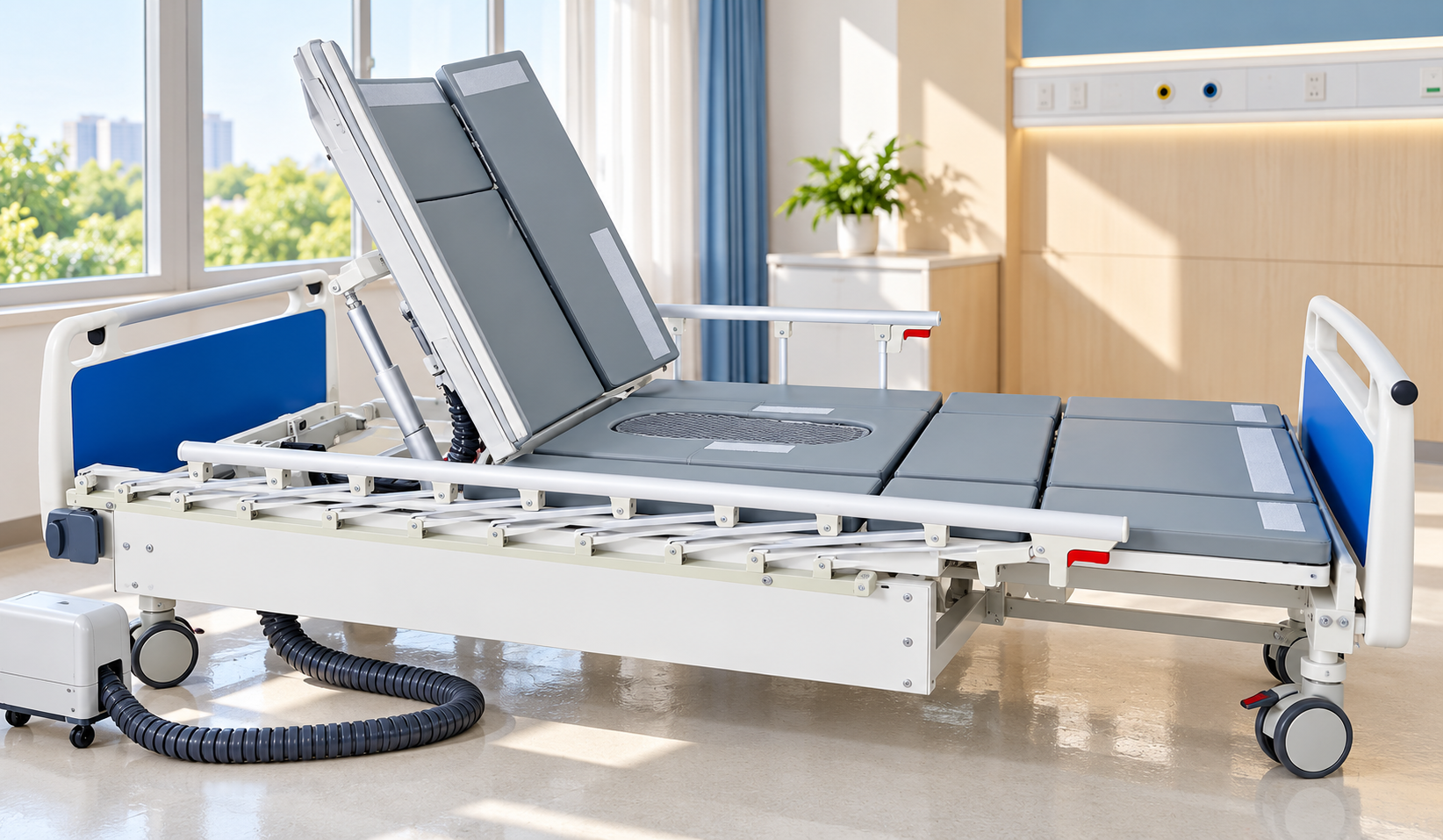
A hospital bed with toilet function—also called a commode bed or toileting hospital bed—is designed to provide access to a commode opening while the user remains in the bed or is positioned over a compatible collection system. Designs vary. Some include an opening in the mattress platform and a removable pan; others use a more integrated mechanism or a separate commode accessory.
Depending on the model, the system may include:
- A split or opening mattress platform
- A removable or replaceable commode pan
- A motorized or manually operated opening mechanism
- A compatible mattress with a shaped opening or removable section
- Bed-height and backrest adjustment
- A bedside control or caregiver control
- Splash guards, liners, or waste-collection accessories
These systems are not all interchangeable. Buyers should verify that the bed, mattress, commode unit, and accessories are designed to work together.
| Feature | Electric commode system | Mechanical commode system |
|---|---|---|
| Operation | Powered by an actuator or motor, often controlled by a handset | Opened, positioned, or operated manually, depending on design |
| Caregiver effort | May reduce physical effort for specified operations | Usually requires more hands-on setup |
| Power dependency | Requires compatible electrical supply; backup features should be confirmed | Usually operates without mains power |
| Controls and training | Requires control familiarization and operating instructions | Often has fewer controls, but manual steps still require training |
| Maintenance | Includes motors, wiring, controls, and moving parts | Typically fewer electrical components |
| Typical buying priorities | Convenience, powered adjustment, frequent use | Simplicity, lower technical complexity, budget |
| Key checks | Voltage, actuator function, cable routing, emergency operation | Locking, alignment, manual force, pinch points |
Important: "Electric" and "mechanical" can describe different parts of the system. Ask the supplier exactly what is powered or manually operated: the bed height, bed positioning, commode opening, pan mechanism, or transfer function.
An electric system typically uses a motor or actuator to move one or more bed components. Depending on the design, a caregiver may use a control to adjust the bed, open a platform section, or position the commode mechanism.
- Less manual effort for the functions that are motorized
- More convenient adjustment in care settings with frequent use
- Easier integration with electrically adjustable bed functions
- Potentially smoother, more repeatable movement when correctly maintained
- Confirm the exact functions controlled by the handset.
- Check voltage, frequency, plug, and electrical documentation for the destination market.
- Ask how the system behaves during a power interruption.
- Review cable protection and routing around moving components.
- Confirm whether emergency lowering or a manual release is available.
- Include operator training and troubleshooting instructions in the OEM documentation.
A motor does not automatically make a product safer or easier for every user. The movement, controls, and care workflow still need to be evaluated in the intended setting.
A mechanical system relies on manual operation for the relevant commode functions. Depending on the design, a caregiver may position or remove a pan, operate a lever, unlock a platform section, or prepare a compatible opening.
- No mains power needed for manually operated functions
- Fewer electrical components in the commode mechanism
- Straightforward operation for trained caregivers
- May suit buyers prioritizing simplicity and lower technical complexity
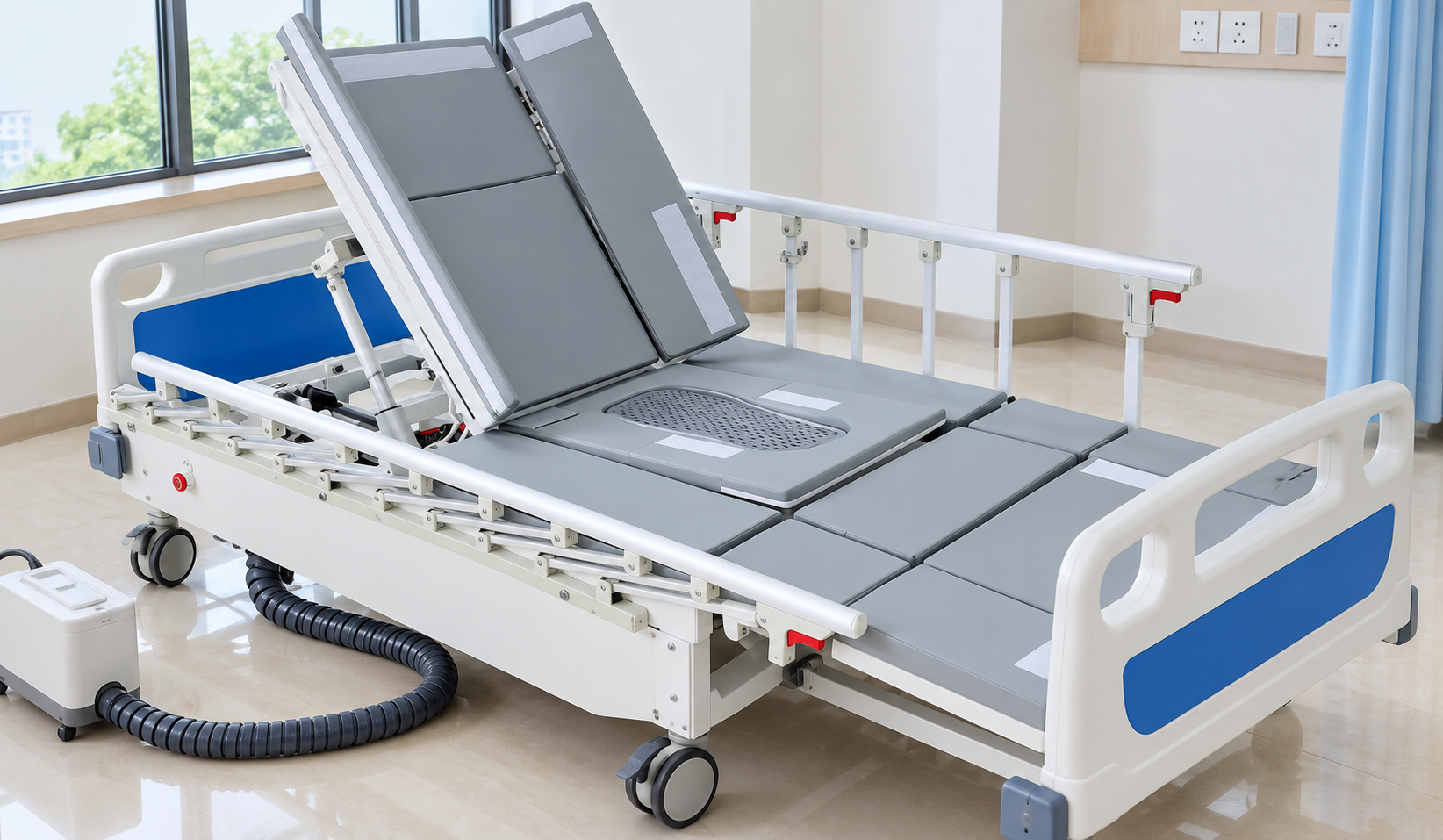
- Determine how much force and handling the procedure requires.
- Check that the pan or removable section locks securely.
- Inspect for pinch points, unstable parts, or difficult-to-reach latches.
- Confirm whether the user must be repositioned to install or remove the pan.
- Evaluate cleaning access and replacement-part availability.
"Mechanical" does not necessarily mean easy to operate. Ask the supplier to demonstrate the complete process with the specified mattress and accessories.
| Use environment | Questions to prioritize |
|---|---|
| Hospital wards | How often will it be used? Can staff clean and reset it quickly? Are controls intuitive? |
| Nursing homes and long-term care | Can the system support the facility’s toileting routine? Is training manageable across shifts? |
| Homecare | Can the caregiver operate it safely in the available room space? Is installation and maintenance practical? |
| Rehabilitation | Does the configuration support the user’s transfer plan and changing mobility needs? |
| Wholesale or distribution | Are spare parts, manuals, packaging, and after-sales support available? |
The best choice is the one that fits the buyer's target customer, local service capability, and product positioning—not necessarily the model with the most functions.
Request a drawing or configuration sheet showing the bed frame, platform opening, mattress, commode pan, and accessories together. Confirm dimensions and how each part is removed for cleaning.
Ask the supplier to demonstrate the intended sequence: positioning, opening or accessing the commode, placing the collection system, closing or restoring the bed, and cleaning. Have an appropriate clinical or care professional assess whether the process fits the intended users.
Inspect seams, joints, contact surfaces, removable parts, and areas around the commode opening. Ask which cleaning agents and procedures the manufacturer has evaluated. Do not assume that a surface is compatible with every disinfectant.
A practical OEM test plan should document the cleaning product, dilution, contact time, and repeated-use method agreed for the project. This is a verification step for the specific finished product—not a claim that all materials tolerate all chemicals.
For powered systems, test every specified movement and control. For manual systems, repeatedly check operation, locks, alignment, and secure positioning. In both cases, record the model, test conditions, results, and any defects.
Before bulk production, confirm availability of:
- Product specification and drawings
- User and cleaning instructions
- Electrical details for powered models
- Inspection and functional-test records
- Spare-parts list
- Warranty and service process
- Labels and manuals in agreed languages
- Packaging specifications
The FDA-recognized IEC 60601-2-52 standard concerns the basic safety and essential performance of medical beds as defined by the standard. Buyers should confirm with their regulatory specialist whether and how it applies to the specific product and market; it should not be treated as blanket approval of a commode function. [accessdata.fda]
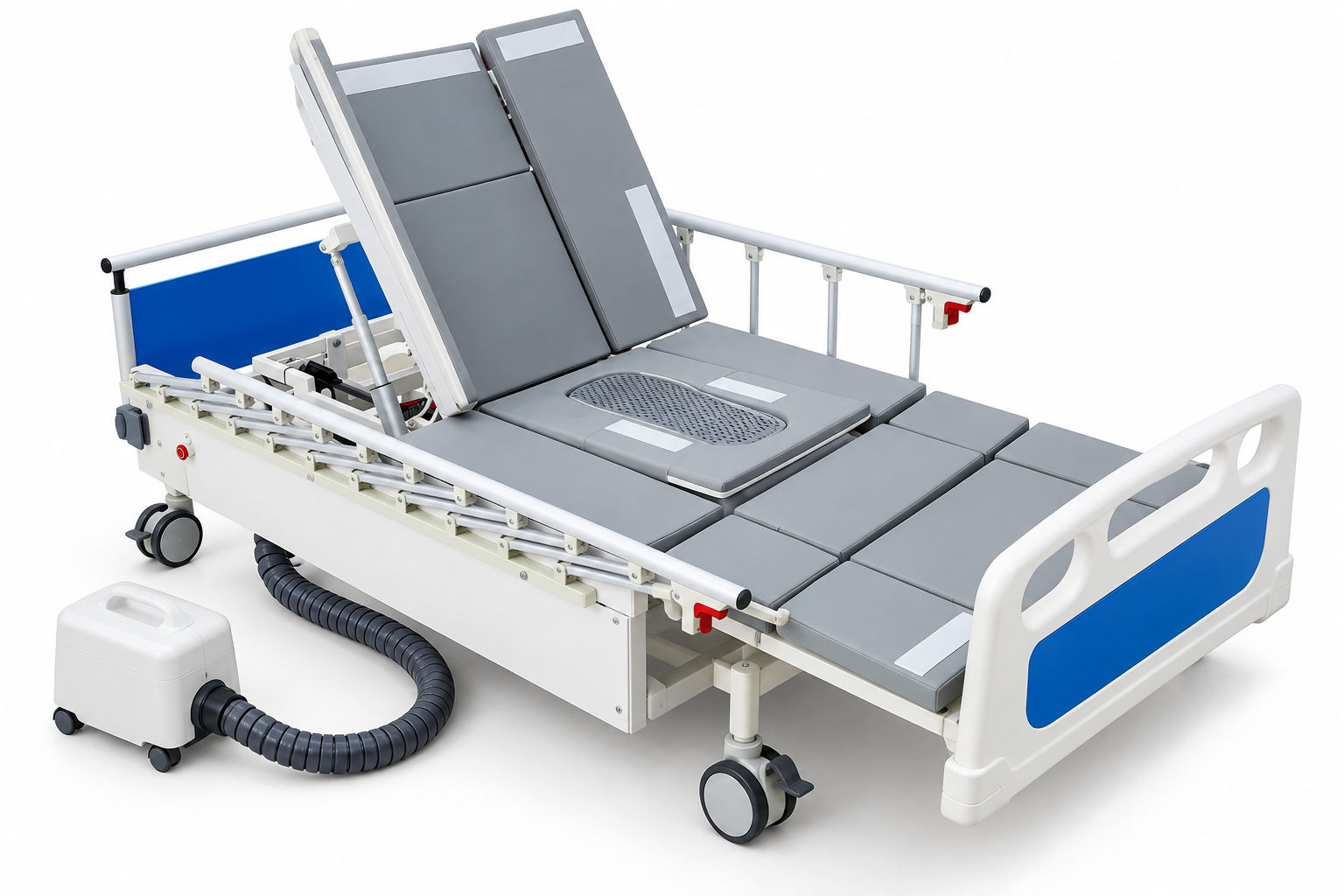
Use this checklist before approving a custom or private-label commode bed:
1. Define the product: bed model, commode design, and intended setting.
2. Specify operation: identify which functions are powered and which are manual.
3. Approve the complete configuration: bed, mattress, pan, controls, and accessories.
4. Confirm market requirements: electrical supply, labels, manuals, and regulatory documentation.
5. Review cleaning access: removable components, surfaces, joints, and agreed cleaning procedure.
6. Test a production-representative sample: operate and inspect the finished configuration.
7. Agree on quality criteria: dimensions, function, appearance, packaging, and acceptance records.
8. Check serviceability: spare parts, replacement pans, motors, controls, or other wear components.
9. Approve OEM branding: logo location, color, labels, and user documentation.
10. Conduct pre-shipment inspection: verify order quantity, accessories, functions, and export packaging.
- Comparing electric and mechanical systems without clarifying which functions are powered.
- Evaluating the bed without the final mattress and commode accessories.
- Assuming a powered system includes backup operation during a power outage.
- Choosing a design without checking how the pan is removed and cleaned.
- Ignoring operator training, spare parts, or local service requirements.
- Treating a standard product document as proof of compliance in every destination market.
- Approving bulk production before testing a representative finished sample.
- Comparison graphic: Electric versus mechanical operation, with powered/manual components labeled.
- Exploded product diagram: Bed frame, mattress opening, commode pan, and removable parts.
- Short demonstration video: Show the operating sequence and cleaning access, without identifying any patient.
- OEM checklist infographic: Summarize sample approval, testing, documentation, and shipment checks.
An electric system uses a powered actuator or motor for specified functions. A mechanical system relies on manual operation. Buyers should ask exactly which functions are powered, as designs vary.
Not necessarily. Powered movement may reduce effort for some tasks, but usability depends on the controls, operating sequence, cleaning access, training, and care environment.
That depends on the design. Confirm whether the model has a battery, manual release, or another backup method, and request instructions for the exact configuration.
Check access to the commode opening, pan, removable parts, joints, and contact surfaces. Confirm cleaning agents and procedures with the supplier for the finished product.
OEM options may include logo, color, labels, manuals, packaging, and selected accessories. Confirm customization limits and approve a production-representative sample before bulk orders.
Request the technical specification, drawings, operating and cleaning instructions, test records, spare-parts information, and applicable conformity documents for the target market.
The standard concerns basic safety and essential performance of medical beds as defined in the standard. Applicability to a particular product and market should be confirmed with a qualified regulatory specialist. [accessdata.fda]
Tianjin Kangli Medical Instrument works with overseas brands, wholesalers, and manufacturers on OEM hospital beds and medical furniture. Share your target market, preferred operating system, electrical requirements, commode configuration, accessories, branding, and packaging needs. Our team can help review the specification and discuss a sample-based evaluation before bulk procurement.
Contact us to request an OEM quotation, technical discussion, or product sample.
1. [Besco Medical — Commode Chairs] — Overview of commode chairs as accessible toileting options for people with limited mobility.
2. [Affinity Home Medical Equipment — What Is a Bedside Commode?] — General description of bedside commodes and their use.
3. [U.S. FDA — Recognized Consensus Standards: Medical Devices] — FDA listing for the medical-bed standard IEC 60601-2-52.


