

Views: 227 Author: Site Editor Publish Time: 2026-08-17 Origin: Site


Content Menu
● Why Compact Elevators Change the Buying Decision
● Foldable Wheelchair vs. Transfer Chair: Core Differences
● When a Foldable Wheelchair Is the Better Choice
>> Advantages for clinical operations
● When a Transfer Chair Is Better for Hospital Elevators
>> The hidden operational advantage
● Compact Elevator Measurement Checklist
>> Test with real people, not only a tape measure
● Safety Features That Matter Most
>> Prioritize these specifications
● OEM Recommendations from Tianjin Kangli Medical Equipment
>> OEM customization options to discuss
● Final Recommendation for Buyers
● FAQ
>> 1. What is the main difference between a foldable wheelchair and a transfer chair?
>> 2. Which chair is better for a narrow hospital elevator?
>> 3. Can a transfer chair be used for daily mobility?
>> 4. How do I measure whether a wheelchair will fit into an elevator?
>> 5. Are lighter transport chairs always safer for caregivers?
>> 6. What should OEM buyers ask a wheelchair manufacturer?
>> 7. Can Tianjin Kangli Medical Equipment Co., Ltd. provide customized OEM mobility solutions?
When comparing a foldable wheelchair vs. transfer chair for compact hospital elevator navigation, the right choice depends on more than folded size. Hospital procurement teams, medical distributors, and private-label mobility brands must balance elevator dimensions, patient independence, caregiver workload, turning clearance, safety, and total lifecycle durability.
At Tianjin Kangli Medical Equipment Co., Ltd., we help overseas brands, wholesalers, and manufacturers develop OEM mobility and hospital-care solutions for real clinical workflows. Founded in 1998, with a 20,000-square-meter factory and 50+ employees, Kangli brings a manufacturing-first perspective: a chair is not truly "compact" unless it performs reliably from the ward to the elevator, through narrow corridors, and back to storage.
A hospital elevator can become a mobility bottleneck. In older hospitals, outpatient clinics, rehabilitation centers, and nursing facilities, the car may be small, the entrance may be narrow, and traffic may include patients, caregivers, IV poles, equipment carts, and visitors.
The purchasing mistake is to compare only a chair's open overall width. In practice, safe elevator navigation depends on a complete set of measurements:
- Overall width when occupied, including armrests and hand position.
- Front-to-back length, including footrests.
- Turning ability at the elevator entrance.
- Door clear opening, not merely the elevator car's interior width.
- Caregiver clearance behind the chair.
- Folded dimensions for storage on the ward or in transport vehicles.
- Patient transfer workflow, especially when the chair is used between bed, examination room, and elevator.
A compact transport chair may fit easily through the door yet still create unsafe workflow issues if the patient needs to self-propel, sit for extended periods, or travel over uneven thresholds. Conversely, a foldable wheelchair may offer better autonomy but take more space during turning because of its large rear wheels.
Expert insight: The narrowest point in the route—not the largest space—should determine product selection. Measure the elevator door, lobby approach, corridor corners, ward doorway, and storage location before approving a chair specification.
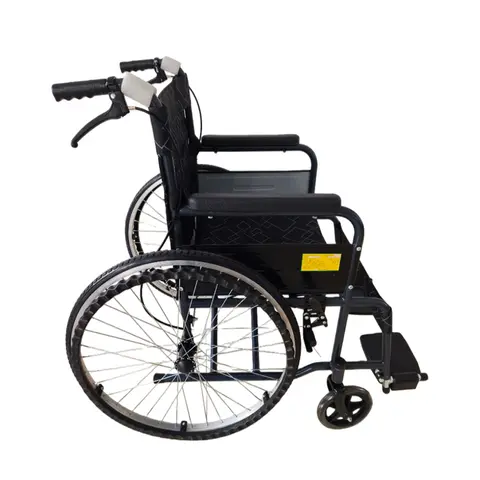
A foldable wheelchair usually has large rear wheels with hand rims. This lets the user propel themselves when they have sufficient upper-body strength, coordination, and clinical clearance.
A transfer chair is primarily designed for attendant propulsion. It generally uses four smaller wheels and is easier to lift, fold, store, and maneuver in confined environments. The trade-off is that the patient cannot independently move the chair over meaningful distances.
| Feature | Foldable Wheelchair | Transfer Chair |
|---|---|---|
| Primary user | Patient who may self-propel | Patient assisted by caregiver |
| Rear wheels | Large rear wheels, commonly 20–24 inches | Small wheels, commonly 8–12 inches |
| Independence | Higher | Lower; attendant required |
| Typical portability | Foldable, but often bulkier | Usually lighter and more compact |
| Elevator maneuverability | Good if width and turning radius are controlled | Often better in tight elevators and corridors |
| Long-duration seating | Generally more suitable | Better for short transfers and appointments |
| Caregiver lifting burden | Higher in many standard models | Lower in many lightweight models |
| Best-fit use case | Daily mobility, wards, rehab, independent users | Short transfers, diagnostics, discharge, clinic flow |
Transport chairs are usually intended for assisted, short-distance movement. Their smaller wheels reduce the chair's physical footprint and can make them materially easier to manage in crowded elevator workflows. In contrast, manual wheelchairs are designed around self-propulsion, which usually requires larger rear wheels and hand rims.
A foldable wheelchair remains the stronger option when patient autonomy is a clinical, operational, or brand priority. In rehabilitation, long-stay care, and settings where users frequently move independently within a ward, a self-propelled chair can reduce dependence on staff.
Choose a foldable wheelchair when the following conditions apply:
- The patient can safely self-propel for at least part of the journey.
- The chair will be used for prolonged daily sitting or frequent independent movement.
- The facility has sufficient elevator-door clearance and corridor turning space.
- The brand's market requires large rear wheels, hand rims, and greater user control.
- The product needs to support a broader range of home-care and rehabilitation scenarios.
A well-designed folding wheelchair gives the user more control over their position and movement. This can support dignity, reduce unnecessary caregiver calls, and improve the experience of patients who retain adequate mobility.
However, the specification must go beyond "folding frame." For compact hospital elevator use, assess:
- Overall open width with armrests and wheels.
- Removable or swing-away footrests to reduce effective length during entry.
- Quick-release rear wheels, where appropriate, for transport and storage.
- Wheel locks that can be engaged reliably by the user or caregiver.
- Anti-tippers, especially for patients with impaired balance or when using ramps.
- Upholstery cleanability and resistance to frequent institutional disinfection.
A self-propelled wheelchair can be folded for storage, but folding does not eliminate the need for enough space during use. Large rear wheels remain an advantage for independence and a constraint in tight elevator turns.
For compact hospital elevators, the transfer chair is often the more efficient operational tool. It is particularly effective for diagnostic transfers, outpatient visits, discharge assistance, post-procedure movement, and caregiver-led movement between floors.
Choose a transfer chair when:
- A caregiver will push the patient for the entire route.
- The main trip is short, frequent, and within a controlled facility.
- Elevator capacity is restricted or routes involve tight corners.
- Staff must lift the chair into vehicles or store it in limited spaces.
- Portability is more important than self-propulsion.
- The chair may be used for temporary or occasional patient transport.
Many lightweight transport chairs weigh approximately 15–25 lb, while standard manual wheelchairs can be substantially heavier because of their larger wheels and more robust self-propulsion structure. Actual product weights vary by material, seat size, features, and load capacity, so buyers should always verify the manufacturer's specification sheet rather than rely on a category average.
The benefit is not just that a transfer chair can be lighter. A lighter chair may reduce repetitive lifting strain for nurses, porters, family caregivers, and transport staff when chairs are folded, lifted, stored, or loaded into vehicles.
But lightweight construction should never mean under-specification. For institutional use, request OEM options that address:
- Reinforced cross-braces or frame joints for repeated folding cycles.
- Reliable attendant brakes and rear-wheel locking systems.
- Ergonomic push handles for staff of different heights.
- Puncture-resistant or maintenance-friendly tires.
- Flame-retardant, cleanable seat materials as required by the market.
- Clear patient weight-capacity labeling.
- Replaceable high-wear components, such as footrests, arm pads, brakes, and caster assemblies.
Before choosing between a foldable wheelchair and a transfer chair, complete a route survey. This is one of the most valuable steps an importer or private-label brand can add to its customer-facing purchasing guide.
1. Elevator door clear width
Measure the unobstructed opening when the doors are fully open. Door tracks, protective edges, and door sensors can reduce usable clearance.
2. Elevator car interior width and depth
Measure the actual usable floor area, excluding handrails or control panels that protrude into the cabin.
3. Approach corridor width
A chair may fit inside the elevator but struggle to line up with the doorway if the corridor is narrow or busy.
4. Turning area at the elevator entrance
Check whether a caregiver can turn the chair and still remain safely positioned behind it.
5. Chair dimensions in operating condition
Use the open chair dimensions with footrests, armrests, and required accessories installed—not only the folded size shown in a catalog.
For accessibility planning, a 30-by-48-inch clear floor area is commonly used as a wheelchair reference dimension in U.S. transportation accessibility guidance. That figure is not a substitute for an elevator-specific design review, but it is a practical baseline for identifying whether a space is likely to be restrictive.
A successful site test should include a patient proxy or weighted mannequin, a caregiver, and the same accessories expected in daily use. Ask the caregiver to enter, turn, brake, position the patient, exit, and repeat the process.
Record whether the operator can:
- Keep both hands safely on the handles.
- Avoid striking door edges, walls, or elevator controls.
- Apply brakes before the elevator moves.
- Maintain adequate clearance around footrests.
- Exit without pulling the chair backward at an unsafe angle.
- Fit an IV pole, oxygen support, or essential clinical accessory when required.
For hospital elevator navigation, the best chair is not simply the narrowest. It is the model that gives both patient and caregiver a predictable, controlled movement experience.
- Attendant braking: Essential on slopes, thresholds, and when stopping inside an elevator.
- Wheel locks: Must be easy to access and secure enough for transfers.
- Anti-tip design: Reduces backward instability, especially with bags or altered patient posture.
- Secure footrests: Footplates should not drag, strike door thresholds, or create trip hazards.
- Comfortable seat geometry: Seat width and depth should support the user without excessive lateral movement.
- Corrosion-resistant finishes: Important for cleaning routines and humid clinical environments.
- Clear load-capacity margin: The selected chair must match the intended patient population and use pattern.
- Serviceable parts: A replaceable caster or brake assembly can extend fleet life and reduce downtime.
For seat fitting, a commonly used practical guideline is to measure the patient's seated hip width and add roughly 1–2 inches for comfort and clothing. This should be treated as a starting point; clinical teams should assess posture, pelvic support, pressure risk, and individual needs.
At Tianjin Kangli Medical Equipment Co., Ltd., we recommend that mobility brands avoid treating hospital transport chairs as interchangeable commodity products. The winning OEM specification should be built around the intended route, patient group, service environment, and brand positioning.
Our manufacturing approach begins with these questions:
- Is this chair for independent mobility or caregiver-led transfer?
- What is the smallest elevator door and tightest corridor in the target customer's facility?
- How often will the chair be folded, stored, and lifted?
- What patient weight range and seat-width options are required?
- Which market certifications, materials, packaging, language labels, and instructions are needed?
- Will the chair be sold as a standalone product or as part of a broader hospital bed and patient-care equipment portfolio?
Kangli's experience in medical equipment manufacturing supports a broader view of patient movement: the chair, hospital bed, caregiver workflow, and facility space should work as one system. On our website, we document a European nursing-home project involving 1,200 ultra-low smart nursing beds, designed with a 20 cm ultra-low platform height, a 250 kg dynamic load capacity, and IEC 60601-2-52 anti-entrapment safety considerations. That project reflects the same design principle relevant to mobility products: safety features must support real caregiver workflows, not exist only on a specification sheet. [klmedbed]
- Private-label branding and color selection.
- Seat-width and load-capacity configurations.
- Aluminum or steel frame selection based on performance and target price.
- Custom packaging, manuals, warning labels, and barcode requirements.
- Institutional upholstery and cleaning-oriented material choices.
- Accessory integration, including leg rests, safety belts, storage bags, and IV-pole compatibility where appropriate.
- Quality-control checkpoints for folding mechanism, brake performance, caster rotation, frame alignment, and load testing.
For compact hospital elevator navigation, a transfer chair is usually the first option to evaluate when the patient will be pushed by staff and trips are short, frequent, and space-constrained. Its smaller wheels, lower lift burden, and typically more compact design can improve transport efficiency.
Select a foldable wheelchair instead when the patient needs independent propulsion, spends longer periods in the chair, or requires a more versatile mobility solution beyond assisted transport. Do not let "foldable" become the only purchasing criterion. The safest decision comes from matching chair geometry, patient needs, caregiver operation, and the narrowest point of the facility route.
Looking for an OEM foldable wheelchair or transfer chair designed for your market? Contact Tianjin Kangli Medical Equipment Co., Ltd. to discuss private-label development, technical specifications, manufacturing capability, and quality requirements.
- Email: [yukili90@tjkangli.com](mailto:yukili90@tjkangli.com)
- Phone/WhatsApp: +86 136 5207 7555
- Website: [www.klmedbed.com]
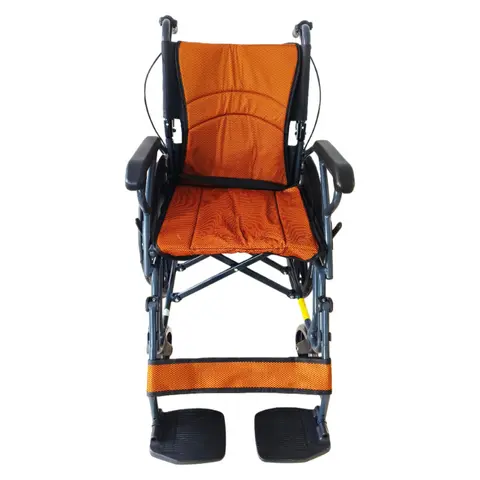
A foldable wheelchair generally has large rear wheels and hand rims so the user can self-propel. A transfer chair has small wheels and is designed to be pushed by a caregiver.
A transfer chair is often better for a narrow elevator because it is typically lighter, shorter in practical operation, and easier for a caregiver to maneuver. However, the final choice should be based on measured door width, elevator depth, turning area, patient needs, and accessory requirements.
It can be used for daily assisted transport, but it is usually not the right solution for a user who needs to self-propel or remain seated for extended periods. For daily independent mobility, a properly fitted manual wheelchair is usually more appropriate.
Measure the elevator door's clear opening, interior width and depth, the approach corridor, turning space, and the chair's open dimensions with footrests and accessories installed. Perform a live maneuverability test with a caregiver whenever possible.
Not necessarily. A lighter chair may reduce lifting effort, but safety also depends on frame stability, brake quality, wheel performance, handle ergonomics, patient weight capacity, and the chair's condition after repeated use.
Ask about open and folded dimensions, net weight, maximum user weight, frame material, brake type, caster durability, upholstery, testing process, quality-control procedures, certifications for the destination market, replacement-parts support, packaging, and private-label options.
Yes. Kangli works with overseas brands, wholesalers, and manufacturers on OEM medical equipment requirements, including product specifications, branding, packaging, quality expectations, and market-focused customization.
1. Tianjin Kangli Medical Equipment Co., Ltd. "Kangli Medical: Hospital Bed Manufacturer China." [https://www.klmedbed.com/]
2. All Care Medical Transport. "Transport Chair vs Wheelchair: Key Differences & When to Use Each." [https://allcaremedicaltransport.com/feeds/blog/transport-chair-wheelchair]
3. Eclipse Care. "Transport Chairs for Elderly: How to Choose the Right One." [https://eclipse.care/transport-chairs-for-elderly-what-actually-works-and-what-most-families-get-wrong/]
4. Affinity Home Medical Equipment. "Transport Wheelchair vs Standard Wheelchair." [https://affinityhomemedicalequipment.com/transport-wheelchair-vs-standard-wheelchair/]
5. DME Superstore. "Transport Wheelchair vs. Standard Wheelchair." [https://dmesuperstore.com/blogs/news/transport-wheelchair-vs-standard-wheelchair]
6. Swift Aid Transport. "What Is ADA Wheelchair Transportation?" [https://www.swiftaidtransport.com/post/what-is-ada-wheelchair-transportation]
7. Call the Care. "How to Safely Transport Patients in Wheelchairs." [https://www.callthecare.com/blog/how-to-safely-transport-wheelchair-patients-in-a-vehicle]
8. Garvee. "Transport Wheelchair vs. Manual Wheelchair." [https://www.garvee.com/blogs/buying-guides/transport-wheelchair-vs-manual-wheelchair]
Hot Tags: China, Global, OEM, private label, manufacturers, factory, suppliers, manufacturing company


