

Views: 255 Author: Tianjin Kangli Publish Time: 2026-09-22 Origin: Site


Content Menu
● Quick Answer: Manual vs. Electric Hospital Beds
● What Is the Difference Between Manual and Electric Hospital Beds?
>> Manual Hospital Beds: Core Strengths
>> Electric Hospital Beds: Core Strengths
● Why General Wards Often Prefer Electric Hospital Beds
>> 1. Better Nursing Ergonomics and Workflow
>> 2. More Support for Patient Independence
>> 3. More Adaptable Bed Allocation
>> 4. Stronger Positioning Options for Premium Ward Programs
● When a Manual Hospital Bed Is the Better Choice
>> Choose Manual Beds When These Conditions Apply
>> Manual Does Not Mean Basic Quality
● A Practical Selection Framework for General Wards
>> 1. Define the Patient Profile
>> 2. Map the Nursing Workflow
>> 3. Calculate Total Cost of Ownership
>> 4. Confirm Power, Safety, and Maintenance Readiness
>> 5. Build the Right Product Specification
● Common Buying Mistakes to Avoid
>> Mistake 1: Selecting by Unit Price Alone
>> Mistake 2: Over-Specifying Every Bed
>> Mistake 3: Ignoring Mattress and Side-Rail Compatibility
>> Mistake 4: Skipping Service and Spare-Part Planning
● Why Work With Tianjin Kangli for Hospital Bed OEM Projects?
● FAQs
>> 1. Are electric hospital beds better than manual hospital beds?
>> 2. What type of hospital bed is best for a general ward?
>> 3. Do electric hospital beds reduce nurse injuries?
>> 4. Are manual hospital beds suitable for hospitals?
>> 5. What functions should an electric general ward bed include?
>> 6. Can hospital-bed manufacturers provide OEM branding?
>> 7. What should buyers check before ordering hospital beds from China?
Manual or electric hospital bed: which is better for general wards? For most high-turnover general wards, the best choice is rarely based on purchase price alone. The right hospital bed depends on patient acuity, nursing workflow, staff safety objectives, maintenance capacity, infection-control routines, and the total cost of ownership over the product's service life.
At Tianjin Kangli Medical Equipment Co., Ltd., we approach this question as a hospital-bed OEM manufacturer, not as a one-size-fits-all seller. Founded in 1998, with a 20,000-square-meter factory and a team of 50+ employees, Kangli supports overseas medical brands, wholesalers, distributors, and manufacturers with practical OEM hospital bed solutions. In our experience, manual beds remain highly relevant in cost-sensitive and lower-acuity wards, while electric hospital beds usually deliver stronger workflow, ergonomic, and patient-independence advantages in busy general-care environments.
The most suitable bed is the one that helps the ward deliver safer, faster, more consistent care—without creating avoidable maintenance, training, or procurement burdens.
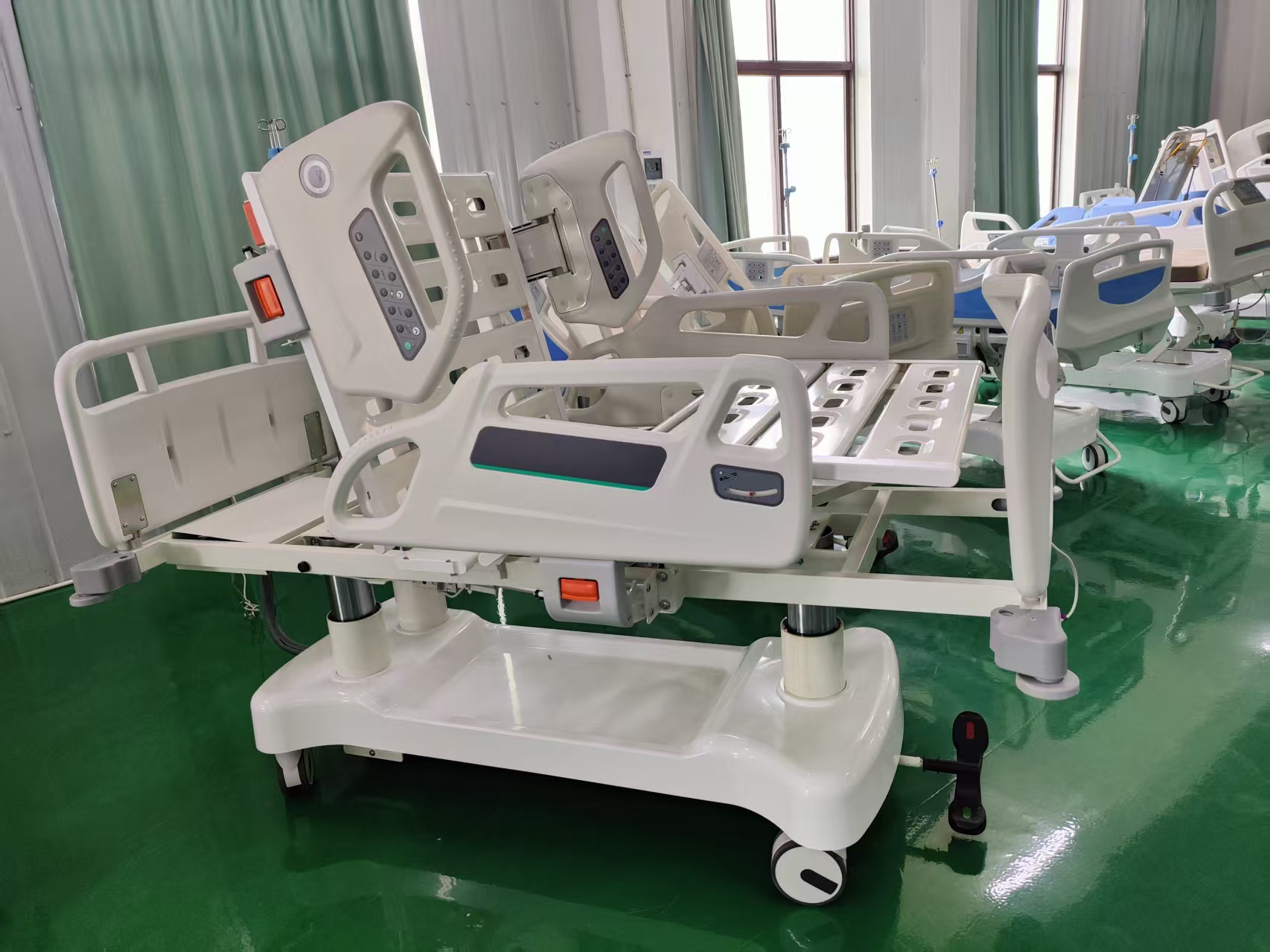
For many general wards, an electric hospital bed is the better long-term clinical and operational choice when the facility has reliable electrical infrastructure, appropriate maintenance support, and a patient population that frequently needs repositioning or assistance with mobility.
However, a manual hospital bed can be the better procurement choice when the ward prioritizes simple operation, lower upfront cost, reduced dependence on electrical components, and reliable use in environments with limited service resources.
| Decision factor | Manual hospital bed | Electric hospital bed |
|---|---|---|
| Initial purchase cost | Usually lower | Usually higher |
| Adjustment method | Hand cranks or mechanical mechanisms | Electric motors and handset controls |
| Nursing workload | More physical effort for repeated adjustments | Faster height and positioning adjustments |
| Patient independence | More limited | Often improved for suitable patients |
| Power dependence | No continuous electrical power required | Requires power and backup planning |
| Maintenance | Simpler mechanical servicing | Motors, controls, batteries, and electrical components require support |
| Best fit | Budget-conscious wards, emergency reserve, low-resource settings | High-turnover general wards, rehabilitation, long-stay and mobility-focused care |
| OEM customization potential | Frame, crank configuration, rails, finishes, branding | Functions, controls, rails, batteries, bed positions, branding and accessories |
The practical answer: General wards should not choose only "manual" or only "electric" as a blanket policy. A well-designed procurement mix often works best: electric beds for patient-facing areas with high repositioning needs, plus manual beds for selected departments, contingency use, or markets where simplicity is a major purchasing requirement.
A manual hospital bed uses hand-operated cranks or mechanical levers to adjust sections of the bed, commonly including the backrest, knee section, and sometimes bed height. These beds are valued for their straightforward design, lower purchasing cost, and reduced reliance on electricity.
An electric hospital bed uses motors to control one or more movements. Depending on the configuration, the bed may provide electric backrest adjustment, knee adjustment, high-low height movement, Trendelenburg positioning, reverse Trendelenburg positioning, and other patient-care functions. Controls may be operated by the patient, caregiver, or both.
For general wards, the difference is not simply about convenience. It changes the way nurses work, how easily patients can reposition themselves, how consistently the ward can set safe working heights, and how efficiently the bed supports daily care tasks.
Manual beds can be highly effective when the clinical need is straightforward and the facility needs durable, accessible equipment.
Key advantages include:
- Lower upfront investment, helping hospitals equip more beds within a limited capital budget
- Simple mechanical operation, which can reduce dependence on electronic components
- Useful during power interruptions, especially where emergency power coverage is limited
- Easier troubleshooting for facilities with basic maintenance capabilities
- Suitable for lower-acuity patients who do not require frequent height adjustments or complex positioning
- Strong option for OEM projects requiring cost control, private-label branding, packaging customization, and market-specific configurations
A manual bed is not an inferior bed by definition. It is a different clinical and operational tool. A well-built two-crank or three-crank manual hospital bed can provide dependable backrest and leg-rest positioning for many general-care applications.
Electric hospital beds are designed to reduce the friction of repeated bed adjustments. In a busy ward, that difference can add up across dozens of patients and hundreds of adjustment events every day.
Important benefits include:
- Faster positioning for nursing care, examinations, meals, transfers, and mobility support
- Electric high-low adjustment, allowing caregivers to set a more appropriate working height
- Improved patient participation, when patients are clinically able to use controls safely
- More consistent positioning, reducing reliance on manual crank operation
- Greater flexibility for facilities serving mixed patient-acuity levels
- Better differentiation for private-label hospital-bed brands, especially in competitive tenders and distributor markets
Research comparing electric and manually operated patient beds has found that electrically powered functions can reduce certain physical demands on nursing staff, particularly for bed movements completed by the motorized mechanism. The evidence also shows an important limitation: electric beds do not eliminate every patient-handling risk. Transfers, turning, repositioning, and assisting highly dependent patients may still require proper procedures and additional handling equipment.
General wards operate under continuous pressure. Nurses manage medication rounds, observations, meals, patient movement, hygiene care, documentation, admissions, discharges, and family communication—often while caring for patients with very different mobility levels.
In this environment, electric beds can improve the usability of the entire care space.
Repeated bending, reaching, repositioning, and adjusting equipment can contribute to caregiver fatigue. An electric hospital bed does not replace safe patient-handling practices, but it can help nurses bring the mattress platform to a more workable height before providing care.
This matters during:
- Wound care and skin inspection
- Bed bathing and hygiene procedures
- Linen changes
- Patient assessment
- Mobilization preparation
- Feeding support
- Transfer preparation
Studies examining nursing tasks have reported that electric beds can reduce subjective effort and certain ergonomic loads compared with hydraulic or manual alternatives, although real outcomes still depend on patient dependency, staff training, and workflow design. [pubmed.ncbi.nlm.nih]
Expert perspective: Procurement teams should avoid assuming that an electric bed alone solves staff-injury risk. The bed should be evaluated as part of a broader safe-patient-handling system that may include transfer aids, lifting equipment, training, and adequate staffing.
For suitable patients, the ability to raise the backrest or adjust the bed position with a handset can encourage participation in daily care. That may support eating, reading, communication, respiratory comfort, and preparation for mobilization.
Electric beds can be particularly useful for patients who are weak but still able to understand and operate basic controls. In practice, this can reduce some small but frequent requests for assistance and improve the patient's sense of control.
However, hospitals should assess whether patient-operated controls are appropriate for their patient population. Patients with confusion, severe cognitive impairment, certain neurological conditions, or mobility restrictions may require caregiver-controlled settings or lockout features.
A general ward does not always receive the same type of patient. One day, the bed may support a post-operative patient who needs regular positioning. The next day, it may be used for an older adult with limited mobility or a patient undergoing rehabilitation.
Electric beds provide a broader functional range. This makes them valuable when bed utilization is high and patient needs change frequently.
For hospital brands, distributors, and project suppliers, electric bed configurations can offer a clearer product ladder. A standard electric ward bed may include three or five functions, while higher-specification models can add features such as:
- Electric high-low adjustment
- Trendelenburg and reverse Trendelenburg
- Central locking castors
- Nurse control panels
- Battery backup
- CPR release mechanisms where applicable
- Adjustable side rails
- Integrated IV pole locations
- Bed extension options
- Under-bed storage or accessory holders
At Kangli, we advise OEM customers to select functions based on the ward's actual patient-care process—not simply because a feature looks advanced on a product sheet.
Choosing a manual hospital bed can be a rational, strategic decision. It is often the right answer when reliability, affordability, and simplified maintenance are more important than high-frequency powered adjustment.
A manual hospital bed may be the better option when:
- The ward has limited capital expenditure
- The facility experiences unreliable power supply
- Local service teams have limited access to electrical spare parts
- The bed will be used in lower-acuity care settings
- Adjustment frequency is relatively low
- The buyer needs a simple, rugged product for distribution or tender projects
- The market prioritizes straightforward operation and a lower total acquisition cost
- The hospital needs reserve beds for surge capacity, emergency use, or temporary wards
For example, a regional hospital may equip high-turnover medical and surgical wards with electric beds while choosing two-crank manual beds for overflow capacity, temporary units, or facilities where service infrastructure is more limited.
A quality manual hospital bed still requires careful engineering. Buyers should assess:
- Frame strength and weld quality
- Mattress platform stability
- Crank smoothness and durability
- Side-rail safety and operation
- Castor mobility and locking performance
- Headboard and footboard attachment
- Surface coating and corrosion resistance
- Ease of cleaning
- Pinch-point awareness
- Spare-part availability
- Clear user instructions and labeling
The best manual bed is not the cheapest model. It is the model that maintains safe, repeatable performance over years of clinical use.
Instead of asking, "Which bed is better?" procurement teams should ask, "Which bed configuration best supports this ward's patient population and operating model?"
Use the following five-step framework before placing a hospital-bed order.
Review the expected mix of patients:
- Are most patients ambulatory, partially dependent, or fully dependent?
- How often do patients require repositioning?
- Are post-operative, elderly, respiratory, orthopaedic, or rehabilitation patients common?
- Will patients be expected to operate the controls independently?
- Are bariatric, pediatric, or isolation requirements involved?
The higher the proportion of patients needing frequent positioning and assistance, the stronger the case for electric functionality.
Observe how staff actually use beds during a normal shift. Focus on real work rather than assumptions.
Ask:
- How many times per patient per day is bed height adjusted?
- How often do nurses reposition patients?
- Are nurses repeatedly bending during care tasks?
- Are beds moved frequently between rooms or departments?
- Are patients routinely prepared for transfers from the bed?
- Do staff need quick emergency access to controls or CPR-related functions?
This workflow review identifies where electric adjustment may produce meaningful operational value.
Do not compare only the quoted unit price. Compare the full lifecycle cost.
Include:
| Cost category | Manual bed considerations | Electric bed considerations |
|---|---|---|
| Purchase price | Lower entry cost | Higher initial investment |
| Maintenance | Mechanical wear, cranks, castors, rails | Motors, handsets, control boxes, batteries, castors, rails |
| Downtime risk | Often easier to keep operational | Requires spare-part and service planning |
| Staff time | More manual adjustment effort | Faster repeated adjustments |
| Training | Simple mechanical training | Patient and nurse control training required |
| Product positioning | Value-driven and essential-care markets | Mid- to premium-tier ward and care environments |
A bed with a lower purchase price may cost more operationally if staff repeatedly lose time making adjustments or if the product does not match the clinical requirement. Conversely, a high-function electric bed may be unnecessary if its features are rarely used.
Before selecting electric hospital beds, confirm:
- The availability and reliability of electrical outlets
- Backup-power and battery requirements
- Electrical safety testing procedures
- Preventive maintenance schedules
- Access to trained technicians
- Spare-part stocking plans
- Cleaning and infection-control protocols
- Control lockout requirements
- Emergency-release and manual override expectations
A good electric bed program includes a service plan from day one. It should not be treated as a one-time equipment purchase.
For OEM buyers, the specification stage is where clinical usability becomes a market-ready product.
A general ward electric bed specification may include:
- Three-function or five-function movement
- Electric backrest and knee-rest adjustment
- Electric high-low height adjustment
- Central locking castors
- Aluminum-alloy or ABS side rails
- Removable ABS headboard and footboard
- IV pole locations
- Mattress retainers
- Optional battery backup
- Private-label logo, cartons, manuals, labels, and color options
A manual general ward bed may include:
- Two-crank or three-crank adjustment
- Durable steel frame and powder-coated surface
- ABS headboard and footboard
- Foldable side rails
- High-quality castors with braking
- IV pole and drainage hook provisions
- Customized packaging and brand identification
The lowest quotation can create long-term problems if the bed has poor usability, difficult maintenance, weak components, or insufficient spare-part support.
Better approach: Compare the product against clinical needs, expected service life, maintenance plan, and staff workflow.
Not every general ward requires a highly complex electric bed with every premium feature.
Better approach: Create a tiered product plan. For example, standard electric beds for core wards, enhanced models for higher-acuity areas, and manual beds for appropriate low-demand applications.
The bed frame, mattress, rails, and accessories must work together. A poorly matched mattress can affect patient comfort, cleaning, mobility, and side-rail performance.
Better approach: Review the full bed system rather than purchasing components in isolation.
Electric beds need a realistic service pathway. Without it, a minor handset or motor issue can take a bed out of use for too long.
Better approach: Ask the manufacturer about recommended spare parts, service documentation, warranty terms, inspection points, and replacement lead times before ordering.
At Tianjin Kangli Medical Equipment Co., Ltd., we help international healthcare brands and distributors turn ward requirements into practical OEM hospital-bed solutions. Our goal is not to push a generic bed model. Our goal is to help buyers specify a product that fits their market, clinical application, target price point, and after-sales capability.
Our OEM support can include:
- Manual and electric hospital bed configurations
- Private-label branding
- Customized product specifications
- Logo, color, label, manual, and packaging customization
- Accessory and functional options
- Export-oriented production support
- Product planning for distributors, wholesalers, tenders, and healthcare projects
With more than two decades of manufacturing experience, Kangli understands that successful hospital-bed sourcing depends on more than appearance. Buyers need stable construction, practical functions, usable safety details, clear documentation, and a configuration that makes commercial sense in their target market. Kangli positions its OEM services around defining the care environment, selecting functions, and reviewing safety and usability details such as side rails, castors, stability, mattress platforms, control accessibility, cleaning, and labeling. [klmedbed]
Need help choosing manual or electric hospital beds for your general-ward project? Contact Tianjin Kangli Medical Equipment Co., Ltd. to discuss your target market, required functions, branding needs, and order specifications.
- Website: [www.klmedbed.com]
- Email: [yukili90@tjkangli.com](mailto:yukili90@tjkangli.com)
- Phone / WhatsApp: +86 136 5207 7555
Electric hospital beds are generally better for busy general wards that need frequent patient positioning, adjustable working height, and improved workflow efficiency. Manual beds can be better for lower-acuity settings, budget-sensitive projects, emergency reserve use, or facilities with limited electrical service support.
A three-function or five-function electric hospital bed is often a strong choice for general wards because it supports backrest, knee-rest, and height adjustment. However, the best choice depends on patient dependency, nursing workload, power reliability, budget, and maintenance resources.
Electric beds can reduce physical effort for bed movements that are fully motorized, particularly height and positioning adjustments. However, they do not replace safe patient-handling procedures, adequate staffing, training, transfer equipment, or lifting aids for highly dependent patients. [academic.oup]
Yes. Manual hospital beds remain suitable for many hospitals, especially for lower-acuity wards, surge capacity, community facilities, value-focused projects, and regions where simple maintenance and power independence are priorities.
A typical electric general ward bed should be evaluated for electric backrest adjustment, knee-rest adjustment, high-low height movement, safe side rails, reliable castors and brakes, removable headboards and footboards, IV pole provisions, mattress retainers, and optional battery backup. Higher-acuity applications may need additional positioning functions.
Yes. An OEM hospital-bed manufacturer can support private-label requirements such as product logos, colors, manuals, labels, cartons, accessories, and selected functional configurations. Tianjin Kangli provides OEM and customization support for healthcare brands, wholesalers, distributors, and manufacturers. [klmedbed]
Buyers should check product specifications, material quality, functional configuration, safety features, castor and side-rail design, cleaning practicality, documentation, packaging, customization options, quality-control process, spare-part availability, warranty terms, and export experience. They should also request clear confirmation of the final approved specification before mass production.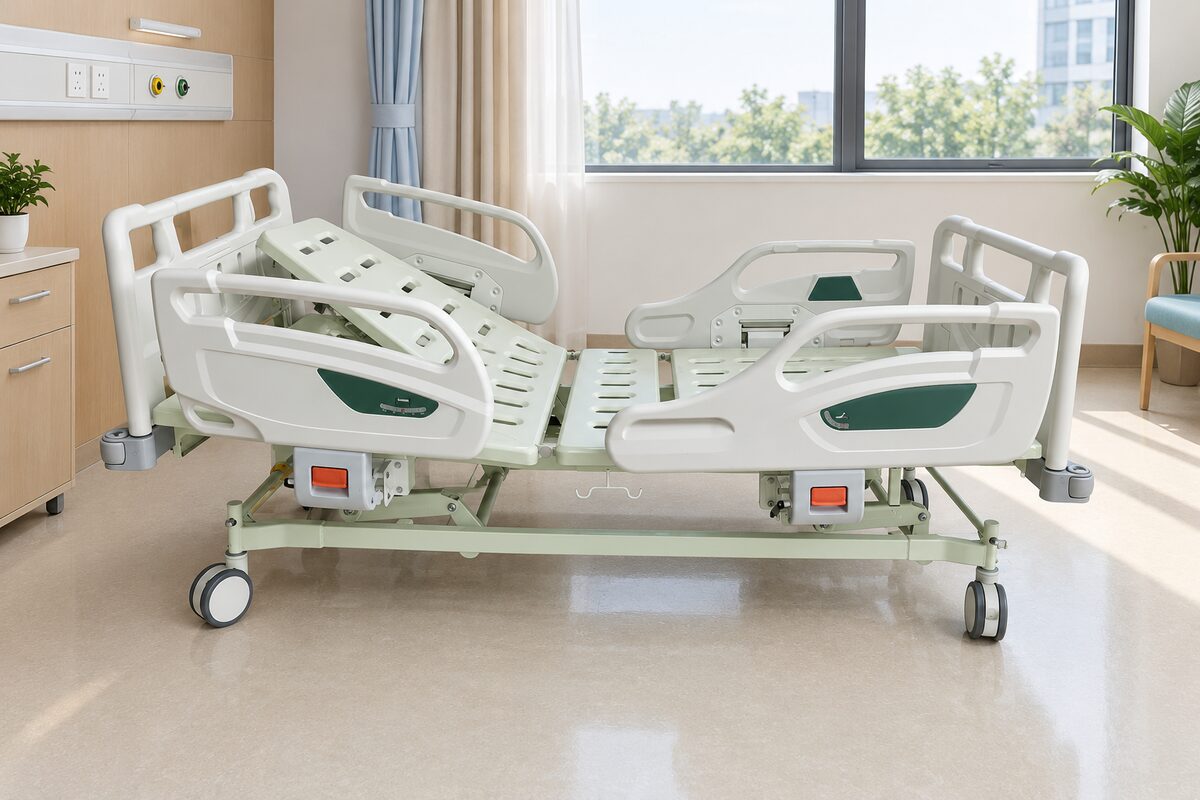
1. [PubMed — Let the bed take the strain: An ergonomic approach to hospital bed provision]
Discusses an ergonomic approach to hospital-bed selection and notes that electrically operated beds can reduce patient-handling episodes and support patient independence. [pubmed.ncbi.nlm.nih]
2. [Occupational Medicine — Do electric patient beds reduce the risk of lower back disorders in nurses?]
Reports statistically significant reductions in estimated lower-back-disorder probability for some tasks completed electrically, while emphasizing that not all acute-ward handling tasks show the same risk reduction. [academic.oup]
3. [PMC — Effectiveness of Safe Patient Handling Equipment and Interventions]
Reviews evidence on patient-handling equipment and explains why powered lifts and transfer aids remain important alongside bed selection. [pmc.ncbi.nlm.nih]
4. [PubMed — Electric versus hydraulic hospital beds: differences in use during basic nursing tasks]
Examines ergonomic, postural, and workload differences for nurses using electric versus hydraulic hospital beds. [pubmed.ncbi.nlm.nih]
5. [Tianjin Kangli Medical Equipment — Hospital Bed Manufacturer in China: OEM Partner for Global Buyers]
Provides company-focused information on Kangli's OEM/ODM and export-oriented hospital-bed manufacturing support. [klmedbed]
6. [Tianjin Kangli Medical Equipment — Hospital Bed OEM Manufacturing Guide]
Details Kangli's approach to defining care environments, selecting functions, and reviewing safety and usability details for OEM hospital-bed projects. [klmedbed]
Hot Tags: China, Global, OEM, private label, manufacturers, factory, suppliers, manufacturing company


