

Views: 421 Author: kangli Publish Time: 2026-11-06 Origin: Site


Content Menu
● Wheelchair Carton Labeling for Export: Model Codes, Barcodes and Packing List Accuracy
>> Why Wheelchair Carton Labels Matter More Than They Seem
>> How to Build a Clear Wheelchair Model Code
>> Barcodes for Wheelchair Cartons: ITF-14, GS1-128 or Your Own Code?
>>> Who Owns the Barcode Number?
>>> Test the Print, Not Just the Screen
>> UDI and Carton Labels: What EU Importers Should Check
>> What to Print on an Export Wheelchair Carton
>> Packing List Accuracy: The Rules That Prevent Delays
>>> Five Checks Before You Issue the Packing List
>> Mixed Orders and Pallets: Keep Traceability Clear
>> A Simple Label Approval Process for OEM Orders
>> Plan Your Export Wheelchair Labels with Kangli
>>> What should be printed on a wheelchair export carton?
>>> Which barcode is best for wheelchair cartons?
>>> Does every wheelchair carton need a UDI?
>>> Why must the packing list match the invoice?
>>> What is the HS code for a manual wheelchair?
>>> Can a factory print my own barcode on OEM cartons?
>> References
By Yuki, head of export at Tianjin Kangli Medical Appliance Co., Ltd.
Planning an export wheelchair order? Talk to our export team directly.WhatsApp: +86 136 5207 7555Email: yukili90@tjkangli.comWebsite: www.klmedbed.com
Wheelchair carton labeling for export decides how easily your goods move through customs, warehouses and hospital receiving docks. A clear model code, a working barcode and an accurate packing list let every team identify a carton in seconds. A wrong label can turn a good shipment into a slow recount.
I run the export department at Kangli, a family-owned Tianjin manufacturer founded in 1998. We make wheelchairs, hospital beds and medical stainless steel products, and we provide OEM services for overseas brands, wholesalers and manufacturers. This guide shows importers and distributors how to set up model codes, barcodes and packing list accuracy before the first carton is printed.
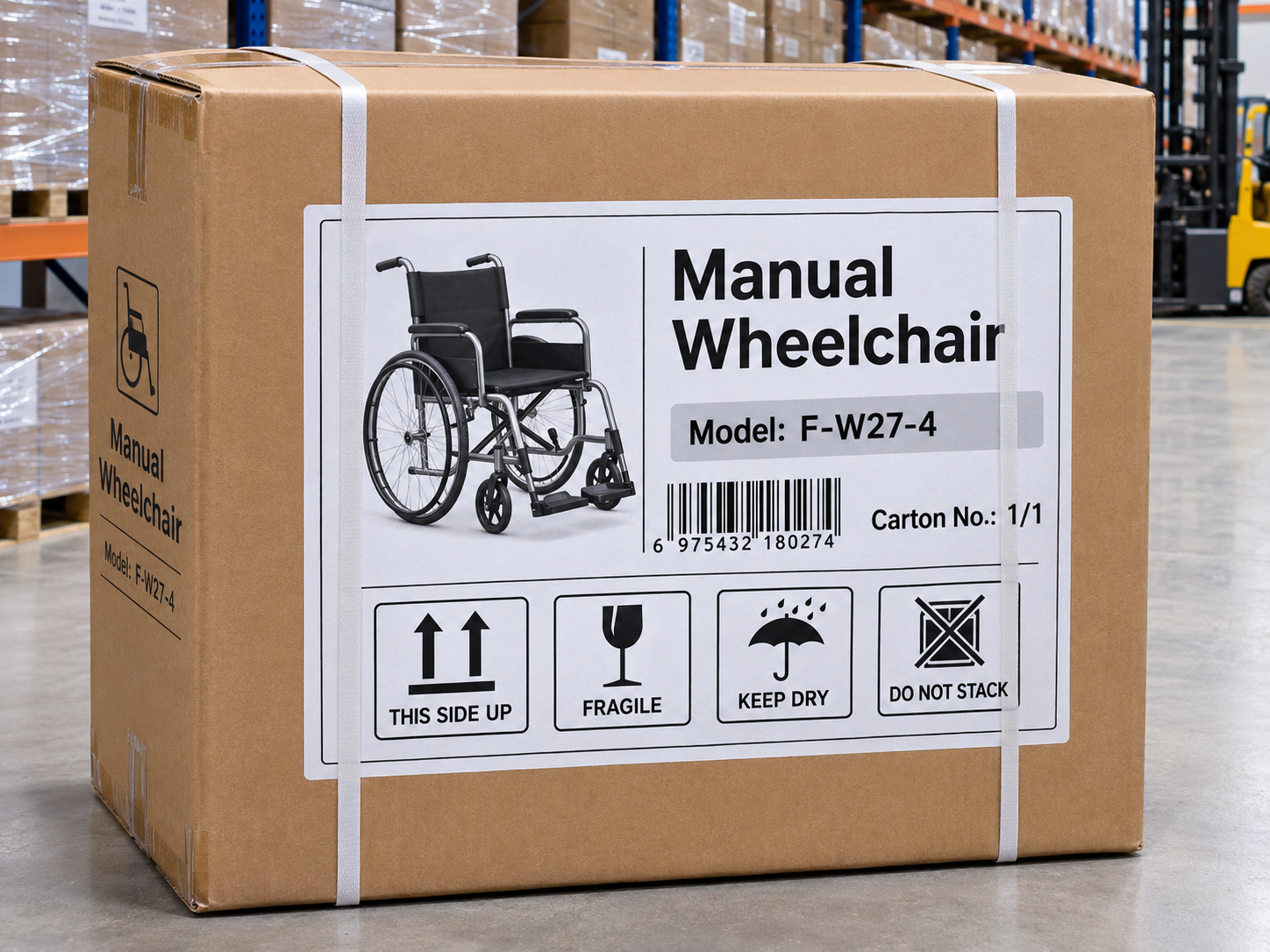
A carton label connects the physical chair to every document in the shipment. A guide from Racklify explains that customs compares the packing list with the commercial invoice and manifest to confirm the shipment matches what was declared. Officers check quantities, weights, carton counts and packaging types [1].
It adds that gaps between documents can trigger exams, which add lead time and handling costs. Customs may also select specific cartons for physical checks, so sequential carton numbers help inspectors find them [1].
Wheelchairs add three challenges of their own:
Similar cartons. Two seat widths can look almost the same from the outside.
Many variants. Model, size, tyre, colour and brand can all change.
Regulated products. Labels may also need to support device identification rules.
The carton must tell people what is inside without opening it.
A good model code is short, consistent and impossible to confuse. Decide the structure once, then use it on the purchase order, carton, invoice, packing list and warehouse system.
Here is an example structure. It is invented for illustration.
| Code part | Meaning | Example |
|---|---|---|
| Product family | Standard steel wheelchair | SW |
| Model | Model number | 200 |
| Seat width | 46 cm | 46 |
| Wheel type | Solid rear tyre | S |
| Brand or version | Client brand A, version 1 | A1 |
Full code: SW-200-46-S-A1
Follow these rules:
Give every variant its own code. If a customer could notice the difference, it needs a new code.
Avoid similar characters. The letters O and I are easily mistaken for 0 and 1.
Keep the same code everywhere. Never use a nickname on the invoice.
Record changes. A changed part or carton quantity should be reviewed before the code is reused.
Map your codes to the factory's. For OEM orders, keep one table linking your code with the factory code.
The right barcode depends on what the scanner needs to read. Start by asking your warehouse, your customers and your logistics partners what they use. Here is how the common GS1 options compare, based on GS1 India and GS1 Sweden [2][3].
| Barcode | What it carries | Typical use |
|---|---|---|
| ITF-14 | GTIN-14 only | Outer cartons, and designed for direct printing on corrugated board |
| GS1-128 | GTIN plus data such as batch and dates, or an SSCC | Cases, pallets and logistics labels |
| EAN-13 | GTIN | Packaging scanned at a retail checkout |
GS1 Sweden advises using a GTIN-13 if a case will be read at checkout, and a GTIN-14 if it will not [3].
For wheelchairs sold through warehouses and hospitals, the choice often comes down to one question: do you need batch or date data in the barcode? If you do, ITF-14 cannot carry it [2].
Do not invent a number that only looks correct. GTINs are issued within the GS1 system. For OEM orders, agree who holds the company prefix and who assigns each number. A brand owner often wants its own number on the carton, but the factory then needs the approved list before printing.
Also check the number at every stage:
Before artwork approval: Match each barcode number to its model code.
Before mass printing: Scan a printed sample with a real scanner.
Before loading: Scan random cartons from the finished goods.
A barcode that looks fine on a computer can fail on brown corrugated board. GS1 Singapore explains that a verification report checks colour, contrast, size, light margin, bar width and check digit, with one-dimensional symbols tested under ISO 15416 [4].
A normal scan only tells you it failed or passed. Verification explains why, so you can correct it before printing thousands of cartons [4]. Pay attention to these points:
Dark bars on a light background
Clear space on both sides of the barcode
Enough room away from carton edges and folds
Good print quality on the actual board
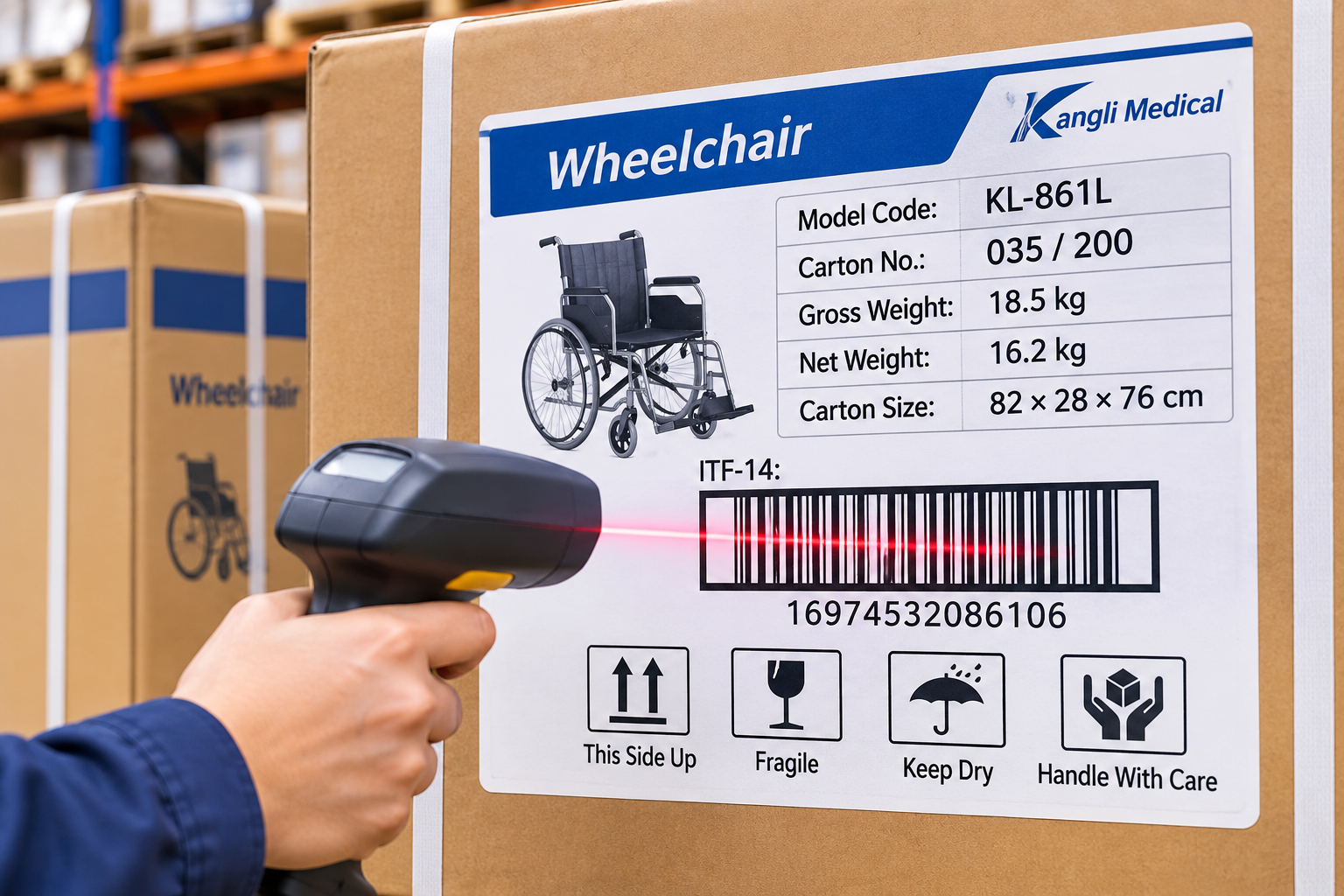
A logistics barcode and a UDI do different jobs. A logistics barcode helps goods move through the supply chain. A UDI identifies a medical device under the regulatory system.
Annex VI, Part C of the EU MDR says the UDI carrier goes on the label or on the device itself, and on higher levels of packaging. It also says that higher levels do not include shipping containers [5]. The EU UDI helpdesk adds that higher packaging levels need their own unique UDI [6].
This creates a practical question: is your carton a device package or a shipping container?
A September 2026 guide to UDI packaging levels gives a helpful test. It says a shipping container is exempt only when its contents vary between shipments. A fixed-quantity master carton of identical units is treated as a regulated package [7]. The same guide says changing a package quantity generally requires new identifiers at that level and above [7].
Keep it simple with your team:
| Carton type | Likely treatment | Action |
|---|---|---|
| One chair in one carton | Device packaging | Confirm the UDI requirements with the manufacturer |
| Fixed-quantity master carton | May be a packaging level | Check whether it needs its own UDI |
| Mixed pallet or changing contents | May be a shipping container | Use logistics labels as agreed |
This table is a starting point, not a legal ruling. The legal manufacturer decides the UDI structure, so ask for it in writing. For private-label orders, also check who is the legal manufacturer. If you sell outside the EU, confirm local label and language rules with your representative.
Need your carton label plan checked? Send your model list and destination to Yuki on WhatsApp: +86 136 5207 7555, email yukili90@tjkangli.com, or visit www.klmedbed.com.
Every carton should answer the same questions in the same place. Use a fixed template, so warehouse teams know where to look.
| Field | Example |
|---|---|
| Consignee mark | ABC / ROTTERDAM |
| Order number | PO 2026-118 |
| Model code | SW-200-46-S-A1 |
| Product name | Manual wheelchair, 46 cm |
| Quantity | 1 unit |
| Carton number | C/No. 15 of 120 |
| Gross and net weight | 18.5 kg / 16.0 kg |
| Carton size | 85 × 35 × 90 cm |
| Origin | Made in China |
| Barcode | As approved for the order |
The values above are invented. Use your confirmed data.
Add handling symbols too. ISO 780 is the international standard for graphical symbols for handling and storing packages [8]. Choose those that suit your packaging, such as this way up or keep dry.
Print the model and seat width large on at least two sides. When cartons are stacked in a warehouse, one side may be hidden.
The packing list should read like a map of the container. A FreightAmigo guide recommends item descriptions with HS codes, net and gross weights, dimensions, package counts, country of origin and reference numbers. It warns against vague terms such as "parts" [9].
The same guide says inaccurate packing lists can lead to delays, fines or seizures, and it advises matching them with the invoice and bill of lading [9].
For a mixed wheelchair order, I suggest one line for each carton range:
| Carton numbers | Model code | Description | Qty | Gross kg | Net kg | CBM |
|---|---|---|---|---|---|---|
| 1–60 | SW-200-46-S-A1 | Manual wheelchair, 46 cm | 60 | 1,110 | 960 | 16.07 |
| 61–100 | SW-200-51-S-A1 | Manual wheelchair, 51 cm | 40 | 780 | 680 | 12.60 |
| 101–120 | Spare parts kit | Castors and hand grips | 20 | 100 | 90 | 1.00 |
These figures are invented for illustration. Your totals must match the carton counts, weights and values on every document.
Confirm the tariff classification with your customs broker. The UK Trade Info service lists 87 13 10 as carriages for disabled persons, not mechanically propelled [10]. Accessories and spare parts may need separate review. Use the code your destination customs accepts, not simply the one on an old invoice.
Count the cartons against the planned numbers.
Weigh a sample from each model.
Measure a sample and recalculate the CBM.
Compare the list with the invoice and purchase order.
Scan a sample of cartons and match the codes.
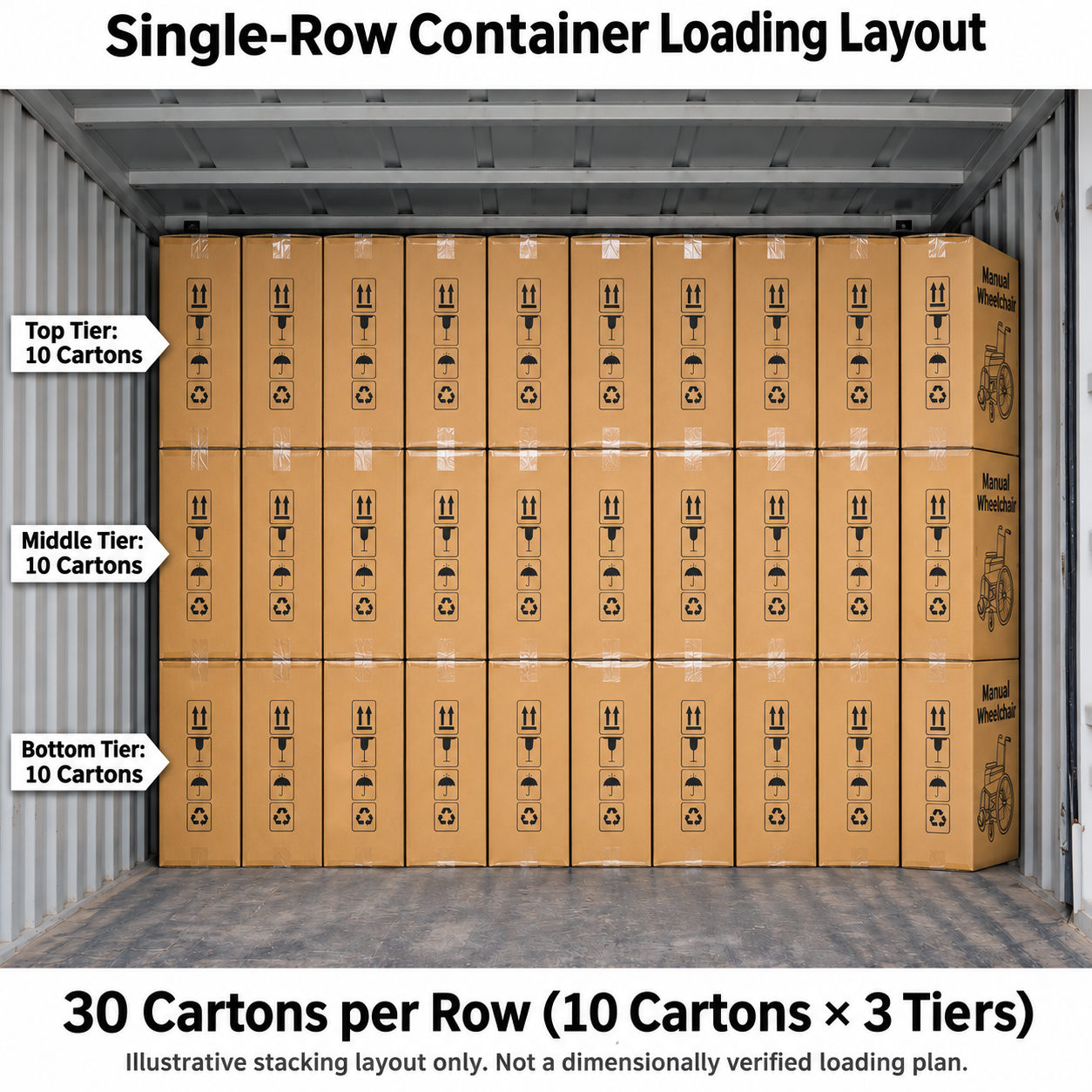
The more models you ship, the more your labels must do. Keep cartons of one model together, and use a visible pallet label if goods are palletised.
GS1 India notes that GS1-128 can carry an SSCC, which is used on logistics labels [2]. Ask your forwarder and warehouse whether they want one. A pallet label should show:
Pallet number
Carton range
Model codes
Total quantity
Gross weight
If you ship in batches for a hospital project, add the batch and ward reference to the carton mark. See our guide to wheelchair staged deliveries for a full batch plan.
Most carton errors happen before printing, when nobody owns the final check. I suggest this routine:
Buyer sends data. Model list, label text, language and barcode numbers.
Factory prepares artwork. Carton marks, labels and packing list format.
Both sides review. Check every code, weight and spelling.
Print one sample. Use the real carton board and scan it.
Approve in writing. Keep one signed version.
Lock changes. Any later change needs a new approval.
Keep the approved file with the order record. If a warehouse reports a label problem, you can see the agreed version.
We provide OEM services for overseas brands, wholesalers and manufacturers. We hold ISO 13485:2016 certification, valid to 14 April 2028, and a CE Declaration of Conformity under EU MDR 2017/745 for Class I manual wheelchairs. SUNGO Europe B.V. is our EU authorised representative.
Send us your model list, label requirements and destination. We will review your carton marks and packing list format with you before production.
WhatsApp: +86 136 5207 7555
Email: yukili90@tjkangli.com
Website: www.klmedbed.com
Include the consignee mark, order number, model code, description, quantity, carton number, weights, size, origin, barcode and handling symbols.
It depends on your scanners and data needs. ITF-14 suits outer cartons with a GTIN only. GS1-128 can also carry batch or date data [2].
Not always. Shipping containers are exempt, but device packaging may not be [5][7]. Ask the legal manufacturer to confirm the structure.
Customs compares them with the shipment. Gaps can trigger exams, extra cost and delays [1].
The UK Trade Info service lists 87 13 10 for carriages for disabled persons, not mechanically propelled [10]. Confirm the code with your customs broker.
Usually, if you supply approved numbers and artwork. Confirm who owns each number, then scan a printed sample before mass production.
Racklify. How Customs Use Packing Lists for Export and Import Clearance.
GS1 India. Difference Between ITF-14 and GS1-128 Barcodes.
GS1 Sweden. Label the outer packaging.
GS1 Singapore. Barcode Verification.
legislation.gov.uk. Regulation (EU) 2017/745, Annex VI, Part C.
European Commission UDI Helpdesk. Packaging levels.
MedDeviceGuide. UDI Packaging Levels. 2026.
iTeh Standards. ISO 780:2015, Packaging, Distribution packaging, Graphical symbols for handling and storage of packages.
FreightAmigo. The Essential Guide to Packing Lists for Customs Declaration.
UK Trade Info. Commodity 871310.


