

Views: 277 Author: Tianjin Kangli Publish Time: 2026-11-20 Origin: Site


Content Menu
● Hospital Bed Dimensions at a Glance
● Standard Hospital Bed Dimensions: A Starting Point, Not a Universal Rule
>> Sleeping Surface Versus Overall Bed Size
>> Why "Standard Size" Can Mislead International Buyers
● Hospital Bed Mattress Dimensions and Safe Compatibility
>> Check Length, Width, Thickness, and Behavior
>> Treat Entrapment as a System-Level Issue
● Bariatric Hospital Bed Dimensions: Width Does Not Equal Capacity
>> Separate These Four Purchasing Requirements
● Hospital Bed Height: Measure the Right Reference Point
>> Deck Height Versus Mattress-Top Height
>> Verify Height Across the Intended Configuration
● How to Measure Hospital Bed Dimensions in Seven Steps
● Room Planning: Evaluate the Bed's Operating Envelope
>> Check Three Different Envelopes
>> Trace the Entire Delivery Route
● Three OEM Checks That Prevent Dimension-Related Rework
>> 1. Create a Dimension-Control Sheet
>> 2. Approve the Bed–Mattress–Rail Combination
>> 3. Separate Product Dimensions From Packaging Dimensions
● A Practical OEM Inquiry Checklist for Kangli
● Frequently Asked Questions About Hospital Bed Dimensions
>> What are standard hospital bed dimensions?
>> How wide is a hospital bed, including side rails?
>> Are hospital bed mattresses interchangeable?
>> How much room is needed around a hospital bed?
>> Does a wider hospital bed support more weight?
>> Can Kangli discuss custom hospital bed dimensions?
At Tianjin Kangli Medical Equipment Co., Ltd., we approach hospital bed dimensions as a complete specification—not simply a mattress measurement. Founded in 1998, our company focuses on medical equipment research, development, and manufacturing, providing OEM services for international brand owners, wholesalers, and manufacturers.
With a 20,000-square-meter factory and 50+ employees, we help buyers translate market requirements into practical product discussions. Our starting point is straightforward: define the patient surface, the complete bed footprint, and the space needed to use the bed.
A commonly referenced adult sleeping surface is 36 × 80 inches, approximately 91.4 × 203.2 cm. However, this is not a universal standard or the overall size of every hospital bed. Before ordering, confirm exactly what each dimension describes.

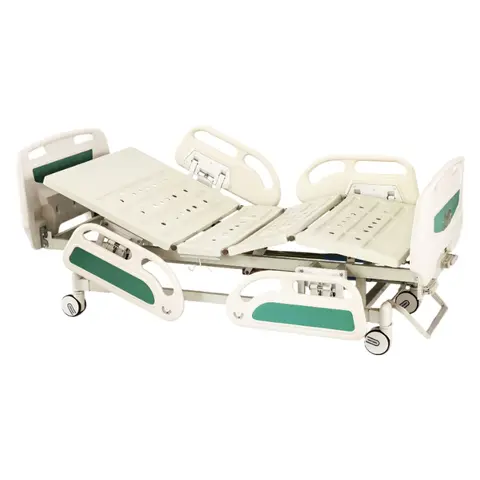
Hospital bed size specifications usually describe three different things: the patient support surface, the external frame, and the adjustable height.
Confusing these measurements can lead to an unsuitable mattress, restricted access, or a bed that cannot travel through the intended building.
| Measurement | What it describes | What buyers should verify |
|---|---|---|
| Sleeping surface width and length | The usable patient support area | Compatibility with the specified mattress |
| Overall width | The bed's widest external points | Rails, bumpers, controls, and accessories |
| Overall length | The complete head-to-foot footprint | Retracted and extended configurations |
| Deck height | Floor to mattress support platform | Minimum and maximum positions |
| Mattress-top height | Floor to the top of the installed mattress | Mattress thickness and measurement conditions |
| Transport dimensions | The configuration used when moving the bed | Doorways, elevators, and corridor turns |
Always request dimensions in both millimeters and inches. Keep the original engineering units as the controlling reference to avoid disputes caused by rounding.
The familiar 36-inch-wide by 80-inch-long surface is useful for initial comparisons. It should not replace a model-specific drawing.
Hospital beds vary by intended use, patient population, mattress system, and manufacturer. Some include an extending foot section. Others have wider surfaces, integrated controls, or external components that increase their footprint.
Consider a documented manufacturer example: the Hillrom Centrella Smart+ specification sheet lists overall frame widths of 40 or 43 inches and an overall length of 86.7–98.7 inches, depending on extension.
Its listed support surfaces are smaller than the external frame. This illustrates why a mattress dimension cannot tell you whether a complete bed fits a room.
These figures describe that product family, not Kangli products or all hospital beds. Check the exact model, configuration, and document revision before using published measurements in a tender.
For an OEM order, "standard hospital bed dimensions" leaves too much open to interpretation.
A buyer may mean the mattress size. An engineer may mean the platform size. A logistics team may need the widest transport configuration.
Replace the word "standard" with a dimensioned requirement wherever possible.
A hospital mattress must do more than sit inside the frame. It must remain compatible with the platform, rails, and positioning functions throughout intended use.
Before approving a mattress, confirm:
- Nominal dimensions and permitted tolerances.
- Compatibility with the articulated platform.
- Approved thickness and any relevant restrictions.
- Retention features that limit unwanted movement.
- Behavior during backrest elevation and knee adjustment.
- Compatibility with an extended foot section, where fitted.
A mattress that appears suitable when the bed is flat may behave differently during articulation.
Replacing a mattress with a thicker or softer alternative can also change the relationship between the patient surface and the rails.
FDA guidance identifies potential entrapment locations involving bed rails, mattresses, and bed frames. It encourages manufacturers to provide information about compatible components and mattress dimensions.
The practical lesson is to evaluate the bed system, not isolated parts.
Do not assume that matching nominal width and length proves safety. Mattress compression, movement, component wear, and rail geometry also matter. A bedside measurement is useful, but it does not replace the applicable assessment methods or manufacturer instructions.
Bariatric procurement requires separate decisions about patient space, structural capacity, mattress performance, and facility access.
A wider surface may provide more room, but it does not independently establish how much weight the bed can support.
1. Patient surface width: Does the surface suit the intended patient population and care tasks?
2. Maximum patient weight: What limit does the manufacturer state for the patient?
3. Safe working load: What total supported load is permitted under the manufacturer's definition?
4. Transport width: Can the selected configuration move through the facility?
Request the definitions behind load figures. Do not assume that maximum patient weight and safe working load are interchangeable.
Likewise, avoid selecting capacity from a generic width chart. The appropriate relationship must come from the specific bed's engineering documentation and labeling.
Height specifications are difficult to compare unless suppliers use the same measurement method.
A published minimum height may refer to the deck without a mattress. Another figure may describe the installed patient surface.
Record both measurements.
For illustration, a 35 cm deck with a 15 cm mattress gives an approximate unloaded mattress-top height of 50 cm. Patient loading and mattress compression can change the actual surface level.
That arithmetic is a planning aid, not a transfer recommendation.
The appropriate transfer or care position depends on the patient, surrounding equipment, care task, and clinical assessment. Avoid treating one fixed height as ideal for every patient.
Ask whether the stated range changes with:
- Caster selection.
- Mattress choice.
- Platform position.
- Optional weighing equipment.
- Other fitted components.
For procurement comparisons, document the configuration beside every height figure.
Use a consistent measurement procedure when reviewing samples or existing equipment.
1. Identify the configuration. Record the model, mattress, rails, accessories, and extension position.
2. Measure the support surface. Record its usable width and length separately from the mattress.
3. Measure overall width. Include the outermost components and record relevant rail positions.
4. Measure overall length. Check both retracted and extended positions where applicable.
5. Record the height range. Distinguish floor-to-deck from floor-to-mattress-top measurements.
6. Check operational movement. Observe rail travel, platform articulation, and accessory clearance.
7. Photograph and document. Use labeled photographs and a dimensioned drawing to resolve uncertainty.
Do not mix measurements from different configurations in one specification table. A single unexplained figure can conceal an important difference.
A bed can fit inside a room and still be difficult to use.
Beyond its parked footprint, it needs space for access, movement, equipment, and the intended care workflow.
| Envelope | What to examine |
|---|---|
| Parked footprint | Overall bed dimensions in its normal room position |
| Operating envelope | Extensions, rail movement, accessories, and caregiver tasks |
| Transport envelope | Door openings, elevator access, corridors, and turning points |
Avoid presenting one clearance figure as a universal requirement. Appropriate space depends on local requirements, facility design, equipment, and care activities.
Measure the route from unloading to the final room—not just the bedroom doorway.
Check clear door openings, elevator entrances and cabins, corridor turns, thresholds, and fixed obstacles. If components must be removed for transport, confirm that the manufacturer permits the procedure and provides suitable instructions.
For home-care projects, document stairs and landing geometry before choosing the delivery configuration.
At Kangli, our recommended sourcing approach is to settle dimensional questions before they become production assumptions.
These checks make an inquiry more precise and help buyers compare proposals consistently.
Use one approved document to define:
- Sleeping surface and external dimensions.
- Minimum and maximum deck height.
- Compatible mattress dimensions.
- Rail and extension configurations.
- Measurement conditions and tolerances.
- Controlling units and drawing revision.
Specify which dimensions are critical to acceptance. This is more reliable than approving a quotation that simply says "standard adult bed."
Review the intended combination during sample evaluation.
Check positioning functions, mattress retention, rail operation, and applicable safety documentation. If a component changes later, assess whether the change affects compatibility or previous verification.
This matters particularly when a distributor plans to source replacement mattresses locally.
A complete bed footprint does not determine its shipping volume.
Request packed length, width, height, gross weight, packaging configuration, and assembly requirements separately. Base loading calculations on approved packaging information rather than the assembled product dimensions.
Confirm which accessories are included in each package and how they will be identified on arrival.
To discuss custom hospital bed dimensions with Tianjin Kangli Medical Equipment Co., Ltd., prepare:
- Destination market and intended care environment.
- Target patient population.
- Required sleeping surface and external size limits.
- Required height range and adjustment functions.
- Mattress and rail requirements.
- Patient-weight and load requirements.
- Doorway, elevator, or transport restrictions.
- Branding, packaging, and documentation needs.
Our preferred starting point is a clear requirement brief rather than an unsupported promise that any size is possible. Final feasibility, performance, and compliance requirements should be confirmed for the proposed model.
Send your dimensional brief or room layout to yukili90@tjkangli.com, or contact us by phone/WhatsApp at +86 136 5207 7555.
Website: [https://www.klmedbed.com]
A frequently referenced adult sleeping surface is 36 × 80 inches, approximately 91.4 × 203.2 cm. Overall frame dimensions vary. Always confirm whether the quoted size describes the mattress, support platform, or complete bed.
There is no universal overall width. Rails, bumpers, controls, and frame design affect the measurement. Request the maximum external width and clarify the rail position used when measuring.
Not automatically. Matching length and width is only part of compatibility. Thickness, compression, platform articulation, retention, and the mattress-to-rail relationship must also be assessed against manufacturer instructions.
The answer depends on care tasks, patient needs, equipment, and applicable facility requirements. Plan for the operating and transport envelopes rather than relying solely on the parked bed footprint.
Not necessarily. Width describes space, not verified load performance. Check the model's stated maximum patient weight, safe working load, and the definitions and conditions attached to those ratings.
Yes. Kangli provides OEM services for overseas brands, wholesalers, and manufacturers. Submit your required dimensions and intended use for technical review; the available configuration must be confirmed for the proposed project.
1. Tianjin Kangli Medical Equipment Co., Ltd. Company information supplied for this article: founding year, factory area, employee count, business focus, and contact details. Corporate website: [https://www.klmedbed.com]. The supplied brief is the basis for the company profile; this article does not independently validate every corporate claim.
2. Tianjin Kangli Medical. "The Complete Guide to Hospital Bed Dimensions: Expert Insights for 2026 From Tianjin Kangli Medical." Existing website article reviewed for content restructuring, not treated as independent validation of every technical claim: [https://www.klmedbed.com/the-complete-guide-to-hospital-bed-dimensions-expert-insights-for-2026-from-tianjin-kangli-medical.html]. [klmedbed]
3. U.S. Food and Drug Administration. "Hospital Bed System Dimensional and Assessment Guidance to Reduce Entrapment." Guidance for Industry and FDA Staff, issued March 2006. Basis for the discussion of system compatibility, dimensional assessment, and entrapment risk: [https://www.fda.gov/regulatory-information/search-fda-guidance-documents/hospital-bed-system-dimensional-and-assessment-guidance-reduce-entrapment]. [fda]
4. U.S. Food and Drug Administration. "A Guide for Modifying Bed Systems and Using Accessories to Reduce the Risk of Entrapment." Relevant to mattress changes, accessory compatibility, and reassessment of existing bed systems: [https://www.fda.gov/medical-devices/hospital-beds/guide-modifying-bed-systems-and-using-accessories-reduce-risk-entrapment]. [fda]
5. U.S. Food and Drug Administration. "A Guide to Bed Safety: Bed Rails in Hospitals, Nursing Homes and Home Health Care: The Facts." Relevant to mattress fit and individualized bed-rail considerations: [https://www.fda.gov/medical-devices/hospital-beds/guide-bed-safety-bed-rails-hospitals-nursing-homes-and-home-health-care-facts]. [fda]
6. Hillrom. "Centrella Smart+ Bed," specification sheet, document US-CS3-230011 v2. Source for the named manufacturer example distinguishing overall frame dimensions from support-surface dimensions; not a Kangli specification: [https://www.hillrom.com/content/dam/hillrom-aem/us/en/marketing/products/centrella-smart-bed/documents/US-CS3-230011-v2_Centrella_Spec-Sheet_LR.pdf]. [hillrom]


