

Views: 721 Author: kangli Publish Time: 2026-11-17 Origin: Site


Content Menu
● Reclining vs Tilt-in-Space Wheelchairs: Product Differences Buyers Should Understand
● What Is the Difference Between Recline and Tilt-in-Space?
>> Reclining Wheelchairs Change the Seat-to-Back Angle
>> Tilt-in-Space Wheelchairs Move the Seating System Together
● Why the Difference Matters to Buyers
>> Suggested image: compare the movement
● Reclining Wheelchairs: Product Benefits and Trade-Offs
>> What Buyers Should Evaluate
● Tilt-in-Space Wheelchairs: Product Benefits and Trade-Offs
>> What Buyers Should Evaluate
● How Distributors Can Choose the Right Product for Their Range
>> Consider a Reclining Model When
>> Consider a Tilt-in-Space Model When
● OEM Selection Checklist: Specify the Mechanism Clearly
● New Expert Insight: Build a Decision Matrix Around the Procurement Brief
● Common Buyer Mistakes to Avoid
● Product Visuals and AI Image Prompts
● FAQ: Reclining vs Tilt-in-Space Wheelchairs
>> 1. What is the main difference between recline and tilt-in-space?
>> 2. Does tilt-in-space change the user's hip angle?
>> 3. Is tilt-in-space always better for pressure management?
>> 4. Does recline make a wheelchair suitable for lying down?
>> 5. Can a wheelchair combine recline and tilt-in-space?
>> 6. Who should decide which design an individual needs?
>> 7. What should distributors request from an OEM supplier?
● Approximate Article Word Count
An OEM product-selection guide for wheelchair brands, distributors, wholesalers, and institutional buyers.
Reclining and tilt-in-space wheelchairs are not the same design. A reclining wheelchair changes the angle between the seat and backrest. A tilt-in-space wheelchair rotates the seating system while keeping the seat-to-back angle substantially unchanged. That difference affects positioning, intended use, product configuration, and the questions buyers should ask before adding either design to a range. [msktc] [colorado]
For international buyers sourcing wheelchairs for hospitals, clinics, care facilities, rehabilitation providers, and distributors, the choice should be based on the intended user, required positioning, caregiver workflow, and the model's verified specifications. No single configuration is right for every user or market. Product selection should involve qualified seating or clinical professionals when individual positioning needs are being assessed.
Tianjin Kangli Medical Device Co., Ltd. supplies medical furniture and mobility products and supports domestic and export business, including distribution, tenders, OEM/ODM, and private-label cooperation. For an OEM wheelchair program, the recline or tilt mechanism should be evaluated as part of the complete chair—not as an isolated feature.
How can I start an OEM partnership with your factory?
We recommend an initial technical consultation to review your design specifications. Please contact our dedicated B2B team at [Yukili90@tjkangli.com] to discuss your product requirements.
Let’s build excellence together. Whether you need a quote for a large-scale project or want to explore private labeling opportunities for our 5-function medical bed series, we are here to support your success. Click here www.klmedbed.com to connect with our B2B team and start your customized manufacturing journey today.

A reclining wheelchair moves the backrest relative to the seat, opening the angle between them. The seat itself generally remains in a fixed orientation relative to the ground. The degree of movement and operation differ by model. [colorado] [msktc]
Buyers should confirm whether a product's backrest reclines through a fixed range, locks in selected positions, or uses another mechanism. Do not assume all reclining wheelchairs provide the same range or functionality.
A tilt-in-space wheelchair rotates the seat and backrest together relative to the ground, maintaining the seat-to-back angle as the chair tilts. This changes the user's orientation without opening the hip angle in the same way as recline. [msktc] [permobil]
The actual tilt range, control method, and compatible seating components are model-specific. A product label alone does not establish the chair's positioning capability or suitability for a particular user.
| Buying consideration | Reclining wheelchair | Tilt-in-space wheelchair |
|---|---|---|
| Main movement | Backrest moves relative to the seat. | Seat and backrest tilt together. |
| Seat-to-back angle | Changes as the back reclines. | Substantially maintained during tilt. |
| User’s orientation | The back moves toward a more reclined position while the seat remains relatively fixed. | The whole seating system changes angle relative to the ground. |
| Product review focus | Recline range, operation, support, and compatibility with other components. | Tilt range, control, stability, positioning supports, and compatibility. |
| Key selection question | Does the product’s recline function meet the specified positioning requirement? | Does the system’s tilt function meet the specified positioning requirement? |
| Clinical decision | Requires assessment against the individual’s needs and product instructions. | Requires assessment against the individual’s needs and product instructions. |
 |  |
Recline and tilt alter the user's seated position in different ways. Research on wheelchair positioning notes that tilt-in-space maintains the seat-to-back angle, while recline changes it; the resulting effects on pressure and posture depend on the individual and configuration. [msktc] A study of incremental wheelchair tilt reported that tilt angle matters when evaluating pressure redistribution, so buyers should avoid treating a small tilt movement as equivalent to a specified pressure-management outcome. [nature]
Neither function should be marketed as a guaranteed pressure-injury prevention solution. Clinical suitability depends on the user, seating system, use pattern, and professional assessment. Buyers and distributors should use evidence-supported product claims and refer individualized positioning questions to qualified clinicians or seating professionals.
A reclining wheelchair may be considered when the product brief calls for the backrest to move independently from the seat. This design may support a more reclined posture, but the actual function and suitability depend on the chair, the user, and the intended use.
- Recline range and positions: Confirm the exact adjustment range and how the backrest is held in position.
- User support: Check how the chair supports the user throughout the approved range.
- Operation: Review how the attendant or user operates the mechanism and whether instructions are clear.
- Component compatibility: Check interaction with head support, leg supports, cushions, and other accessories.
- Transport and storage: Confirm dimensions and any product-specific handling instructions.
- Service needs: Ask which components require inspection and how replacement parts are identified.
Because recline changes the seat-to-back angle, the user's body position changes differently from tilt-in-space. Clinical and product literature cautions that the effects of recline on pressure and skin loading need individual evaluation. [msktc] Product selection should therefore not be based on a broad promise that recline is suitable for a particular medical condition.
Tilt-in-space designs move the seating system as a unit while maintaining the seat-to-back relationship. Some product and clinical guidance discusses tilt as a way to alter orientation and redistribute loading, but the outcome depends on the tilt angle, chair configuration, and the individual user. [msktc] [nature]
- Tilt range: Confirm the product's documented range; do not infer it from a product category.
- Control method: Identify whether adjustment is manual or powered and who is expected to operate it.
- Stability and clearance: Review the complete chair throughout the specified movement range.
- Support components: Check compatibility with headrests, cushions, leg supports, and positioning accessories.
- Caregiver workflow: Determine whether staff can operate and maintain the feature under the intended conditions.
- Service and documentation: Confirm inspection instructions, maintenance guidance, and parts support.
Tilt-in-space may suit a product brief that requires whole-seat orientation changes while preserving the seat-to-back angle. It is not automatically the right choice for every user or facility. A qualified assessment should guide individual seating decisions.
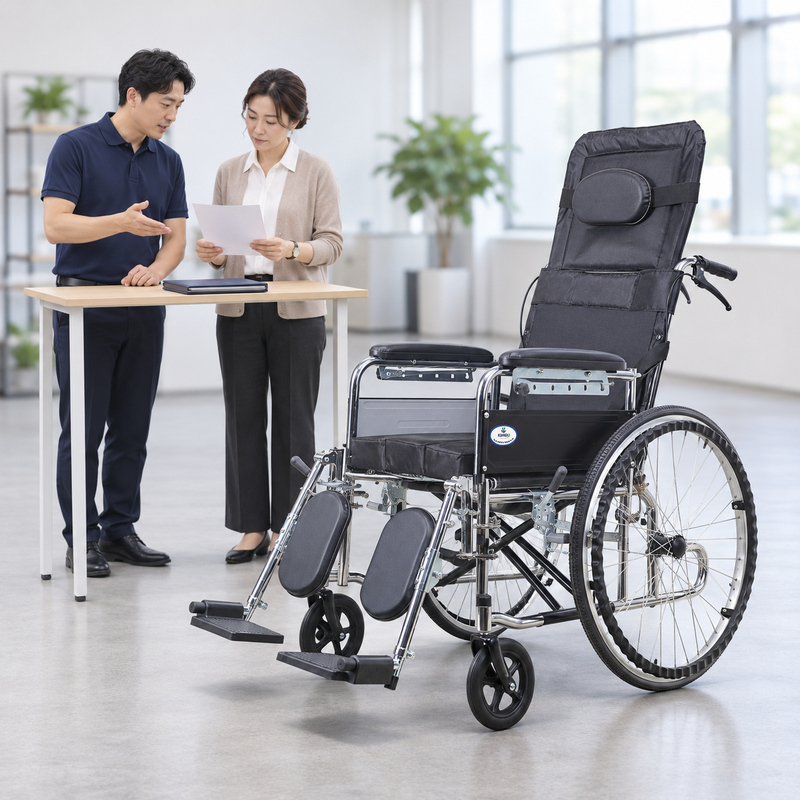
Instead of asking which mechanism is "better," distributors should identify which customer requirement each model is designed to address.
- Buyers specifically require an adjustable backrest angle.
- The intended application and user assessment support recline.
- The product's documented range, operation, and support meet procurement requirements.
- The distributor can explain operation, maintenance, and limitations accurately.
- Buyers specify whole-seat tilting while maintaining the seat-to-back relationship.
- The tilt range and control method meet the product brief.
- The product configuration is compatible with required seating and support components.
- The distributor can provide appropriate documentation and service guidance.
When comparing products, align the specification across models. Record:
- Manual or powered operation.
- Recline or tilt range as stated by the manufacturer.
- Seat dimensions and available configurations.
- Overall and transport dimensions.
- Weight and weight-capacity information as documented.
- Included supports and optional accessories.
- Cleaning, maintenance, and warranty information.
- Applicable market documentation and certifications, verified for the specific product.
Do not compare a basic manual recliner with a fully configured powered tilt-in-space model as if the mechanism alone explains differences in price, weight, or function.
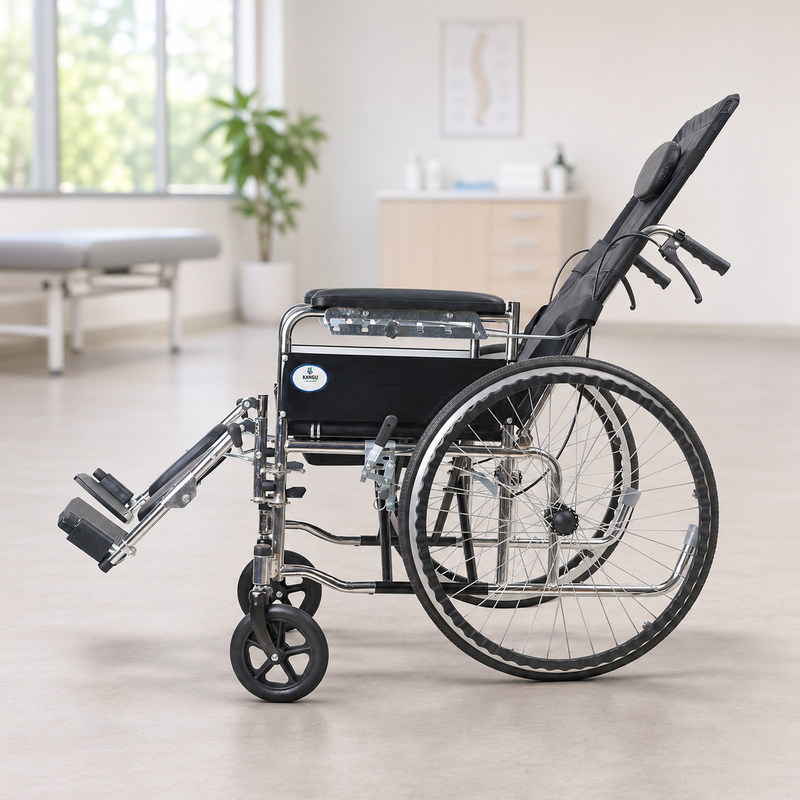
For OEM/ODM and private-label orders, write the requirement into the product specification instead of relying on a broad label such as "reclining chair" or "tilt wheelchair."
1. State the intended product use and target market.
2. Identify the mechanism: recline, tilt-in-space, or a combined design, if technically available.
3. Specify the documented adjustment range and control method.
4. List required seating supports and compatible accessories.
5. Request drawings, configuration details, and a representative sample.
6. Agree on assembly, inspection, and functional-check criteria.
7. Confirm manuals, labels, service parts, and after-sales arrangements.
8. Approve the exact configuration and revision before mass production.
For a powered model, buyers should also clarify power controls, battery-related documentation, and market-specific requirements with the manufacturer. Avoid publishing technical or regulatory claims before the relevant documentation has been verified.
A useful way to prevent feature-led buying is to score each candidate model against the actual procurement need. For each requirement, mark it required, preferred, or not applicable:
| Procurement question | Recline model | Tilt-in-space model |
|---|---|---|
| Does the brief specify a changing seat-to-back angle? | Review the specified recline function. | Usually not the defining movement; verify product details. |
| Does the brief specify whole-seat orientation changes? | Verify whether the product offers this separately. | Review the documented tilt function and range. |
| Are specific supports or accessories required? | Confirm compatibility by model. | Confirm compatibility by model. |
| Does the facility need manual or powered operation? | Confirm the exact mechanism. | Confirm the exact mechanism. |
| Are service and training resources available? | Check documentation and parts support. | Check documentation and parts support. |
This matrix does not replace a clinical assessment. It helps procurement teams make product comparisons traceable to the stated requirements, and helps OEM suppliers identify configuration questions early.

- Treating recline and tilt as interchangeable terms.
- Assuming every product in a category has the same adjustment range.
- Making clinical benefit claims without product-specific evidence.
- Selecting a mechanism before defining the intended user and workflow.
- Ignoring accessory compatibility and service documentation.
- Relying on marketing images instead of verified drawings and specifications.
- Assuming a feature on one model is available on every OEM configuration.
Suggested visual 1: A side-by-side technical illustration showing recline changing the seat-to-back angle and tilt-in-space moving the seat and back together.
AI image prompt:
"Create an original, medically responsible B2B product diagram comparing two generic manual care wheelchairs in side view. Left panel: reclining wheelchair, backrest rotates relative to the seat, clearly show the changing seat-to-back angle. Right panel: tilt-in-space wheelchair, seat and backrest rotate together while their angle remains constant. Neutral white background, precise clean line illustration, no brand logos, no text, no clinical outcome claims, leave space for labels to be added by an editor."
Suggested visual 2: A labeled product photo or diagram identifying the backrest, seat, tilt mechanism, recline mechanism, head support, and leg supports.
AI image prompt:
"Create a realistic, neutral studio product illustration of two generic medical wheelchairs, one reclining and one tilt-in-space, with accurate structural proportions and visible adjustment components. Use subtle arrows to indicate movement, no logos, no text, no exaggerated medical claims, white background, professional catalog style."
Have a product engineer review AI-generated technical visuals before publication. Use the actual model's manual and approved drawings for operating instructions.
Recline changes the angle between the seat and backrest. Tilt-in-space moves the seat and back together while maintaining their angle. [msktc]
The design maintains the seat-to-back angle during tilting, unlike recline, which opens that angle. Actual posture depends on the individual, seating system, and chair configuration. [msktc]
No. The outcome depends on the user, the system, and the angle used. Research reports that tilt angle matters, so buyers should avoid assuming small movements provide the same effect as larger ones. [nature]
Not necessarily. The available recline range and intended use are model-specific. Check the manufacturer's specifications and manual.
Some product designs may offer multiple positioning functions. Verify the exact configuration, operation, compatibility, and documentation with the manufacturer before specifying it.
Individual seating and positioning choices should be made with qualified clinical or seating professionals, considering the person's needs and the wheelchair's instructions.
Request model-specific specifications, drawings, adjustment details, accessory compatibility, user and maintenance instructions, spare-parts information, and verified market documentation.
1. [MSKTC — Pressure Relief and Weight Shifts for Spinal Cord Injury] — Explains the distinction between tilt and recline and discusses how tilt angle and recline affect positioning and pressure.
2. [Colorado Department of Health Care Policy and Financing — Wheelchair Benefit Policy] — Defines reclining wheelchair movement as a change in the seat-to-back angle and includes policy descriptions of tilt-in-space products.
3. [Waugh et al., *Measuring the Effect of Incremental Angles of Wheelchair Tilt on Interface Pressure*, Spinal Cord] — Research examining wheelchair tilt angle and interface pressure.
4. [Permobil — Explaining Power Seat Functions: Power Tilt & Power Recline] — Product education describing the different movement patterns and uses of power tilt and recline.
5. [KARMA Medical — A Guide to Choosing a Manual Wheelchair] — General wheelchair-selection discussion including tilt-in-space and reclining functions.
6. [Sunrise Medical — Seating and Wheelchair Angles] — Seating and positioning considerations relevant to wheelchair configuration.
Reclining wheelchairs change the seat-to-back angle; tilt-in-space wheelchairs tilt the seating system together. That mechanical difference should guide product comparison, but it does not establish which chair is clinically appropriate or commercially best for every buyer. Distributors should match each model to a defined procurement brief, verify specifications, and confirm documentation and support before listing or ordering.
Tianjin Kangli Medical Device Co., Ltd. welcomes inquiries from overseas brands, wholesalers, and project buyers seeking wheelchair distribution, OEM/ODM, or private-label cooperation. Share your target market, required mechanism, configuration, documentation needs, and order plan to discuss product options and a tailored quotation. Verify company scale, establishment date, and certifications against current official records before using them in published materials.


