
Views: 254 Author: Tianjin Kangli Publish Time: 2026-08-20 Origin: Site


Content Menu
● Quick Comparison: Integrated Commode Bed vs. Standard Nursing Bed
● Why Incontinence Changes Bed Selection
● What Is a Medical Bed With Integrated Commode?
>> Potential Benefits for Suitable Patients
● When a Standard Nursing Bed Is the Better Choice
● Patient Selection: The Five Questions Buyers Should Ask
>> 1. Can the Patient Participate in Toileting?
>> 2. Is Incontinence Predictable or Constant?
>> 3. What Is the Transfer Risk?
>> 4. What Is the Skin Condition?
>> 5. Can the Product Be Cleaned Correctly Every Time?
● Safety Requirements for Integrated Commode Beds
● Expert View: Equipment Does Not Replace Care Protocols
● How Tianjin Kangli Supports OEM Buyers
● FAQ
>> 1. Is a medical bed with an integrated commode suitable for every incontinent patient?
>> 2. Can an integrated commode bed prevent pressure injuries?
>> 3. Does an integrated commode bed reduce caregiver workload?
>> 4. What safety standards should OEM buyers consider for medical beds?
>> 5. What is the most important feature in a nursing bed for incontinent bedridden patients?
>> 6. Can Tianjin Kangli provide OEM customization for medical beds?
For incontinent bedridden patients, choosing between a medical bed with an integrated commode and a standard nursing bed is not simply an equipment decision. It directly affects dignity, caregiver workload, transfer safety, skin-moisture management, and the daily care experience.
At Tianjin Kangli Medical Equipment Co., Ltd., we have focused on medical bed R&D and manufacturing since 1998. As a national high-tech enterprise with a 20,000-square-meter factory and 50+ employees, we provide OEM medical-bed solutions for overseas brands, wholesalers, and manufacturers. From a manufacturer's and care-equipment specialist's perspective, the right option depends on the patient's mobility, continence pattern, cognitive status, caregiver resources, and care setting.
A medical bed with an integrated commode can reduce the need to transfer a patient to a separate toilet or bedside commode. However, a standard nursing bed may be the more practical and economical choice when incontinence is frequent, the patient cannot cooperate with positioning, or caregivers already use a well-established continence-care routine.
| Decision factor | Medical bed with integrated commode | Standard nursing bed |
|---|---|---|
| Toileting access | Patient can use an integrated commode opening without leaving the bed | Usually requires bedpan, urinal, absorbent products, or transfer to a commode |
| Transfer burden | Can reduce toilet-related transfers for selected patients | Often requires more repositioning or transfers for toileting |
| Patient dignity | May support a more private, toilet-like routine | Depends heavily on caregiver technique and continence products |
| Caregiver workload | Can reduce some lifting tasks but requires cleaning and operating procedures | Familiar workflow, but bedpan placement and hygiene can be labor-intensive |
| Best patient profile | Partially cooperative patients with predictable toileting needs | Fully dependent, highly incontinent, unstable, or non-cooperative patients |
| Cleaning complexity | Commode mechanism and waste-management components require thorough cleaning | Fewer integrated hygiene components, but more disposable-product management |
| Cost and configuration | Higher initial complexity; requires product and training review | Usually lower initial equipment cost |
| Safety considerations | Requires safe opening design, positioning controls, rails, and caregiver training | Requires safe rails, mattress selection, repositioning, and transfer procedures |
Key conclusion: An integrated commode bed is not automatically "better." It is best viewed as a targeted solution for appropriate patients—not a replacement for clinical assessment, skin care, repositioning, and continence management.
Incontinence is closely linked to skin moisture, discomfort, infection risk, sleep disruption, and caregiver workload. When urine or stool remains against the skin, prolonged moisture and friction can contribute to skin breakdown. Pressure-injury prevention guidance consistently emphasizes moisture control, prompt cleansing, barrier protection, appropriate support surfaces, and individualized repositioning plans. [pmc.ncbi.nlm.nih]
For a bedridden person, the bed becomes more than a resting surface. It becomes part of the daily care system. The right medical bed should help caregivers perform essential tasks safely:
- Reposition the patient without excessive physical strain.
- Maintain skin hygiene after episodes of incontinence.
- Reduce unnecessary transfers where transfer risk is high.
- Support comfortable posture for toileting, meals, rest, and care.
- Preserve dignity through predictable, respectful routines.
- Enable observation of skin condition, movement ability, and changing care needs.
A standard nursing bed provides a stable platform for these tasks. A medical bed with an integrated commode adds a toileting function directly into that platform.
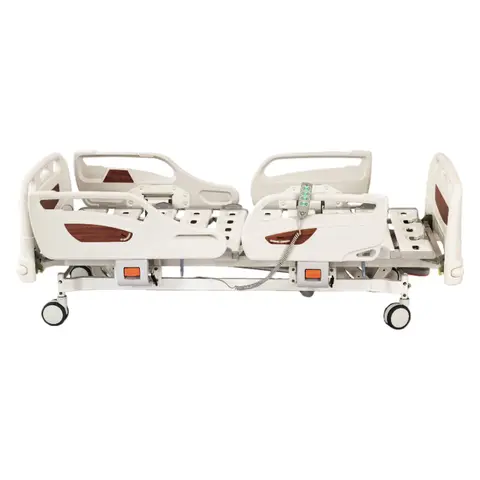
A medical bed with an integrated commode, sometimes called a hospital bed with a built-in toilet or toilet-function nursing bed, includes a commode opening and collection system within the bed structure. Depending on the design, the patient may be positioned over the opening through an adjustable mattress section, removable cushion, powered mechanism, or manually operated system.
The intended benefit is clear: the patient can use a toileting function without being moved to a bathroom or separate bedside commode.
For a patient with limited mobility, avoiding repeated transfers can be meaningful. Transfers can be physically demanding for caregivers and may be unsafe if the patient has weakness, poor balance, dementia, pain, fractures, or post-operative restrictions. FDA guidance on hospital-bed systems also highlights the need to manage entrapment risks associated with openings, rails, mattresses, and bed-system dimensions.
However, the integrated commode function must be assessed as part of the whole care environment. The bed must be easy to operate, clean, inspect, and maintain. The patient must also be able to tolerate positioning and understand, or be assisted through, the toileting process.
A well-designed integrated commode bed may offer several advantages:
- Fewer toilet-related transfers, which may reduce caregiver lifting demands.
- More timely toileting for patients who can communicate the need to void.
- Greater privacy than repeated bedpan placement for some users.
- Reduced disruption at night, especially when access to a bathroom is difficult.
- A more consistent care routine for home-care or long-term-care environments.
- Improved comfort when the mattress, posture adjustment, and commode positioning work together.
In practice, the strongest candidates are often patients with limited mobility but enough trunk control, cognition, or caregiver assistance to use the function safely and consistently.
A standard nursing bed remains an excellent choice for many incontinent bedridden patients. It can be configured with adjustable backrest and knee sections, side rails, a pressure-relief mattress, IV pole provisions, transfer aids, and other accessories. It supports routine nursing care without adding a commode mechanism that may not be used effectively.
A standard nursing bed is often preferable when:
- The patient has continuous or unpredictable incontinence.
- The patient cannot safely be positioned over a commode opening.
- The patient has severe agitation, confusion, contractures, or uncontrolled movement.
- A wound, surgical site, pelvic condition, or pain issue makes the commode position unsuitable.
- The care team uses absorbent products, catheterization, scheduled toileting, or bedpan protocols successfully.
- The facility prioritizes easy cleaning, universal use, and lower equipment complexity.
For fully dependent patients, a high-quality adjustable nursing bed combined with a pressure-relief mattress and a disciplined skin-care protocol may deliver more practical value than an integrated commode system.
Before sourcing either solution, brand owners, distributors, and care providers should evaluate the patient profile—not just compare product features.
A patient who can communicate urgency, follow basic instructions, or tolerate a semi-upright position may benefit more from a built-in commode function.
If the patient is unable to cooperate, an integrated commode may create extra steps without delivering reliable toileting benefits.
Scheduled toileting can work best when bladder or bowel patterns are relatively predictable. Nursing-home continence programs often use regular checks and prompted toileting routines, illustrating why timing and caregiver response matter as much as equipment.
For constant leakage or frequent fecal incontinence, prompt cleaning, moisture control, barrier products, and skin inspection remain essential regardless of bed type.
If moving a patient to a bathroom or standalone commode presents a high fall or manual-handling risk, an integrated commode bed may reduce unnecessary transfers.
But it does not eliminate all care risks. Caregivers still need safe positioning, close observation, hygiene procedures, and emergency-response readiness.
Patients with fragile skin, existing pressure injuries, dermatitis, or high moisture exposure require careful assessment. A commode feature must not create new pressure points, shearing forces, gaps, or delays in cleansing.
The care plan should include regular repositioning, skin checks, appropriate mattress selection, moisture management, and clinician-led wound-care decisions.
This question is frequently underestimated. An integrated commode bed is only valuable when cleaning processes are simple, repeatable, and reliable.
Buyers should ask about:
- Removable or accessible waste containers.
- Splash-control design.
- Surface materials and seam construction.
- Cleaning access around the commode opening.
- Replacement parts and consumables.
- Instructions for disinfection compatibility.
- Training materials for caregivers and facility staff.
Safety should be designed into the product, not added after sourcing. Medical beds intended for adults are covered by IEC 60601-2-52 requirements addressing basic safety and essential performance. The standard applies specifically to medical beds for adult users.
For OEM purchasers, safety review should include more than certificates. Request documentation and evaluate the actual bed configuration, including the mattress, rails, commode components, actuator system, and accessories.
- Side-rail gaps and openings: Evaluate potential entrapment zones with the selected mattress and accessories.
- Load capacity: Confirm safe working load, dynamic load, and patient-weight range.
- Stable positioning: Ensure the bed remains stable during backrest adjustment and commode use.
- Emergency function: Verify manual or battery backup options where powered functions are used.
- Pinch-point protection: Review moving mechanisms around the commode and bed deck.
- Waterproofing and hygiene: Confirm protection of electrical parts from expected cleaning exposure.
- Mattress compatibility: Avoid gaps that can increase entrapment risk or create pressure points.
- Clear labeling: Provide operating instructions, warnings, cleaning guidance, and maximum-load information.
FDA hospital-bed guidance specifically addresses dimensional criteria intended to reduce life-threatening entrapment risks. This is particularly important when rails, mattresses, and bed-frame components come from different suppliers.
From our experience in medical-bed manufacturing, buyers achieve the best outcomes when they purchase a care solution, not only a bed.
An integrated commode bed can make toileting easier. But it cannot replace:
1. A clinical continence assessment.
2. A scheduled turning and repositioning plan.
3. Prompt skin cleansing after incontinence.
4. Barrier protection when clinically appropriate.
5. Daily skin observation.
6. Correct caregiver training.
7. A suitable pressure-relief mattress.
For example, a long-term-care operator may select an integrated commode bed for residents who can signal toileting needs but cannot safely walk to the bathroom. Meanwhile, the same facility may use standard low nursing beds with advanced pressure-relief mattresses for residents with severe dementia, unpredictable incontinence, or high fall risk.
This mixed-fleet approach is often more practical than forcing one bed type onto every patient.
Tianjin Kangli Medical Equipment Co., Ltd. helps international brands, wholesalers, and manufacturers develop medical-bed solutions aligned with their target care setting and market position.
Founded in 1998, Kangli operates a 20,000-square-meter manufacturing facility and supports OEM projects for medical and nursing-bed applications. Our approach begins with the care scenario: home care, nursing homes, rehabilitation centers, hospitals, or specialized elderly-care environments.
For example, Kangli delivered 1,200 Ultra-Low Smart Nursing Beds to a European nursing-home group operating more than 50 premium facilities. The project combined a 20 cm ultra-low platform, dual-motor lifting system, 250 kg dynamic load capacity, customized side rails, and a homelike wood-grain design. According to the project information, the customer reported a 78% reduction in patient fall incidents and a 15% improvement in room occupancy rates after deployment. [klmedbed]
For OEM integrated commode-bed projects, we recommend defining these specifications early:
- Target patient weight and safe working load.
- Powered or manual commode operation.
- Mattress construction and commode opening design.
- Backrest, knee-rest, height-adjustment, and turning functions.
- Side-rail type and safety-gap requirements.
- Cleaning workflow and waste-container configuration.
- Home-care, nursing-home, or hospital positioning.
- Branding, color, packaging, manuals, and spare-parts requirements.
- Required testing, certification, and destination-market documentation.
Choose a medical bed with an integrated commode when the patient has limited mobility, can benefit from scheduled toileting, and needs fewer transfers to a separate toilet or commode.
Choose a standard nursing bed when the patient is fully dependent, incontinence is highly unpredictable, skin protection is the primary concern, or the care team needs the simplest and most universal workflow.
The most important purchasing decision is not "Which bed has more functions?" It is: Which bed helps caregivers provide safer, cleaner, more dignified care for this specific patient group?
If you are developing an OEM medical bed with an integrated commode, low-height platform, nursing functions, or customized side-rail system, contact Tianjin Kangli Medical Equipment Co., Ltd. for a feasibility discussion.
Email: yukili90@tjkangli.com
Phone / WhatsApp: +86 136 5207 7555
Website: [www.klmedbed.com]
No. It is most suitable for patients with limited mobility who can tolerate positioning and have predictable toileting needs. Fully dependent or highly agitated patients may be better served by a standard nursing bed and a structured continence-care plan.
No bed can independently prevent pressure injuries. The bed can support care, but prevention requires repositioning, moisture control, skin inspection, appropriate support surfaces, nutrition management, and clinical assessment.
It can reduce some toilet-related transfers and lifting tasks. However, it introduces cleaning, positioning, and operating procedures. The net workload benefit depends on patient suitability and staff training.
OEM buyers should evaluate applicable destination-market requirements and medical-bed safety standards, including IEC 60601-2-52 for adult medical beds. They should also assess rail, mattress, and opening dimensions to reduce entrapment risks.
There is no single feature. The best solution combines safe adjustment functions, compatible pressure-relief support, easy cleaning, appropriate side rails, stable construction, and a care protocol that addresses hygiene and repositioning.
Yes. Tianjin Kangli supports OEM medical-bed projects for overseas brands, wholesalers, and manufacturers, including functional configurations, branding, side rails, materials, packaging, manuals, and market-specific project requirements.

1. Tianjin Kangli Medical Equipment Co., Ltd. [Kangli Medical: Hospital Bed Manufacturer China]
2. U.S. Food and Drug Administration. [Hospital Bed System Dimensional and Assessment Guidance to Reduce Entrapment]
3. U.S. Food and Drug Administration. [Recognized Consensus Standards: Medical Devices—IEC 60601-2-52]
4. International Organization for Standardization. [IEC 60601-2-52: Medical electrical equipment—Part 2-52]
5. National Center for Biotechnology Information. [Preventing Pressure Injuries in Individuals With Impaired Mobility]
6. National Center for Biotechnology Information. [Urinary and Fecal Incontinence in Nursing Home Residents]
7. Mather Hospital. [Caregiver Tips for Pressure Injuries]
8. Royal Children's Hospital Melbourne. [Pressure Injury Prevention and Management]
Hot Tags: China, Global, OEM, private label, manufacturers, factory, suppliers, manufacturing company


