

Views: 444 Author: kangli Publish Time: 2026-09-14 Origin: Site


Content Menu
● ICU Bed Weighing System: Accuracy, Calibration, Alarms, and Buyer Questions
● What Is an Integrated ICU Bed Weighing System?
● Why ICU Bed Weighing Systems Matter
>> Accuracy, Repeatability, Resolution, and Trend Reliability
● ICU Bed Weighing Specifications Buyers Should Compare
● How Accurate Should an ICU Bed Scale Be?
>> Request a Performance Table
● Calibration vs. Zeroing: What Is the Difference?
>> Calibration
● Practical ICU Bed Calibration and Verification Workflow
>> Step 1: Prepare the Environment
>> Step 2: Confirm the Weighing Configuration
>> Step 4: Apply Reference Loads
>> Step 6: Maintain Traceability
● Common Causes of Incorrect ICU Bed Weight Readings
>> 2. Added Equipment After Zeroing
>> 7. Overload
>> 8. Weak Battery or Power Interruption
● ICU Bed Weighing-System Alarms Explained
● Data Integration and Cybersecurity Questions
● OEM and Private-Label Questions for International Buyers
● ICU Bed Weighing System Buyer Checklist
● Recommended Visual Content for Better UX and SEO
● Final Recommendation for International Buyers
>> 1. How accurate is an ICU bed weighing system?
>> 2. Does zeroing replace calibration?
>> 3. How often should the system be calibrated?
>> 4. Why does the weight change after equipment is added?
>> 5. Can weighing continue during a power failure?
>> 6. Can weight data connect to a hospital information system?
>> 7. What should OEM buyers request?
How can I start an OEM partnership with your factory?
We recommend an initial technical consultation to review your design specifications. Please contact our dedicated B2B team at [Yukili90@tjkangli.com] to discuss your product requirements.
Let’s build excellence together. Whether you need a quote for a large-scale project or want to explore private labeling opportunities for our 5-function medical bed series, we are here to support your success. Click here www.klmedbed.com to connect with our B2B team and start your customized manufacturing journey today.
An ICU bed weighing system measures a patient without transferring them to a separate scale. In critical care, this can support weight-based medication decisions, fluid management, nutrition planning, and trend monitoring. However, buyers should evaluate more than display resolution. Accuracy, repeatability, zeroing, calibration, alarm behavior, sensor protection, and after-sales support determine whether the system is clinically useful.
For international medical brands, wholesalers, distributors, and healthcare projects, Tianjin Kangli Medical Instrument provides OEM and ODM ICU bed solutions, including customized weighing systems, private-label documentation, technical support, and spare-parts planning.
> Clinical note: An integrated weighing system supports clinical assessment but does not replace professional judgment or a separately validated reference scale when confirmation is required.

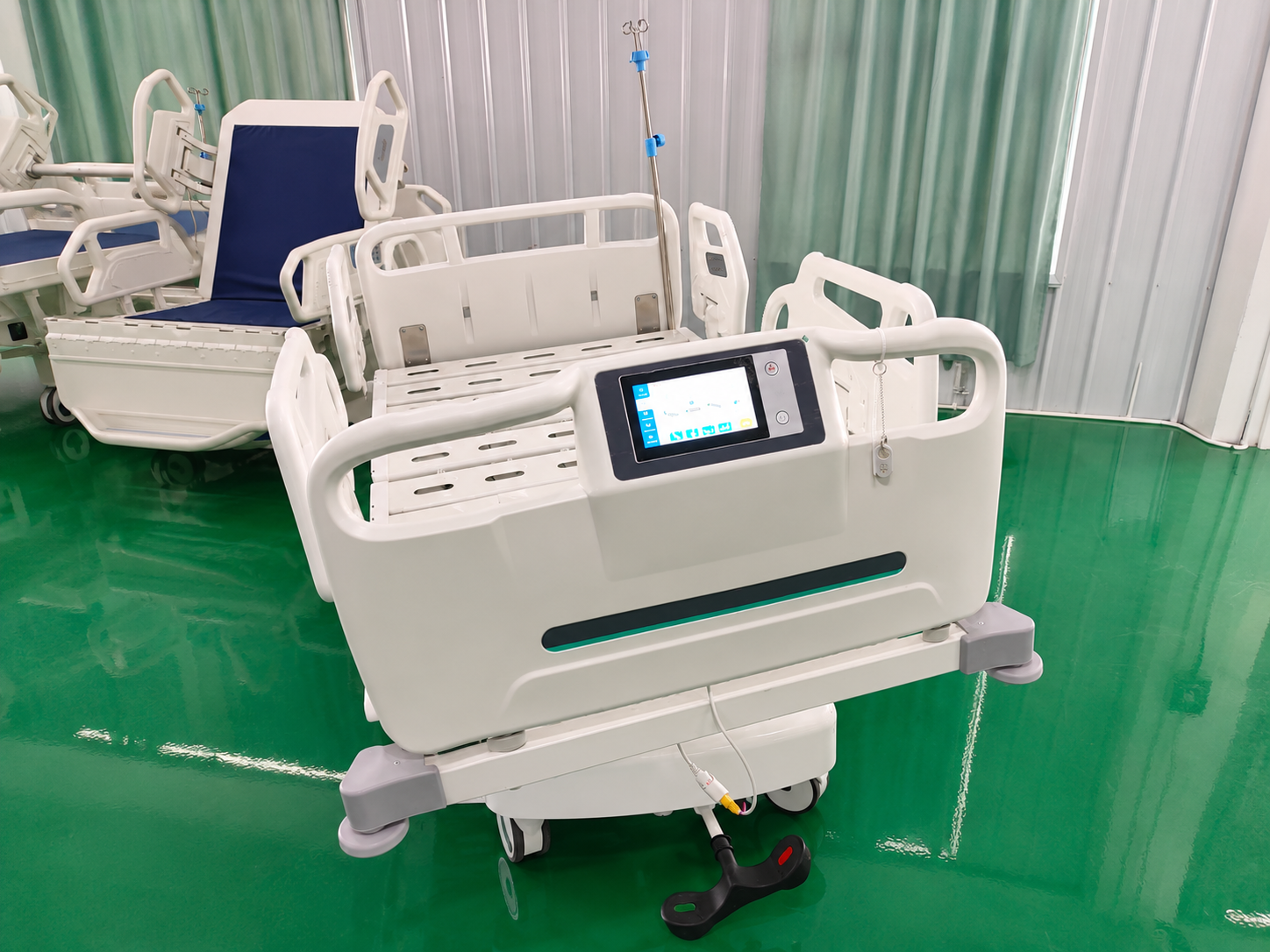
An integrated ICU bed weighing system usually uses load cells or force sensors installed in the bed frame or support structure. The system measures the total supported load and uses a zeroing or tare function to estimate patient weight.
A complete system may include:
- Load cells
- Signal-processing electronics
- Bedside display
- Nurse-control panel
- Zeroing and tare functions
- Calibration controls
- Overload protection
- Unstable-reading indicators
- Sensor-fault alarms
- Data storage or communication interface
The measurement can be affected by the mattress, bedding, attached accessories, bed position, external contact, floor conditions, and patient movement. Therefore, the operating procedure is as important as the sensor specification.
---
Accurate weight information may support:
- Medication and infusion calculations
- Fluid-balance management
- Renal replacement therapy
- Nutritional planning
- Diuretic therapy
- Bariatric-care decisions
- Trend monitoring
- Reduced patient transfers
The greatest benefit is often not a single perfect measurement, but consistent and repeatable measurements under a defined protocol.
These terms should be separated:
- Accuracy: How close the measurement is to the reference value.
- Repeatability: Whether repeated measurements under identical conditions remain similar.
- Resolution: The smallest displayed increment.
- Stability: Whether the displayed value settles and remains steady.
- Trend reliability: Whether changes over time reflect meaningful changes rather than setup differences.
A display showing increments of 0.1 kg does not necessarily mean that the overall measurement accuracy is ±0.1 kg.
| Specification | Why it matters | Questions to ask |
|---|---|---|
| Capacity | Prevents overload and supports the target patient population | What are minimum, maximum, and safe working loads? |
| Accuracy | Determines measurement reliability | Is accuracy stated as a percentage, fixed value, or both? |
| Resolution | Shows the displayed increment | Is the resolution appropriate for the clinical use? |
| Repeatability | Supports reliable trend monitoring | What is the repeatability under fixed conditions? |
| Zeroing range | Removes bed and accessory weight | Can the system tare the mattress and standard accessories? |
| Calibration method | Maintains measurement confidence | Is calibration factory-only or field-serviceable? |
| Display | Affects usability and error prevention | Is weight visible from the bedside? |
| Alarm behavior | Helps identify overload or system faults | What alarms are visual, audible, or both? |
| Data export | Supports documentation and integration | Is there a communication interface? |
| Cleaning compatibility | Protects long-term operation | Which chemicals are approved? |
| Battery backup | Maintains function during outages | Does weighing work during power loss? |
| Serviceability | Reduces downtime | Are sensors and electronics replaceable? |
Buyers should request a formal specification sheet instead of relying on phrases such as "high precision" or "hospital grade."
---
There is no single accuracy level suitable for every ICU bed. The required specification depends on:
- Clinical purpose
- Patient weight range
- Intended dosing decisions
- Measurement range
- Hospital policy
- Applicable regulatory requirements
- Whether the system is primarily for absolute weight or trend monitoring
Accuracy may be expressed as:
- ±0.5% of full scale
- ±1% of reading
- ± a fixed number of kilograms
- A combination of percentage and fixed error
These expressions are not interchangeable. For example, ±1% of full scale may produce a larger absolute error at lower patient weights than ±1% of the actual reading.
Ask the manufacturer for results at:
- Low-range load
- Typical adult-patient load
- High-range load
- Near-capacity load
The report should identify:
- Reference weight
- Displayed weight
- Permitted error
- Repeatability
- Test location
- Bed position
- Mattress and accessory configuration
- Environmental conditions
If weight information will support high-risk medication or fluid-management decisions, the hospital's clinical engineering team should approve the final performance specification.
Zeroing removes the weight of the empty bed and approved accessories. It is normally part of routine operation.
A typical procedure is:
1. Place the bed on a level floor.
2. Apply the brakes.
3. Install the approved mattress and standard accessories.
4. Remove temporary objects that should not be included.
5. Ensure that the bed does not touch a wall or external equipment.
6. Activate the zero or tare function.
7. Wait for a stable reading.
8. Document the configuration if required.
Calibration compares the system with known reference masses to verify or adjust its performance. It normally requires:
- Calibrated test weights
- A defined service procedure
- Trained personnel
- Stable environmental conditions
- Documented results
Calibration may be required:
- During production
- At scheduled intervals
- After load-cell replacement
- After major repairs
- When readings become unreliable
- According to hospital policy
Zeroing does not replace calibration. A bed can be correctly zeroed and still require calibration.
NIST explains that calibration establishes a measurement value and its associated uncertainty, while reliable measurement programs require documented and traceable procedures.
---
The exact procedure must follow the product service manual. A general verification process includes the following.
Confirm that:
- The bed is on a level floor.
- Brakes are applied.
- No caster is improperly loaded.
- No cable or tube is pulling on the frame.
- The bed is not touching a wall.
- No external object supports part of the bed.
- Vibration is minimized.
Record the condition of:
- Mattress
- Bedding
- Side rails
- IV pole
- Oxygen-cylinder holder
- Monitor shelf
- Ventilator shelf
- Drainage bags
- Other standard accessories
The calibration or zeroing configuration should match the hospital's approved procedure.
Activate the tare function with the approved empty-bed configuration. Wait until the display stabilizes.
Use calibrated test weights at specified positions. The service procedure should define:
- Reference loads
- Load locations
- Application sequence
- Stabilization time
- Permitted error
- Repeatability requirements
Document:
- Reference load
- Displayed value
- Error
- Bed serial number
- Calibration equipment
- Technician
- Date
- Pass/fail result
Keep a calibration record showing:
- Previous and next calibration dates
- Reference-weight identification
- Equipment certificate
- Corrective action
- Final approval
For a professional OEM project, the manufacturer should provide the calibration procedure, acceptance criteria, and service documentation before shipment.

A wall, cabinet, patient lift, equipment stand, or adjacent bed can carry part of the load.
A monitor, pump, blanket, or support device added after tare may change the displayed value.
Tight ventilator tubing, cables, or drainage lines can pull on the bed frame.
Coughing, repositioning, bed transfers, and vibration may prevent stable measurement.
Raising the backrest, changing height, or activating Trendelenburg may alter load distribution. The manufacturer should state the required measurement position.
Uneven floors can distribute weight unevenly across the sensors.
The weighing system must not be operated beyond its specified measurement range or safe working load.
Some systems may lose selected functions during low-battery conditions. Buyers should confirm exactly what remains operational.

Alarm behavior differs between manufacturers. Request an alarm matrix before ordering.
| Alarm or indication | Possible meaning | Buyer verification |
|---|---|---|
| Overload alarm | Load exceeds the specified range | What is the threshold and reset method? |
| Unstable reading | Movement or vibration prevents measurement | Is there a stability indicator? |
| Sensor fault | Load cell or wiring problem | Is the affected sensor identified? |
| Zeroing error | Tare range or setup is incorrect | What conditions block zeroing? |
| Low battery | Battery may not support normal operation | Does weighing continue safely? |
| Communication fault | Display or control-board connection problem | Is data stored locally? |
| Calibration due | Scheduled verification is required | How is the reminder displayed? |
| Power failure | External electrical supply is unavailable | Is emergency backup included? |
Ask whether each alarm is:
- Audible
- Visual
- Shown as a code
- Displayed on the nurse panel
- Stored in an event log
- Transmitted to another system
Clear alarm logic helps reduce confusion and unnecessary alarm fatigue.
---
Some advanced ICU beds support electronic data communication. Buyers should ask:
- Is the interface wired or wireless?
- Which protocol is supported?
- Can weight data be exported?
- Is the date and time recorded?
- Can the reading be linked to a patient identity?
- Is data stored if the network fails?
- Who can access or modify data?
- Are software updates controlled?
- Is cybersecurity documentation available?
- Can the system integrate with the hospital information system?
Do not assume that an advertised "smart bed" will connect automatically to every hospital network. Integration should be defined, tested, and approved before deployment.

For overseas brands, the weighing system must be included in the overall product-control strategy.
Ask the manufacturer:
1. Can the display and interface be private-labeled?
2. Can manuals be translated?
3. Can alarm messages be localized?
4. Are load cells standard or proprietary?
5. Are spare sensors available for the expected service life?
6. Can distributor technicians receive training?
7. Who owns customized drawings and software settings?
8. Will critical component changes be notified in advance?
9. Can factory acceptance testing be arranged?
10. Are calibration records supplied for each production batch?
The OEM agreement should define responsibility for:
- Technical files
- Calibration documentation
- Software changes
- Labels and manuals
- Regulatory submissions
- Warranty repairs
- Post-market complaints
- Spare-parts inventory
---
- [ ] Measurement range confirmed
- [ ] Accuracy definition confirmed
- [ ] Repeatability data provided
- [ ] Resolution confirmed
- [ ] Safe working load confirmed
- [ ] Test points documented
- [ ] Measurement position defined
- [ ] Zeroing procedure supplied
- [ ] Calibration procedure supplied
- [ ] Reference-weight requirements defined
- [ ] Calibration interval recommended
- [ ] Service tools identified
- [ ] Load-cell replacement procedure available
- [ ] Calibration records can be maintained
- [ ] Overload alarm tested
- [ ] Sensor-fault alarm tested
- [ ] Unstable-reading indicator tested
- [ ] Battery alarm tested
- [ ] Display visibility confirmed
- [ ] Data-export requirements confirmed
- [ ] Network integration tested, if required
- [ ] User manual supplied
- [ ] Service manual supplied
- [ ] Test reports supplied
- [ ] Risk documentation reviewed
- [ ] Labels approved
- [ ] Private-label responsibilities documented
- [ ] Warranty terms signed
- [ ] Spare-parts plan agreed
---
Consider inserting the following assets:
1. Annotated ICU bed image: Show sensor locations, display, side rails, and control panel.
2. Calibration flowchart: Explain configuration, zeroing, reference loads, recording, and approval.
3. Alarm table graphic: Present overload, instability, sensor fault, and low-battery indications.
4. Demonstration video: Show a standardized weighing procedure.
5. OEM process diagram: Display specification confirmation, prototype testing, documentation, and mass production.
Use descriptive alt text such as "ICU hospital bed weighing system calibration procedure" instead of generic image names.
---
An ICU bed weighing system should be evaluated as a complete clinical measurement solution, not as an extra feature on a hospital bed. Buyers should request evidence covering:
- Accuracy
- Repeatability
- Zeroing and calibration
- Alarm performance
- Accessory compensation
- Cleaning and electrical safety
- Data integration
- Serviceability
- Spare parts
- OEM documentation
Tianjin Kangli Medical Instrument supports overseas brands, wholesalers, distributors, and healthcare projects with customized ICU bed solutions. Contact our team to request an ICU bed weighing-system specification, calibration procedure, alarm matrix, OEM configuration, and project quotation.
---
Accuracy depends on the model, load range, sensor design, and specification method. Request results at low, typical, and high loads, together with repeatability data and test conditions.
No. Zeroing removes the weight of the bed and approved accessories. Calibration verifies performance against known reference weights.
The interval depends on the manufacturer's instructions, hospital policy, usage intensity, applicable regulations, and previous measurement history. Calibration should also be considered after sensor replacement or major repair.
The equipment adds load to the bed. It should be included before zeroing or removed before measurement according to the hospital's weighing protocol.
Some systems include battery backup, while others lose selected functions. Confirm whether the display, weighing function, alarm system, and data storage remain available.
Some models support data communication, but compatibility depends on the interface, protocol, software, and hospital infrastructure. Integration should be tested before purchase.
Request the specification sheet, accuracy and repeatability report, calibration procedure, alarm matrix, service manual, spare-parts plan, warranty terms, labels, and private-label responsibilities.
---
Editorial note: Exact accuracy, alarms, calibration intervals, and regulatory obligations vary by product model and destination market. Buyers should verify all details with the manufacturer, importer, clinical engineering department, and relevant authority.
Editorial note: Exact accuracy, alarms, calibration intervals, and regulatory obligations vary by product model and destination market. Buyers should verify all details with the manufacturer, importer, clinical engineering department, and relevant authority.


