

Views: 260 Author: Tianjin Kangli Publish Time: 2026-11-19 Origin: Site


Content Menu
● Hospital Bed vs Transport Trolley: The Essential Difference
● When a Transport Trolley Is Better for an Emergency Department
>> Frequent Transfers Between Clinical Areas
>> Rapid Assessment and Procedural Access
>> Short Care Episodes With Suitable Support
● When a Hospital Bed Is Better for Emergency Departments
>> Extended Observation and Boarding
>> Patients Requiring Frequent Position Changes
>> Ongoing Care for Higher-Risk Patients
● Why the Mattress Can Matter More Than the Product Category
● A Practical Framework for Choosing Emergency Department Equipment
>> Step 1: Separate Transport Demand From Care Demand
>> Step 2: Identify Patients Whose Needs Can Change Quickly
>> Step 3: Conduct a Realistic Product Trial
>> Step 4: Specify the Equipment Mix
● Three Procurement Checks Buyers Often Overlook
>> 1. Safe Working Load Is Not Simply Patient Weight
>> 2. Compatibility Must Be Assessed as a System
>> 3. Cleaning Performance Includes Access and Durability
● Compare Total Cost, Not Just Purchase Price
>> Is a hospital bed better than a transport trolley for every emergency patient?
>> Can a patient remain on a transport trolley overnight?
>> Do hospital beds always prevent pressure injuries better?
>> What is the difference between a transport trolley and an emergency stretcher?
>> Are all transport trolleys suitable for imaging?
>> What should an OEM buyer request before ordering?
● Discuss Your Emergency Department OEM Requirements
At Tianjin Kangli Medical Equipment Co., Ltd., we approach the question "hospital bed vs transport trolley: which is better for emergency departments?" as a workflow decision—not simply a comparison of two products. Emergency teams need equipment that supports rapid movement, safe assessment, appropriate positioning, and care that may continue longer than expected.
Founded in 1998, Kangli supports overseas brands, wholesalers, and manufacturers with OEM services for medical equipment. With a 20,000-square-meter factory and more than 50 employees, our focus is helping buyers translate clinical requirements into practical product specifications.
The short answer: a transport trolley generally suits frequent transfers and rapid patient access, while a hospital bed is often better suited to extended observation and ongoing bedside care. Many emergency departments need both.
The right choice depends on patient needs, expected care duration, available space, and the capabilities of the specific model.

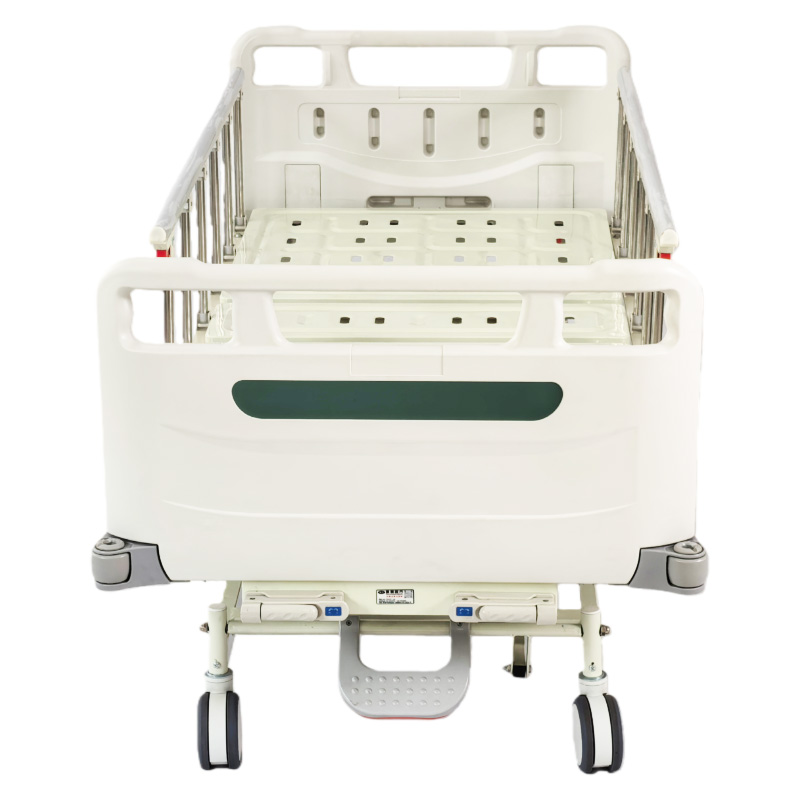
A hospital bed is primarily a platform for sustained patient care. A transport trolley—also called a patient stretcher or transfer stretcher—is primarily designed around patient movement and access.
However, these categories overlap. An advanced emergency stretcher may provide height adjustment, backrest positioning, imaging access, and a pressure-redistributing mattress. A basic hospital bed may offer fewer functions.
For this comparison, "transport trolley" means a clinical patient-transfer device, not an equipment cart or an ambulance loading stretcher.
Buyers should compare documented specifications rather than assume that every bed provides better care or every trolley moves more easily.
| Decision factor | Hospital bed | Transport trolley |
|---|---|---|
| Main purpose | Ongoing bedside care and positioning | Patient transfer and rapid access |
| Typical workflow | Observation, boarding, inpatient-style care | Assessment, movement, examinations |
| Maneuverability | Depends on dimensions, castors, and steering | Often prioritized in product design |
| Positioning | May offer multiple powered adjustments | Varies from basic to advanced |
| Pressure management | Depends on the selected support surface | Depends on mattress design and configuration |
| Imaging access | Model-specific | Model-specific; confirm compatibility |
| Space requirements | Check operating and transport dimensions | Check turning envelope and accessory clearance |
| Procurement priority | Care functions and long-stay suitability | Movement, access, and transfer performance |
A transport trolley is a strong candidate when patients move repeatedly between triage, examination rooms, imaging, treatment areas, and inpatient destinations.
The relevant purchasing question is not simply, "Does it have wheels?" It is, "How does this configuration perform along our actual transport route?"
Evaluate:
- Starting and sustained pushing effort.
- Steering through corners and doorways.
- Brake accessibility from normal working positions.
- Stability with approved accessories attached.
- Clearance around lifts, thresholds, and equipment.
- Access to the patient during movement.
A compact frame can help in confined spaces, but overall width alone does not establish maneuverability.
Emergency teams may need access from several sides of the patient. Rail design, underframe clearance, backrest operation, and accessory placement therefore deserve close attention.
For departments using mobile imaging, verify the radiolucent area and cassette or detector access. "X-ray compatible" should describe a documented capability, not a general marketing promise.
Do not assume that imaging compatibility includes MRI use. MRI suitability requires separate, explicit verification.
A trolley may suit patients undergoing brief assessment or treatment when its mattress, positioning functions, and monitoring arrangements meet their needs.
"Short stay," however, is not a universal safety threshold. Patient mobility, skin condition, clinical stability, and pressure-injury risk remain important even when a brief visit is expected.
When patients remain in the emergency department awaiting admission or ongoing assessment, equipment requirements change.
Teams may need repeated repositioning, easier personal care, suitable sleeping arrangements, and a support surface matched to the patient's risk.
A hospital bed configured for these tasks can be more appropriate than a basic transfer trolley. Nevertheless, replacing a trolley with a bed does not automatically solve pressure management, staffing, or overcrowding problems.
The complete care arrangement matters.
Patients with limited mobility may need assistance with backrest adjustment, leg positioning, height changes, and transfers.
Depending on the model, powered bed functions may support these tasks. Buyers should verify the adjustment range, control accessibility, lockout functions, and operation during power interruption.
A useful specification describes what staff and patients need to accomplish—not merely how many motors the bed contains.
Patients with fragile skin, reduced sensation, poor mobility, or difficulty repositioning require individualized assessment.
For these patients, prioritize the combination of frame, mattress, positioning capability, and care protocol. A premium frame paired with an unsuitable mattress is not a complete solution.
Side rails also require individual assessment. They are not a universal answer to falls and can introduce entrapment hazards when components are incompatible.
One common procurement mistake is comparing frames while treating mattresses as interchangeable accessories.
Pressure-injury prevention depends partly on how the support surface manages pressure, alongside repositioning, skin assessment, moisture management, and the patient's condition.
Emergency-department research identifies prolonged pressure and shear as important concerns. This makes the mattress a clinical specification rather than a cosmetic addition.
Ask suppliers to document:
1. Intended use and patient weight range.
2. Pressure-redistribution characteristics and supporting test information.
3. Mattress dimensions and compatibility with the frame.
4. Cover cleaning instructions and disinfectant compatibility.
5. Cover inspection, repair, and replacement requirements.
6. Compatibility with positioning and imaging functions, where relevant.
Avoid selecting mattresses by thickness alone. Likewise, descriptions such as "medical-grade" or "high-density" do not independently establish clinical performance.
Instead of asking which category is universally better, map the patient journey first.
Record where patients move, how often they move, and what happens between transfers.
A fast-transfer pathway has different requirements from an observation area where patients remain relatively stationary.
Use your own operational data rather than a supplier's generic bed-to-trolley ratio.
Consider how the department manages immobility, deteriorating condition, pressure-injury risk, and unexpected boarding.
Define who reassesses equipment suitability and how an alternative support surface becomes available.
Avoid rigid rules that require a patient to remain on one platform simply because it was assigned at arrival.
Test shortlisted equipment on the actual route with trained staff and an appropriate simulated load.
Include turning, braking, height adjustment, accessory management, transfer preparation, and cleaning access.
Document observations consistently so competing products face the same evaluation.
A department may benefit from transport-focused trolleys near high-movement pathways and more capable care platforms in observation areas.
This is a planning approach, not a universal layout recommendation. Clinical leadership, nursing teams, infection-prevention staff, facilities personnel, and biomedical engineering should help approve the final arrangement.
Ask how the manufacturer defines safe working load and maximum patient weight.
Depending on the product documentation, the permitted load may need to account for the patient, mattress, accessories, and other supported items.
Request written clarification rather than assuming that a headline load rating equals allowable patient weight.
The frame, mattress, rails, and accessories interact.
FDA guidance highlights entrapment risks involving openings within and around bed systems. Replacing a mattress or adding an accessory can change those relationships.
Request model-specific compatibility information. Do not assume that FDA hospital-bed guidance constitutes a certification or applies identically to every transport device.
Smooth-looking surfaces are not enough.
Ask staff to inspect joints, controls, rail mechanisms, mattress seams, and areas beneath the patient platform. Confirm approved cleaning agents, contact times, and any restrictions in the instructions for use.
A cleaning demonstration can reveal practical limitations that a product photograph cannot.
A lower unit price may not produce a lower operating cost.
Build a comparison using:
- Equipment and accessory purchase costs.
- Freight, installation, and commissioning.
- Staff training.
- Planned maintenance and spare parts.
- Battery replacement, where applicable.
- Mattress and cover replacement.
- Cleaning labor.
- Downtime and service arrangements.
Use the same evaluation period and assumptions for every option.
Avoid assigning financial savings to faster transfers, fewer injuries, or shorter stays unless your organization has credible evidence supporting those estimates.
A transparent comparison is more useful than an impressive but unverified return-on-investment claim.
No. A trolley may better support frequent movement, while a suitably configured bed may better support extended care. Match the equipment to the patient and workflow.
Suitability depends on the device's intended use, support surface, patient condition, and local clinical policy. An unexpectedly prolonged stay should trigger reassessment rather than automatic continuation.
No. The mattress, patient risk, repositioning, skin care, and overall care plan matter. Product category alone does not establish pressure-injury prevention performance.
The terms often overlap, but suppliers use them differently. Confirm intended use, adjustment functions, patient access, and transport capabilities rather than relying on the product name.
No. Verify the exact imaging application, usable radiolucent area, detector access, and manufacturer instructions. Never infer MRI suitability from an X-ray-related claim.
Request an agreed specification, model-specific technical documentation, relevant test evidence, labeling requirements, warranty terms, spare-parts arrangements, and sample-approval criteria.
Choose equipment around the care journey: transport performance where movement dominates, and appropriate bedside capability where care continues.
Contact Tianjin Kangli Medical Equipment Co., Ltd. with your target market, intended use, required functions, and estimated quantity to discuss an OEM specification and quotation.
Website: [https://www.klmedbed.com]
Email: yukili90@tjkangli.com
Phone / WhatsApp: +86 136 5207 7555
1. Tianjin Kangli Medical Equipment Co., Ltd. — Official website. Used as the company's public-facing website reference. Founding year, factory area, employee count, OEM positioning, and contact details were supplied by the company for this brief; they were not independently audited. No website case-study outcome figures were reproduced. [klmedbed]
2. Fulbrook, P., Miles, S., and Coyer, F. — "Preventing pressure injuries in the emergency department." *International Wound Journal*, 2019. Supports the discussion of emergency-department pressure-injury risks, pressure and shear, risk assessment, and preventive care. Available through PubMed Central. [pmc.ncbi.nlm.nih]
3. U.S. Food and Drug Administration — "Hospital Bed System Dimensional and Assessment Guidance to Reduce Entrapment." Supports the discussion of bed-system openings, component relationships, and entrapment-risk assessment. This is guidance, not a product certification. [fda]
4. U.S. Food and Drug Administration — "A Guide for Modifying Bed Systems and Using Accessories to Reduce the Risk of Entrapment." Supports the discussion of mattress, rail, frame, and accessory compatibility when changing existing bed systems. [fda]
5. U.S. Food and Drug Administration — "Hospital Beds." Supports individualized assessment of bed-rail use and consultation with manufacturers and facility risk-management teams. [fda]
6. MedicalExpo — "Patient transfer stretcher trolley — A 97 — Tianjin Kangli Medical Instrument." Provides a public example of a Kangli-listed hydraulic patient-transfer trolley with height adjustment, side rails, and an IV pole. Listed features should be reconfirmed against the current quotation and technical documentation. [medicalexpo]


