

Views: 268 Author: Tianjin Kangli Publish Time: 2026-09-01 Origin: Site


Content Menu
● Why Wheelchair Choice Matters Before Prosthetic Fitment
● Manual Wheelchair vs. Heavy Duty Wheelchair: The Core Difference
● When a Manual Wheelchair Is Usually the Better Choice
>> Why lighter propulsion matters
>> Manual wheelchair features worth specifying
● When a Heavy Duty Wheelchair Is the Safer Choice
>> What "heavy duty" should mean in an OEM specification
● Amputation Level Changes the Wheelchair Setup
● A Five-Step Wheelchair Selection Process for Amputees
>> 1. Define the mobility period
>> 2. Measure the user and the environment
>> 3. Assess transfers and upper-limb capacity
>> 4. Match the chair's configuration
>> 5. Build training and review into the delivery plan
● Common Buying Mistakes to Avoid
>> Choosing by weight capacity alone
>> Ordering a seat that is too wide
>> Ignoring the wheelchair's own weight
>> Forgetting anti-tip and residual-limb support
>> Treating the wheelchair as disposable
>> Skipping user and caregiver training
● FAQ
>> 1. Is a heavy duty wheelchair always better for an amputee?
>> 2. Why do amputees need anti-tip wheels?
>> 3. Can a wheelchair still be useful after prosthetic fitting?
>> 4. What seat width should an amputee wheelchair have?
>> 5. Should a temporary wheelchair be lightweight?
>> 6. What should OEM buyers request from a wheelchair manufacturer?
>> 7. How soon after amputation can prosthetic fitting begin?
For amputees awaiting prosthetic fitment, choosing between a manual wheelchair and a heavy duty wheelchair is not simply a matter of selecting the highest weight capacity. It is a temporary—but clinically important—mobility decision that affects safe transfers, residual-limb protection, sitting comfort, upper-limb effort, caregiver workload, and readiness for later prosthetic rehabilitation.
At Tianjin Kangli Medical Equipment Co., Ltd., we help international medical brands, wholesalers, rehabilitation suppliers, and healthcare manufacturers develop dependable OEM mobility and care-equipment solutions. Founded in 1998, with a 20,000-square-meter manufacturing facility and more than 50 employees, Kangli approaches wheelchair sourcing from both a product-engineering and real-world care perspective: the right chair must fit the user's body, functional ability, living environment, and expected rehabilitation pathway—not just a procurement specification.
For a person with a recent lower-limb amputation, a standard self-propelled manual wheelchair is often the more practical starting point. A heavy duty wheelchair becomes the safer option when higher user weight, a larger body frame, increased transfer forces, wider seating needs, or long-duration institutional use demand a reinforced design. The key is to avoid over-specifying strength at the expense of propulsion efficiency, fit, transportability, and user independence.
The period between amputation and prosthetic fitting can be unpredictable. Healing time, residual-limb volume changes, wound condition, pain, balance, cardiovascular endurance, strength, and access to rehabilitation all influence when and how a person begins using a prosthesis.
A wheelchair is therefore not "just temporary equipment." It can become the person's primary mobility platform during recovery and may remain a useful secondary mobility option after prosthetic fitting—for example, during nighttime bathroom trips, long-distance travel, periods of residual-limb discomfort, showering, exercise, or times when the prosthesis is not being worn.
For amputees, poor wheelchair selection can create several avoidable problems:
- Unsafe transfers from bed, toilet, shower chair, car, or therapy plinth.
- Instability or rearward tipping, especially when lower-limb mass is reduced.
- Excessive shoulder strain from propelling a chair that is too heavy or poorly configured.
- Poor residual-limb positioning, which may contribute to discomfort or unwanted joint positioning.
- Pressure and skin risks from an ill-fitting seat, unsuitable cushion, or prolonged static sitting.
- Low confidence, resulting in reduced participation in rehabilitation and daily activity.
- Higher caregiver burden when the user cannot independently propel, brake, transfer, or manage the chair.
Evidence also suggests that the wheelchair itself is only part of the solution. In a rehabilitation pilot study involving people with newly acquired lower-limb amputations, structured wheelchair-skills training improved reported performance, confidence, and frequency of wheelchair use. Participants' reported performance scores improved by an average of 42.3 percentage points after training.
That finding has a practical message for OEM buyers and care providers: a suitable wheelchair plus structured user training is more valuable than a stronger frame alone.
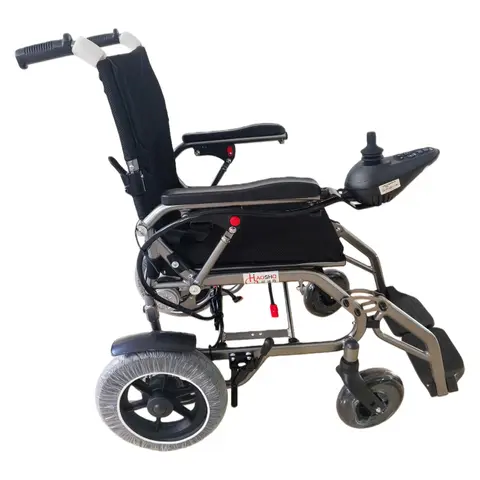
A manual wheelchair is generally designed for everyday self-propulsion, attendant pushing, short-to-medium mobility distances, and straightforward indoor or community use. It may be folding or rigid-frame, standard-weight or lightweight, and available with different seat widths, armrests, footrests, rear-wheel configurations, and accessories.
A heavy duty wheelchair—often described as a bariatric or reinforced wheelchair—is designed for users who need a higher safe working load, wider seat dimensions, increased frame durability, and additional structural support. Typical heavy duty models commonly provide capacities above standard chairs, with many product categories covering approximately 300–700 lb or more depending on model and configuration.
The central distinction is not "basic versus premium." It is mobility efficiency versus reinforced capacity.
| Selection factor | Manual wheelchair | Heavy duty wheelchair |
|---|---|---|
| Primary purpose | Everyday independent or assisted mobility | Higher-capacity, wider-seat, reinforced mobility |
| Typical user profile | Average-weight user with adequate arm strength and manageable transfer needs | Larger-bodied user, higher body weight, wider hip width, or higher structural-demand use |
| Propulsion effort | Usually lower, especially with an optimized lightweight configuration | Often higher because reinforced frames and wider components add mass |
| Seat options | Broad range; compact options are common | Wider seat sizes are often a defining feature |
| Transport and storage | Frequently easier to fold, lift, store, and load | Often bulkier and more difficult to transport |
| Stability | Can be excellent when properly configured | Often offers a wider base and reinforced structure, but does not automatically eliminate tipping risk |
| Best procurement focus | Fit, wheel setup, cushion compatibility, adjustability, ease of propulsion | Verified weight capacity, frame strength, seat width, stability, brake performance, and long-term durability |
| Common mistake | Buying an overly basic chair with poor fit or no amputee support options | Buying a chair that is unnecessarily heavy, wide, and hard to self-propel |
Bottom line: A heavy duty wheelchair is not inherently "better" for an amputee. It is better only when the person's size, weight, transfer demands, care setting, or durability requirements justify the reinforced design.
For many unilateral lower-limb amputees awaiting their first prosthesis, a well-fitted manual wheelchair is the more balanced choice. It supports mobility while encouraging active participation in rehabilitation.
A manual chair is often appropriate when the user:
- Is within the manufacturer's rated weight capacity.
- Has sufficient upper-limb strength, hand function, and endurance for self-propulsion.
- Needs to move through narrow home corridors, bathroom doorways, elevators, or compact clinical spaces.
- Will frequently transport the chair in a vehicle.
- Is expected to progress toward prosthetic ambulation and needs a practical, adaptable recovery chair.
- Requires a chair that caregivers can fold, lift, and maneuver easily.
- Benefits from adjustable footrests, removable armrests, stump supports, or anti-tip components.
After lower-limb amputation, mobility can depend heavily on the shoulders, arms, trunk control, and cardiovascular endurance. A chair that is too heavy—or configured with poor rear-wheel position, seat height, or hand-rim access—can increase effort and reduce willingness to self-propel.
This does not mean every amputee needs an ultralight wheelchair. It means procurement teams should evaluate propulsion efficiency, not just frame price. In practical use, a chair that is easier to propel may help the user practice independence, navigate daily routines, and preserve energy for therapy.
For brands or distributors sourcing manual wheelchairs for amputee rehabilitation, consider the following OEM specifications:
- Adjustable rear axle position to balance propulsion efficiency and rearward stability.
- Anti-tippers or anti-tip wheels, particularly for users with above-knee or bilateral amputations.
- Swing-away or removable leg supports to simplify transfers.
- Elevating leg rests or stump supports, where clinically indicated.
- Removable or desk-length armrests for lateral transfers under tables or beside beds.
- Reliable parking brakes that are easy to reach and operate.
- Pressure-management cushion compatibility rather than a fixed, low-quality seat pad.
- Washable upholstery and replaceable components for institutional and rental-fleet use.
- Appropriate caster size for the environment: smaller for smooth indoor floors, larger pneumatic or semi-pneumatic options for rougher surfaces.
- Seat dimensions matched to the individual, not selected solely from inventory availability.
A properly fitted chair should allow the user to sit upright without excessive pressure or friction, while leaving appropriate clearance at the hips, behind the knees, and around the armrests.
A heavy duty wheelchair is appropriate when a standard manual chair may be pushed beyond its intended structural limits. This is especially important for suppliers serving bariatric care, long-term care, rehabilitation hospitals, home-care providers, or rental fleets where durability and safety margins are core purchasing criteria.
Choose a heavy duty wheelchair when one or more of the following conditions apply:
- The user's body weight approaches or exceeds the safe working load of a standard wheelchair.
- The user needs a wider seat due to hip width, body shape, clothing, positioning needs, or comfort requirements.
- Transfers place high loads on armrests, frame joints, footrests, or brakes.
- The chair will be used intensively in a healthcare facility, long-term-care setting, or shared-equipment environment.
- The user requires enhanced stability during assisted transfers or prolonged sitting.
- A standard chair's frame, upholstery, cross-brace design, or wheel components are not suitable for the expected duty cycle.
- The patient has a larger frame and needs room for pressure-management cushions, lateral supports, winter clothing, or medical accessories without compressing the hips.
For a professional buyer, "heavy duty" should never be a vague marketing label. It should be supported by measurable product requirements.
Ask suppliers to define:
1. Maximum user weight and the test method behind that rating.
2. Seat width and depth range, including whether wider seats affect stability or capacity.
3. Frame material and tube dimensions, such as reinforced steel or aluminum construction.
4. Cross-brace, welding, and fatigue-test requirements for folding chairs.
5. Wheel, tire, caster, and bearing specifications for the intended environment.
6. Brake holding performance, especially on common slopes and transfer surfaces.
7. Armrest and footrest load performance, because transfers can apply concentrated force.
8. Cushion and accessory compatibility, including stump supports, elevating leg rests, trays, belts, and lateral positioning supports.
9. Product traceability and quality documentation for B2B tenders and regulated markets.
10. Spare-part availability, especially for brakes, tires, upholstery, armrests, footrests, casters, and anti-tip assemblies.
A higher weight capacity alone does not guarantee better clinical performance. A chair can be structurally strong yet still be too wide for a bathroom, too tall for safe transfers, too heavy for independent propulsion, or poorly balanced for a user with a high-level amputation.
The type and level of amputation affect balance, residual-limb support needs, transfer technique, and wheelchair configuration.
A person with a below-knee amputation may retain knee function but still need careful residual-limb positioning, especially during early healing. Depending on clinical advice, they may benefit from a stump support, elevating leg rest, or removable leg support.
Key considerations include:
- Avoiding pressure on sensitive surgical areas.
- Supporting the residual limb without forcing uncomfortable knee positioning.
- Enabling safe transfers without obstructive leg-rest hardware.
- Maintaining enough clearance to maneuver indoors.
Above-knee amputees often experience a more significant shift in sitting balance because of the greater loss of limb mass and leverage. Rearward tipping risk can be more pronounced, particularly when the user reaches backward, ascends ramps, or carries objects.
For these users, consider:
- Anti-tip devices as a baseline safety feature.
- A cautious rear-wheel setup that balances efficiency with stability.
- Accessible, effective brakes.
- A firm and properly sized seat cushion.
- Transfer training before independent use in higher-risk environments.
Bilateral amputees may require more individualized seating, transfer planning, and stability control. Their wheelchair may need a wider base, carefully selected anti-tip protection, customized residual-limb supports, and direct clinician assessment.
The most important decision is not whether the chair is standard or heavy duty. It is whether the chair supports safe sitting balance, controlled transfers, and functional independence.
Rather than purchasing based on one specification, use a structured assessment process.
Ask whether the wheelchair is for:
- Early inpatient recovery.
- Home discharge before prosthetic fitting.
- A short-term rental or loan fleet.
- Long-term secondary mobility after prosthetic fitting.
- Long-term care or institutional use.
Prosthetic fitting may begin only after healing, reduction in swelling, and functional readiness; for many people, fitting occurs months after surgery. A chair selected for this period should be durable enough for daily recovery needs but flexible enough to accommodate changing function.
Record:
- User weight and expected weight fluctuations.
- Hip width, thigh length, and lower-leg or residual-limb support needs.
- Seat-to-floor transfer height requirements.
- Door widths, bathroom access, elevator dimensions, and vehicle storage constraints.
- Indoor versus outdoor use.
- Terrain, ramps, thresholds, and flooring type.
For OEM programs, develop a standard measurement form for distributors, therapists, or care coordinators. This reduces preventable returns and improves patient outcomes.
Determine whether the user can:
- Apply and release the brakes independently.
- Propel using both arms.
- Perform or assist with a lateral transfer.
- Remove or swing away footrests.
- Sit without significant loss of balance.
- Manage doors, slopes, rugs, thresholds, and bathroom access.
If the user cannot safely transfer or self-propel independently, the solution may need caregiver support, transfer aids, a different seating system, or a powered mobility assessment—not simply a heavier frame.
Select a wheelchair with the required:
- Weight capacity.
- Seat width, depth, and height.
- Backrest height.
- Armrest type.
- Footrest or stump-support configuration.
- Anti-tip protection.
- Cushion interface.
- Wheel and tire type.
- Folding, transport, and storage format.
A wheelchair should be delivered with more than an instruction leaflet. The user and caregiver should understand:
- Brake use.
- Safe transfer positioning.
- Footrest removal and reattachment.
- Anti-tip use.
- Pressure-relief routines.
- Basic cleaning and maintenance.
- When to report loose parts, tire issues, skin problems, pain, or instability.
Research involving people with recent lower-limb amputations found that a structured wheelchair-skills program improved users' reported skill performance and confidence, reinforcing the value of training alongside equipment provision.
A 500 lb-rated chair may be appropriate for one user and completely unsuitable for another. Seat width, transfer height, propulsion demands, doorway access, and balance must still be evaluated.
A wider chair can feel more comfortable at first, but excessive width may reduce trunk support, make hand-rim reach harder, increase overall chair width, and prevent access through standard doorways.
A reinforced chair may meet capacity needs but become difficult to propel, fold, load, or control. This matters particularly when the user has limited shoulder strength or needs to transport the wheelchair frequently.
For amputee users, these are not minor accessories. They can be essential elements of stability and comfort, especially during early recovery.
Even if the wheelchair is temporary, it supports daily activities at a vulnerable stage of recovery. Poor fit or poor reliability can reduce confidence and increase caregiver dependence.
A well-made wheelchair cannot compensate for unsafe transfers, unlocked brakes, incorrect footrest positioning, or untrained use on slopes and uneven terrain.
For most amputees waiting for prosthetic fitment, start with a properly fitted manual wheelchair that supports safe transfers, manageable self-propulsion, residual-limb comfort, and the user's home environment. Move to a heavy duty wheelchair when body weight, seating width, transfer loads, long-term facility use, or durability requirements exceed what a standard chair is designed to handle.
The strongest decision is not "manual versus heavy duty" in isolation. It is a clinically informed match between the individual, the environment, the rehabilitation plan, and the wheelchair's measurable performance specifications.
Are you building a wheelchair product line for rehabilitation, home-care, hospital, wholesale, or private-label distribution? Contact Tianjin Kangli Medical Equipment Co., Ltd. to discuss OEM requirements, custom configurations, sample development, branding, packaging, and scalable manufacturing options.
- Website: [www.klmedbed.com]
- Email: [yukili90@tjkangli.com](mailto:yukili90@tjkangli.com)
- Phone / WhatsApp: +86 136 5207 7555
No. A heavy duty wheelchair is best when the user needs higher weight capacity, a wider seat, added structural durability, or a more robust platform for demanding transfers and institutional use. For many amputees, a properly fitted manual wheelchair is easier to propel, maneuver, transport, and use in smaller homes.
Lower-limb amputation changes the body's weight distribution and may increase rearward tipping risk, especially during reaching, ramps, transfers, or sudden changes in position. Anti-tip wheels can add an important safety margin, although the full wheelchair setup should still be assessed by a clinician.
Yes. Many people continue to use a wheelchair or crutches for specific activities, such as nighttime mobility, long distances, travel, showering, exercise, or times when they cannot comfortably wear their prosthesis.
Seat width should be based on the user's actual hip width, clothing, posture, cushion needs, and transfer requirements. A seat that is too narrow can create pressure and discomfort; one that is too wide can reduce support, increase overall chair width, and make propulsion harder.
Not always, but its weight and propulsion efficiency matter. If the user will self-propel or transport the chair frequently, an unnecessarily heavy frame can increase shoulder effort and reduce independence. The correct balance depends on user weight, body size, strength, intended environment, and durability needs.
OEM buyers should request clear information on rated capacity, frame design, seat dimensions, brake performance, wheel and caster specifications, anti-tip compatibility, accessories, quality-control procedures, branding options, packaging, spare parts, and applicable market documentation.
Timing varies by healing, swelling reduction, wound condition, residual-limb shape, overall health, and rehabilitation progress. A prosthetic fitting often begins after the incision has healed and swelling has reduced; some people begin earlier with temporary solutions, while others require a longer recovery period.

1. Tianjin Kangli Medical Equipment Co., Ltd. [Kangli Medical official website]. Accessed September 2026.
2. Charlton, K., Murray, C., Boucaut, R., & Berndt, A. "Facilitating Manual Wheelchair Skills Following Lower Limb Amputation Using a Group Process: A Nested Mixed Methods Pilot Study." *Australian Occupational Therapy Journal*, 2021. [Read the full study on PubMed Central].
3. Amputee Coalition. "Prosthetic FAQs for the New Amputee." [Read the guidance].
4. CoreMedical Group. "Wheelchair Seating and Fitting Basics for Physical Therapists." [Read the seating guide].
5. Permobil. "Wheelchair Seating & Positioning Guide." [Read the guide].
6. Karman Healthcare. "How to Pick the Right Heavy Duty Wheelchair." [Read the article].
7. Freedom Home Medical Equipment. "Bariatric Wheelchair vs. Standard Wheelchair." [Read the comparison].
8. Aracent Healthcare. "Wheelchair for Amputee: Discover Your Ideal Choice." [Read the article].
Hot Tags: China, Global, OEM, private label, manufacturers, factory, suppliers, manufacturing company


