

Views: 263 Author: Tianjin Kangli Publish Time: 2026-08-26 Origin: Site


Content Menu
● Why Continuous IV Therapy Changes Mobility Requirements
>> The Mobility Challenge for Nurses and Patients
● Transport Trolley With IV Pole vs. Standard Trolley
>> When a Standard Trolley May Still Be Appropriate
● How an Integrated IV Pole Supports Safer Ambulation
>> 1. Better Control of IV Bags and Pumps
>> 3. More Efficient Caregiver Workflow
● Essential Design Features for OEM Buyers
>> Stability and Load Distribution
>> Materials, Cleaning, and Durability
● Pre-Ambulation Safety Checklist
>> A Practical Five-Step Check
● Common Procurement Mistakes to Avoid
>> Ignoring Real Equipment Loads
>> Treating the IV Pole as an Afterthought
● Why Work With Tianjin Kangli Medical Equipment Co., Ltd.
● Start Your OEM Trolley Project
● FAQ
>> 1. What is a transport trolley with an IV pole?
>> 2. Can a standard trolley be used for continuous IV fluid delivery?
>> 3. Is it safe for a patient to lean on an IV pole while walking?
>> 4. What features improve IV trolley stability?
>> 5. How can hospitals reduce tubing hazards during ambulation?
>> 6. Can Tianjin Kangli provide OEM customization for IV pole trolleys?
Tianjin Kangli Medical Equipment Co., Ltd. is an experienced OEM partner for international medical brands, wholesalers, and manufacturers seeking reliable hospital transport and mobility solutions. Founded in 1998, with a 20,000-square-meter manufacturing facility and more than 50 employees, Kangli combines practical clinical design thinking with flexible OEM support for healthcare equipment buyers.
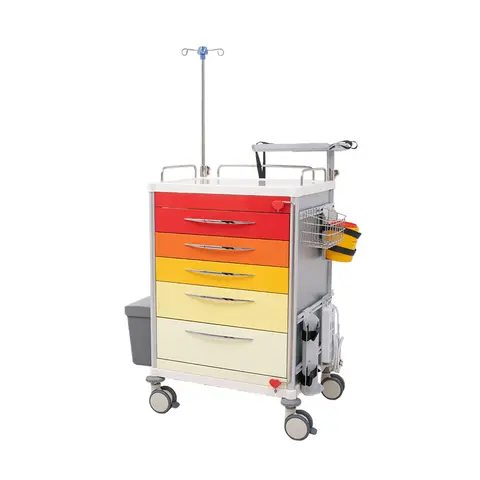
When a patient needs to walk while receiving continuous IV fluid therapy, the choice between a transport trolley with IV pole and a standard trolley is not simply a purchasing decision. It affects workflow, tubing control, stability, patient confidence, caregiver workload, and the continuity of treatment. A purpose-designed trolley with an integrated IV pole can help support safer ambulation by keeping fluid delivery equipment mobile, visible, organized, and aligned with the patient's movement.
Continuous fluid delivery can be necessary for hydration, medication administration, electrolyte replacement, nutrition, or other prescribed treatment. Yet IV therapy should not automatically mean that a suitable patient must remain in bed.
Early and supported mobility is widely recognized as an important part of hospital care. However, ambulation with IV equipment introduces practical risks. A patient, nurse, or caregiver may have to manage the patient's balance, IV line length, pump placement, fluid bags, wheels, doors, bedside furniture, and changing floor surfaces at the same time.
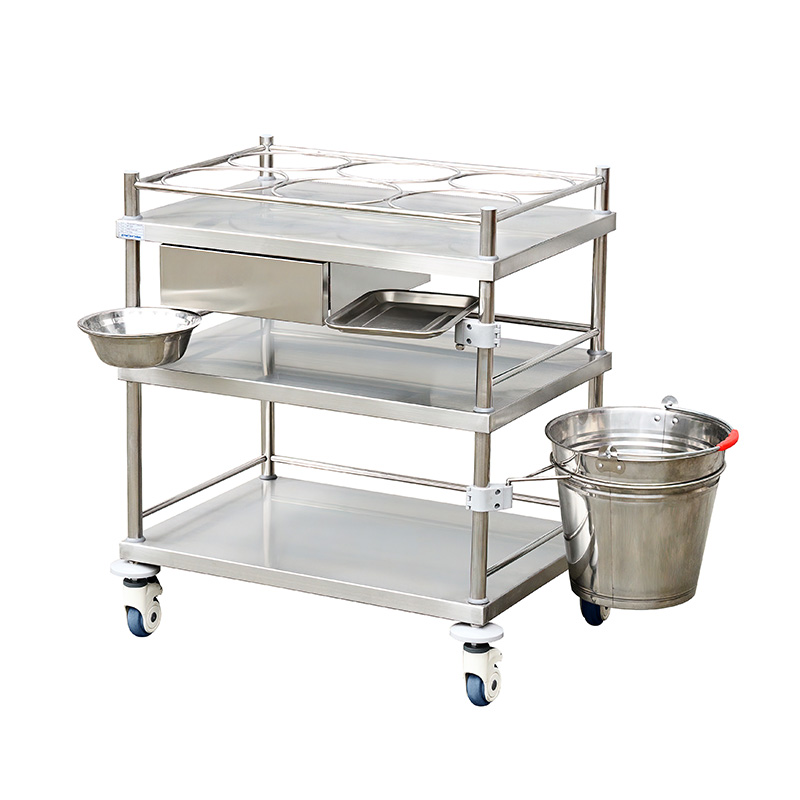
A standard trolley may be useful for moving supplies, meals, linen, instruments, or non-connected equipment. But it is often not engineered around the specific needs of continuous fluid delivery during ambulation.
A transport trolley with IV pole is designed to better integrate mobility and infusion support. The central question is not whether every patient needs one. The question is whether the equipment configuration supports the intended clinical task with sufficient stability, visibility, and control.
From an equipment-design perspective, a patient walking with an infusion system has several needs:
- A stable support platform for the IV pole, bag, pump, and accessories
- Adequate pole height to preserve prescribed flow conditions and reduce line tension
- Organized tubing routes that avoid wheels, floor contact, and obstacles
- Smooth rolling performance across common clinical surfaces
- Clear access to the patient for a nurse or caregiver providing ambulation assistance
- Easy equipment handling without making the trolley a walking aid
An IV pole should never be treated as a patient-support device. Patients should not pull on it, lean on it, or rely on it to stand. Proper ambulation support, patient assessment, and supervision remain essential. IV stand instructions commonly warn against using the stand as a walking aid, exceeding load capacity, moving over uneven surfaces, or allowing tubing and cables to create a tipping or tripping hazard.
A transport trolley with IV pole is typically a mobile clinical platform that combines storage or transport capacity with a dedicated IV-pole mounting point. In contrast, a standard trolley may offer shelves and drawers but may lack a secure pole interface, suitable center of gravity, pump-ready configuration, or purposeful line-management features.
| Selection factor | Transport trolley with IV pole | Standard trolley |
|---|---|---|
| Continuous IV fluid support | Designed to accommodate an IV pole and infusion-related equipment | May require an add-on pole or improvised positioning |
| Equipment stability | Can be designed around load distribution and an appropriate wheelbase | Stability may vary significantly with added pole and hanging loads |
| Tubing management | Can include dedicated routing and accessory locations | Tubing may cross open shelves, wheels, or walkways |
| Nursing workflow | Supports transport, supply access, and infusion organization in one setup | Often requires separate equipment pieces |
| Patient ambulation use | Better suited when a patient needs to move while infusion continues | More appropriate for general supply or equipment transport |
| OEM customization | Can be configured for pole height, hooks, drawers, baskets, and pump mounting | Usually focused on basic storage and cart movement |
| Risk-control potential | Enables a more standardized equipment configuration | Greater variation between setups and clinical teams |
The difference is especially important where a facility wants to create repeatable mobility workflows. Standardization can help staff recognize where the pump, fluid bag, tubing, accessories, and emergency supplies belong before a patient starts walking.
A standard trolley can remain a practical choice when:
- The trolley is used only for supplies and not connected to the patient
- The patient is not ambulating during active infusion
- The IV pole is independently stable and does not need to travel with the trolley
- The clinical area uses dedicated mobile infusion stands instead of combination trolleys
- Storage capacity matters more than IV integration
The key is to avoid assuming that any trolley can safely serve as an infusion mobility platform. If the trolley was not designed or validated for that role, a separate IV stand or purpose-built transport trolley may be more appropriate.
An integrated IV pole does not eliminate clinical risk. It can, however, reduce avoidable equipment-management problems when the design is appropriate and staff use it correctly.
IV poles are commonly used to suspend fluid containers and support fluid-delivery devices. They may be freestanding, attached to another device, adjustable in height, and fitted with multiple hooks.
For ambulation, a dedicated pole integration point can make it easier to keep the IV system upright and within the caregiver's visual field. This helps reduce the need to balance infusion devices on shelves or attach accessories in inconsistent locations.
A well-designed OEM configuration may include:
- Adjustable stainless-steel or aluminum alloy IV pole
- Multiple hooks for prescribed fluid containers
- Infusion-pump mounting options
- Pole clamps designed for secure attachment
- Adjustable basket or accessory tray
- Wire or line-management accessories
- A trolley frame designed to support the expected equipment load
Tubing is often the hidden issue in mobile infusion workflows. Long or poorly routed lines can drag, snag on a wheel, catch on furniture, or pull against the patient's catheter site.
Before movement, staff should inspect line routing, secure the IV access site, trace lines to their source, and confirm that tubing has enough length without excess slack near wheels or the floor. Practical IV safety guidance also emphasizes keeping lines organized, elevated where appropriate, visible, and away from travel paths.
An integrated trolley setup can help create a defined route from IV bag to pump to patient. That is more controllable than allowing tubing to travel randomly across a generic cart.
During ambulation, nurses and caregivers should focus first on the patient—not on improvising equipment placement. A trolley with integrated IV support can reduce unnecessary handling steps by bringing key components into one coordinated platform.
For example, a nurse assisting a patient down a corridor may need to observe:
- The patient's gait, fatigue, dizziness, and response to movement
- The condition of the IV site and tubing
- The pump status and alarms
- Obstacles, door thresholds, and wet surfaces
- The relationship between the patient and the trolley
A predictable configuration lets the caregiver identify problems faster. It also helps facilities train new staff using a standardized setup.
For medical brands, distributors, and healthcare equipment manufacturers, the best product is not always the trolley with the most accessories. It is the one with the right clinical purpose, load profile, materials, maneuverability, and customization options.
A mobile IV configuration must remain stable under real operating conditions—not only when empty in a showroom.
Evaluate:
- Base footprint: A wider and appropriately designed base generally improves resistance to tipping.
- Center of gravity: Heavy items mounted high on a pole can reduce stability.
- Caster diameter: Larger, quality casters can improve movement over common floor transitions.
- Caster performance: Smooth rotation, directional control where needed, and reliable braking are essential.
- Pole offset and mounting location: Pump weight and hanging loads must be considered in the design.
- Maximum safe working load: This should be clearly specified and validated for the intended configuration.
Overloading or unevenly distributing items on IV poles can make the system unstable. Industry guidance consistently warns that heavy pumps, full bags, or uneven loading may increase tipping risk.
Healthcare trolleys must withstand frequent cleaning, repeated movement, and daily contact with staff and equipment. Buyers should ask about:
- Frame material and corrosion resistance
- Surface finish and cleanability
- Drawer, shelf, and basket material
- Compatibility with the facility's cleaning procedures
- Caster wear resistance and replacement availability
- Edge finishing and user-contact safety
- Repairability over the product lifecycle
For OEM programs, material choices should align with the target market's regulatory requirements, clinical environment, and desired product positioning.
One hospital may require a compact trolley for outpatient infusion. Another may need drawers, a monitor shelf, oxygen-cylinder support, waste-bin mounts, or a large basket for inpatient use.
Useful OEM customization options can include:
| OEM option | Why it matters |
|---|---|
| Adjustable IV pole height | Supports different infusion setups and user heights |
| Pump mounting rail or bracket | Creates a dedicated, visible pump location |
| Lockable drawers | Helps organize supplies and reduce unauthorized access |
| Utility basket | Keeps lightweight consumables within reach |
| Accessory rails | Allows modular additions without redesigning the entire trolley |
| Braked medical casters | Supports controlled positioning when stationary |
| Color and branding customization | Helps distributors create differentiated product lines |
| Packaging customization | Supports international distribution and private-label requirements |
At Tianjin Kangli Medical Equipment Co., Ltd., OEM discussions can begin with the actual care setting and buyer specification—not simply with a catalog model. Since 1998, our manufacturing team has supported customers who need practical healthcare furniture and mobility solutions tailored to their market, product range, and operational requirements.
A trolley with an IV pole is only one component of a safe mobility process. The patient's condition, the therapy, the environment, and staff preparation remain decisive.
Before ambulation, qualified staff should follow facility policy and assess whether the patient is appropriate for walking. General patient-transport guidance recommends considering weight-bearing ability, alertness, balance, pain, hemodynamic stability, connected lines, and fall risk before choosing the transport method.
1. Assess the patient. Confirm that ambulation is clinically appropriate. Check alertness, balance, symptoms, footwear, and the need for assistance.
2. Inspect the infusion system. Confirm that the IV site is secure, the prescribed therapy is running as intended, and the pump is properly mounted if used.
3. Trace and organize every line. Ensure tubing is visible, untangled, not stretched, and positioned away from wheels and the floor.
4. Inspect the trolley. Check pole connection, hooks, load distribution, casters, brakes, shelves, and accessories. Do not exceed specified capacities.
5. Prepare the route. Remove obstacles, identify thresholds or slopes, and avoid wet or uneven surfaces whenever possible.
Never rush the movement process. If the equipment feels unstable, the patient appears unwell, or tubing cannot be managed safely, stop and reassess before proceeding.
In our experience supporting healthcare equipment buyers, many problems arise before the trolley ever reaches a ward. They begin at the specification stage.
The lowest-cost trolley can become more expensive if it creates frequent repairs, unstable accessory combinations, poor cleaning performance, or inconsistent user adoption. Buyers should consider total ownership cost, replacement parts, packaging protection, service support, and product life.
A trolley may perform well with an empty IV pole but behave differently once infusion pumps, fluid bags, baskets, and supplies are attached. Define the intended use case and expected load before approving the design.
A generic pole clamp added late in development may not create the right balance, working height, or line-routing path. The pole, frame, caster system, and accessories should be considered as one functional system.
Nurses, transport teams, and biomedical staff often identify the details that specifications miss: handle comfort, drawer access, cleaning difficulty, caster noise, pole adjustment, and the placement of pumps or baskets.
The strongest procurement process combines technical requirements with feedback from the people who will move, clean, maintain, and use the product every day.
Tianjin Kangli Medical Equipment Co., Ltd. is a national high-tech enterprise focused on medical equipment research, development, and manufacturing. We serve overseas brand owners, wholesalers, and manufacturers through OEM cooperation.
Our manufacturing profile includes:
- Founded: 1998
- Factory area: 20,000 square meters
- Team: 50+ employees
- Business focus: Medical equipment R&D, manufacturing, and OEM support
- Core market support: International brands, wholesalers, and manufacturers
For buyers developing a transport trolley with IV pole, we can discuss configuration priorities such as trolley dimensions, frame structure, IV-pole design, accessories, storage layout, caster specifications, color options, branding, packaging, and target-market requirements.
Our approach is practical: first understand how your customer will use the trolley, then build a product specification that supports usability, safety-oriented design, manufacturability, and brand differentiation.
If you are sourcing a transport trolley with IV pole for continuous fluid delivery during ambulation, contact Tianjin Kangli Medical Equipment Co., Ltd. to discuss your OEM requirements.
Share your target market, preferred trolley dimensions, expected load, IV-pole configuration, accessory needs, branding requirements, and estimated order volume. Our team can help turn your product concept into a structured manufacturing solution.
- Website: [www.klmedbed.com]
- Email: [yukili90@tjkangli.com](mailto:yukili90@tjkangli.com)
- Phone / WhatsApp: +86 136 5207 7555
A transport trolley with an IV pole is a mobile clinical trolley that combines storage or equipment transport functions with a dedicated pole for IV fluid containers, infusion pumps, or related accessories. It can help support organized mobility when IV therapy must continue during patient movement.
A standard trolley may be appropriate for general supply transport, but it may not have the stability, pole mounting, pump placement, or tubing-management features needed for connected-patient ambulation. The intended clinical use, loading, and facility protocol should determine the appropriate solution.
No. An IV pole or trolley should not be used as a walking aid or weight-bearing support. Patients who need assistance should receive appropriate mobility support according to clinical assessment and facility policy.
Important features include a suitable base footprint, controlled center of gravity, appropriate load limits, secure pole mounting, quality medical casters, balanced hanging loads, and a configuration that does not place excessive weight high on the pole.
Staff should secure the IV site, trace each line, remove tangles, keep tubing away from wheels and floor surfaces, confirm adequate slack without loops, clear the route, and monitor the patient throughout movement.
Yes. Tianjin Kangli Medical Equipment Co., Ltd. supports OEM projects for overseas brands, wholesalers, and manufacturers. Customization discussions may include trolley size, materials, IV-pole design, drawers, baskets, accessories, casters, branding, colors, and packaging.
1. Tianjin Kangli Medical Equipment Co., Ltd. "Kangli Medical: Hospital Bed Manufacturer China." [Company website]
2. World Health Organization. "Pole, Intravenous Infusion, Mobile." [WHO MEDEVIS device record]
3. U.S. National Library of Medicine. "DEVICE: IV Pole." [AccessGUDID device record]
4. U.S. Food and Drug Administration. "Class 2 Device Recall: Rotating IV Pole." [FDA recall record]
5. InnerSpace Healthcare. "Instruction Guide for IV Stands." [IV stand instruction guide]
6. Access Health. "Ultimate Guide to Different Types of IV Poles." [Article]
7. BeataClasp. "5 Steps to Reduce IV-Related Fall Risks in Healthcare." [Article]
8. CME Corp. "IV Poles: A Complete Buying Guide." [Article]
Hot Tags: China, Global, OEM, private label, manufacturers, factory, suppliers, manufacturing company


