

Views: 111 Author: kangli Publish Time: 2026-11-17 Origin: Site


Content Menu
● What Are Quick-Release and Fixed Rear Wheels?
● Quick-Release vs Fixed Rear Wheels: At-a-Glance Comparison
● When Quick-Release Wheels Are Worth Considering
● When Fixed Rear Wheels May Be the Better Choice
● The Safety and Maintenance Difference Buyers Must Understand
● Is the Quick-Release Upgrade Worth the Cost?
>> Evaluate the Full Cost and Value
>> Use a Good-Better-Best Product Architecture
● OEM Checklist: How to Specify Rear-Wheel Options
● A Practical Buyer Evaluation Process
● Product Images and AI Image Prompts
● FAQ: Quick-Release vs Fixed Wheelchair Rear Wheels
>> 1. What is a quick-release wheelchair rear wheel?
>> 2. Are quick-release wheels safer than fixed wheels?
>> 3. Do quick-release wheels make a wheelchair easier to transport?
>> 4. Can a fixed rear wheel be removed?
>> 5. Can quick-release wheels be added to any wheelchair?
>> 6. Should quick-release axles be offered as standard on an OEM wheelchair?
>> 7. What should a distributor check before selling a quick-release wheelchair?
● Approximate Article Word Count
How can I start an OEM partnership with your factory?
We recommend an initial technical consultation to review your design specifications. Please contact our dedicated B2B team at [Yukili90@tjkangli.com] to discuss your product requirements.
Let’s build excellence together. Whether you need a quote for a large-scale project or want to explore private labeling opportunities for our 5-function medical bed series, we are here to support your success. Click here www.klmedbed.com to connect with our B2B team and start your customized manufacturing journey today.
For wheelchair brands, wholesalers, and institutional buyers, choosing quick-release vs fixed rear wheels is a product-range decision—not just a hardware option. Quick-release rear wheels can make a manual wheelchair easier to disassemble for transport, storage, or servicing. Fixed rear wheels provide a simpler attachment arrangement. Whether the upgrade is worthwhile depends on the wheelchair's intended use, buyer expectations, price target, service capability, and the complete product design.
For OEM and private-label programs, the key question is not simply, "Which wheel is better?" It is: Which configuration creates meaningful value for the target customer without adding unnecessary cost or complexity? At Tianjin Kangli Medical Device Co., Ltd., we recommend reviewing the axle, wheel, frame, and user instructions as one system before deciding which option belongs in a product specification.
This guide explains how quick-release and fixed rear wheels differ, what buyers should consider, and how distributors can choose a configuration that fits their product range.
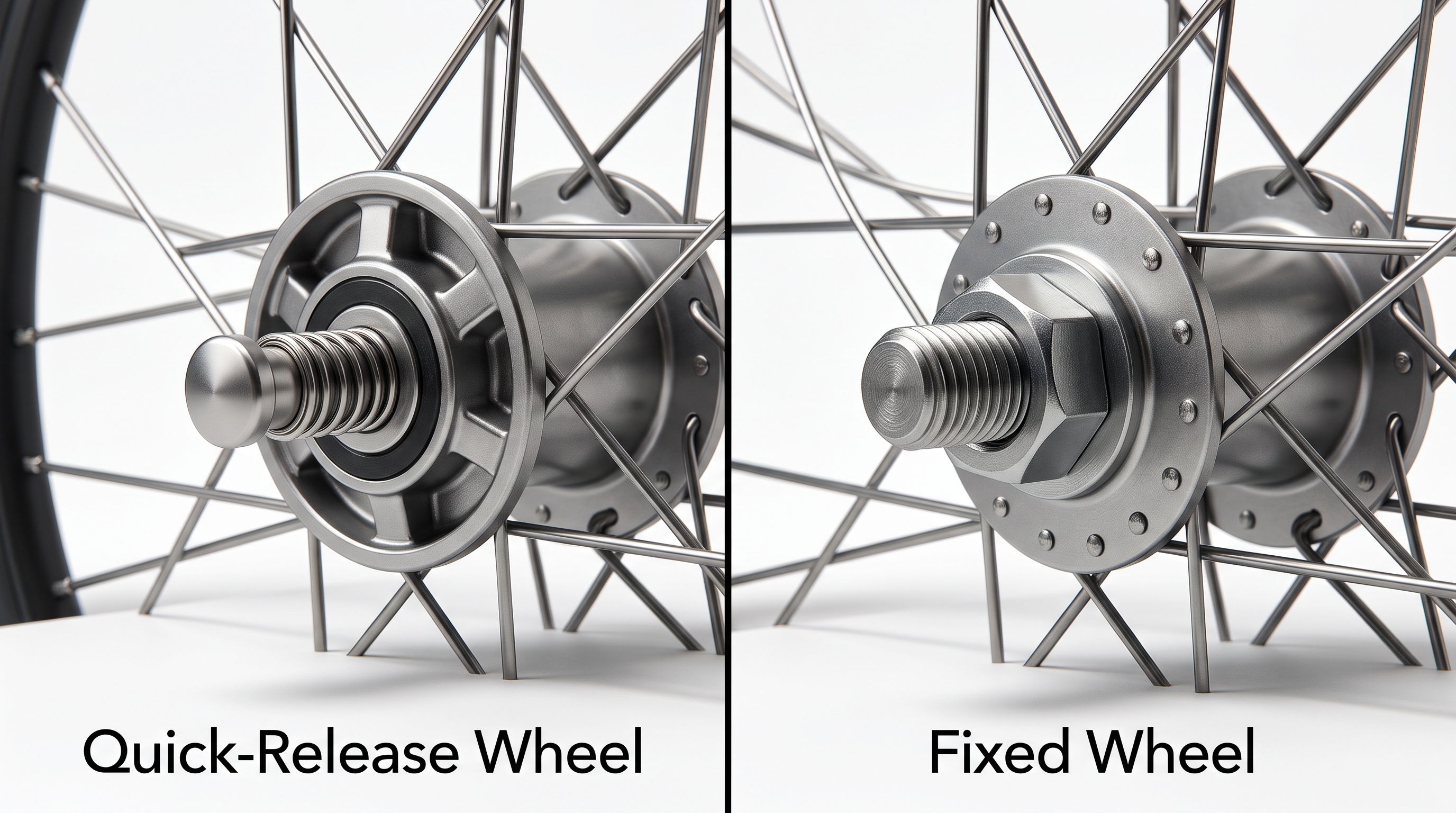
A wheelchair rear wheel attaches to the frame through an axle or axle assembly. The two terms describe how the wheel is removed and secured; they do not, by themselves, define wheel size, tire type, chair weight, or intended user.
A quick-release wheelchair wheel uses a release mechanism—commonly a push-button axle—that allows the wheel to be removed without using a separate tool for the basic removal action. The user or attendant operates the release, removes the wheel, and reinstalls it by engaging the axle into the chair's receiver.
Manufacturer instructions stress that the wheel must be correctly reinstalled and locked before the wheelchair is used. A wheel that is not fully secured can detach and create a fall hazard.
A fixed rear wheel is secured to the wheelchair in a way that is not designed for routine tool-free removal. Depending on the model, removing it may require tools and service knowledge. "Fixed" should not be interpreted as "impossible to remove" or "maintenance-free"; the precise attachment and service method are model-specific.
For distributors, it is important to confirm the exact axle arrangement rather than relying on a broad catalog label. Ask for the product drawing, assembly instructions, or a sample to verify how the wheel is attached.

| Buying factor | Quick-release rear wheels | Fixed rear wheels |
|---|---|---|
| Removal | Designed for convenient removal using the specified release mechanism. | Not intended for routine tool-free removal; service may require tools. |
| Transport and storage | Can make the chair easier to separate into components, depending on the overall design. | Wheel remains attached during ordinary handling. |
| User operation | Requires correct release and secure reinstallation. | Requires fewer user-operated wheel-removal steps. |
| Design components | Adds an axle-release and receiver interface that must be compatible and maintained. | Uses the model’s specified fixed attachment arrangement. |
| Service considerations | Requires checks for correct engagement, cleanliness, and condition of the axle system. | Service procedures depend on the attachment and should follow the product manual. |
| OEM implications | May increase configuration options and requires clear instructions and quality checks. | May support a simpler standardized specification, depending on the design. |
| Best suited to | Buyers who value tool-free wheel removal for transport, storage, or handling. | Buyers who do not require routine wheel removal and prefer a simpler user-facing setup. |
This comparison is a product-planning guide, not a claim that one option is inherently safer, stronger, or more durable. Those qualities depend on the complete wheelchair design, manufacturing controls, correct assembly, use, and maintenance.
 |  |
Quick-release wheels can be valuable when buyers have a clear use case for removing the rear wheels. Examples may include fitting a wheelchair into a vehicle, separating components for storage, or facilitating a particular service or handling process. Some wheelchair manufacturers describe tool-free rear-wheel removal as a feature that can support easier transport or lifting, though the benefit depends on the complete chair and the user's situation.
Consider quick-release wheels when:
- Transport is a regular concern. Buyers often remove the wheels to reduce the packed or lifted configuration.
- Storage space is limited. Separating components may help in some storage arrangements.
- The product range includes lightweight or configurable models. The feature may align with an expected specification in the target segment.
- A distributor wants a clear feature distinction. Quick-release can be a meaningful option if customers understand its practical use.
- Service workflows benefit from wheel removal. This should be confirmed with the service team and product instructions.
However, a quick-release axle does not automatically make the wheelchair lightweight, easy to lift, or suitable for a particular vehicle. The frame, total weight, folded dimensions, wheel size, and handling method all contribute. Avoid selling the feature as a universal solution.

Fixed rear wheels may suit a product range where buyers do not need routine tool-free wheel removal. A simpler user-facing arrangement can be appropriate for chairs intended to remain assembled during day-to-day use, provided the design meets the product's functional and service requirements.
Consider fixed rear wheels when:
- The buyer has no defined need for frequent wheel removal.
- The product specification prioritizes a standardized configuration.
- The intended distributor or facility prefers fewer user-operated steps.
- The product's target cost and feature set favor a straightforward option.
- Service teams can support the specified attachment method.
Do not assume fixed wheels eliminate maintenance. Wheels, tires, bearings, fasteners, and other components still need care according to the wheelchair's model-specific instructions. The relevant service method should be clear to the facility or technician.
The most important operational distinction is that quick-release wheels add an action the user or attendant must perform: remove and reinstall the wheel correctly. That action requires a clear procedure and a reliable check before use.
Manufacturer manuals warn users not to operate a wheelchair unless the quick-release axles are fully locked. They describe confirming engagement through the axle's locking mechanism and instruct users to keep relevant components clean. The exact check differs by model, so the chair's own manual must be followed.
For OEM buyers, include the following in the review:
- Release operation: Is the action understandable to the intended user or attendant?
- Reinstallation: Can the wheel be seated and locked as specified?
- Confirmation: Does the product documentation explain how to verify engagement?
- Cleaning and inspection: Are care instructions provided for the axle and receiver?
- Service escalation: Is it clear when a wheel or axle should be referred for professional service?
- Training and labeling: Do packaging, manual, or product labels communicate critical steps clearly?
A product should not rely on a vague instruction such as "push until secure." The model-specific manual should describe the correct installation and safety check. Buyers should not invent or reuse a check from another wheelchair model.

The upgrade is worthwhile when it solves a real customer problem and the commercial value exceeds the additional product and support costs. A buyer should compare the total product proposition, not only the axle component price.
Consider:
1. Added component and assembly cost. Confirm the difference between configurations with the supplier.
2. Inspection requirements. Determine how the axle, receiver, and locking action will be checked.
3. Documentation and training. Account for instructions, labels, and distributor or facility guidance.
4. Spare-parts planning. Confirm availability and identification of compatible axle components.
5. Customer value. Ask whether target buyers will use wheel removal often enough to value it.
6. Commercial positioning. Decide whether the feature belongs in a standard model, an upgraded SKU, or an optional configuration.
There is no universal price premium or sales uplift that applies across markets. Request actual OEM quotations and test customer interest in the relevant channel before making a range-wide decision.
For distributors serving different customer groups, a tiered range can be more effective than adding the feature to every wheelchair. For example:
- Standard configuration: fixed rear-wheel arrangement for buyers who prioritize a straightforward specification.
- Enhanced configuration: quick-release axle for customers who identify transport or removal as a requirement.
- Custom OEM configuration: a buyer-approved wheel and axle specification, subject to technical compatibility and verification.
This is a product architecture example, not a recommendation that every factory or model can offer these exact options. Confirm feasibility, compatibility, MOQ, lead time, and documentation with the manufacturer before publishing the range.
A clear RFQ or product specification should state more than "quick release" or "fixed." Include:
- Wheelchair model and frame configuration.
- Rear-wheel size and type.
- Axle type and attachment arrangement.
- Axle and receiver compatibility.
- Required removal method, if applicable.
- Assembly and locking-check instructions.
- Inspection criteria for production and pre-shipment review.
- Spare axle or wheel part numbers, if available.
- Packaging and shipping configuration.
- Market-specific labeling and documentation requirements.
Request a drawing or sample when the axle interface is critical. Confirm that the wheel, axle, receiver, frame, and any associated parts match the approved configuration. A change to one component should trigger a compatibility review rather than being treated as a cosmetic substitution.
 |  |
Use this sequence when comparing configurations for a new product range:
1. Identify the use case. Ask distributors and facility buyers how often wheels are removed and why.
2. Define the user and channel. Separate home use, institutional procurement, rental, and transport-related requirements.
3. Compare actual samples. Review removal, reinstallation, handling, and documentation on the complete chair.
4. Check safety instructions. Ensure the model-specific manual clearly explains secure installation and required checks.
5. Review after-sales readiness. Confirm spare parts, service routes, and staff guidance.
6. Compare total commercial impact. Assess costs, target price, feature differentiation, and likely customer value.
7. Approve and control the specification. Record the axle type, compatible components, drawing revision, and quality criteria.
This process helps prevent a common sourcing mistake: choosing a feature because it sounds premium, without confirming that buyers need it or that the complete product is ready to support it.
Suggested image 1: Side-by-side comparison. Show two similar manual wheelchairs, one with a fixed rear-wheel attachment and one with a quick-release axle. Add restrained labels and a close-up inset of each hub.
AI image prompt:
"Create a clean, realistic B2B product comparison image for a medical wheelchair manufacturer. Show two adult manual wheelchairs side by side in a bright neutral studio. Left: close-up detail of a fixed rear-wheel axle attachment. Right: close-up detail of a push-button quick-release axle. Accurate wheelchair proportions, professional product photography, neutral background, no logos, no text, no exaggerated claims, clear visible axle areas."
Suggested image 2: Quick-release operation sequence. Illustrate the steps of removing and reinstalling a wheel, with a prominent reminder to follow the model's manual and confirm the axle is locked.
AI image prompt:
"Create a three-panel instructional-style illustration of a manual wheelchair rear wheel quick-release system: press the axle button, remove the wheel, reinstall and verify the axle is locked according to the product manual. Show a generic wheelchair, clear close-ups, simple neutral background, safety-focused, no brand marks, no unsupported technical details, include no text so labels can be added by a technical writer."
AI-generated technical illustrations should be checked by a product engineer before publication. Do not use them as a substitute for the actual product's operating instructions or photographs.
It is a rear wheel designed to be removed using a release mechanism, commonly a push-button axle. The exact operation and locking confirmation depend on the wheelchair model.
Not inherently. Safety depends on the design, correct assembly, condition, instructions, and use. With quick-release wheels, users must confirm that the axle is fully locked before operating the chair, as specified in the model's manual.
They can make wheel removal more convenient, which may help in some transport or storage situations. The overall benefit also depends on wheelchair weight, frame design, folded dimensions, and the person handling it.
It may be removable for service, but not necessarily designed for routine tool-free removal. Follow the manufacturer's instructions and use a qualified service provider when required.
No. The axle, receiver, wheel, and frame must be compatible. Ask the manufacturer to confirm compatibility for the exact model and configuration before ordering or modifying a wheelchair.
Only if the target buyers value the feature and the product program can support its additional specification, quality checks, instructions, and service needs. Some brands may prefer it as an upgraded or optional configuration.
Confirm the wheel and axle specification, availability of the correct manual, clear installation and locking instructions, and the route for obtaining compatible replacement parts.
Motion Composites — Folding Wheelchairs User Manual — Model-specific guidance and warnings concerning removal, reinstallation, and locking of quick-release rear axles.
Permobil — Fuze JR Owner’s Manual — Instructions and warnings on quick-release axle installation and locking.
Sunrise Medical — QS7 R / QS7 R Hybrid User Information — Product information describing quick-release axles on rear wheels.
World Health Organization — Assistive Product Specification: Manual Wheelchairs for Occasional Use — Procurement specification that includes possible wheelchair configuration features such as flip-up and/or removable armrests; useful as broader specification context.
Permobil — Manual Wheelchair Guide — Overview of manual wheelchair selection considerations.
MSKTC — Manual Wheelchair: What the Consumer with Spinal Cord Injury Needs to Know — General wheelchair selection information, including configuration considerations.
Quick-release rear wheels are a worthwhile upgrade when tool-free removal addresses a clear transport, storage, or service need—and when the design is supported by compatible components, understandable instructions, and appropriate quality checks. Fixed wheels may suit buyers who do not need routine removal and prefer a straightforward configuration. The best choice is the one that fits the buyer's use case and the complete wheelchair specification.
Tianjin Kangli Medical Device Co., Ltd. supplies medical furniture and mobility products and supports domestic and export business, including distribution, tender projects, OEM/ODM, and private-label cooperation. Contact our team with your target market, wheelchair model, preferred wheel configuration, and order requirements to discuss a product specification and quotation. Company profile details and certifications should be confirmed against current official records before publication.


