

Views: 232 Author: kangli Publish Time: 2026-11-13 Origin: Site


Content Menu
● Hospital Wheelchair Maintenance Logs: What Manufacturers Can Provide to Facility Buyers
>> Suggested visual: wheelchair inspection points
● Why Hospital Wheelchair Maintenance Logs Matter
● What Manufacturers Can Provide to Facility Buyers
>> 1. Model-Specific User and Maintenance Instructions
>> 2. A Printable or Digital Maintenance Log
>> 3. Illustrated Parts and Component Identification
>> 4. Spare-Parts and Service Information
>> 5. Cleaning and Storage Guidance
● What a Hospital Wheelchair Maintenance Log Should Record
● Designing a Model-Specific Inspection Checklist
>> Separate Routine Checks From Technical Service
● A Practical Workflow for Facility Buyers
● OEM Documentation: A Checklist for Buyers and Manufacturers
● New Expert Perspective: Treat the Log as a Feedback Loop
>> Suggested visual: maintenance-log workflow
● Common Maintenance-Log Mistakes to Avoid
● FAQ: Hospital Wheelchair Maintenance Logs
>> 1. What is a wheelchair maintenance log?
>> 2. Does a manufacturer have to provide a maintenance log?
>> 3. How often should hospital wheelchairs be inspected?
>> 4. Can one maintenance checklist be used for all wheelchair models?
>> 5. What should staff do when they find a defect?
>> 6. Should the log include serial numbers and parts replaced?
>> 7. Can a manufacturer customize a log for a private-label wheelchair?
● Work With Tianjin Kangli Medical on OEM Documentation
>> Summary
*An OEM documentation guide for hospitals, care facilities, wheelchair brands, and distributors.*
A hospital wheelchair maintenance log helps a facility track inspections, servicing, repairs, and recurring issues across its wheelchair fleet. For facility buyers, a useful log is more than a blank form: it should connect each wheelchair to its model and serial number, identify what was checked, record any action taken, and show when the next service is due. For wheelchair brands, wholesalers, and manufacturers, providing a practical wheelchair maintenance record template can make product handover and after-sales support clearer.
At Tianjin Kangli Medical, we recommend that buyers discuss maintenance documentation as part of the OEM specification—not as an afterthought once products arrive. A log should complement the wheelchair's model-specific user manual and the facility's own maintenance procedures. It cannot replace either one. Wheelchair manufacturers note that maintenance needs and intervals vary by model and use; facilities should follow the manual for the specific chair.
This guide outlines what a wheelchair manufacturer can provide, what a hospital maintenance log should record, and how OEM buyers can make documentation useful across a fleet.
How can I start an OEM partnership with your factory?
We recommend an initial technical consultation to review your design specifications. Please contact our dedicated B2B team at [Yukili90@tjkangli.com] to discuss your product requirements.
Let’s build excellence together. Whether you need a quote for a large-scale project or want to explore private labeling opportunities for our 5-function medical bed series, we are here to support your success. Click here www.klmedbed.com to connect with our B2B team and start your customized manufacturing journey today.
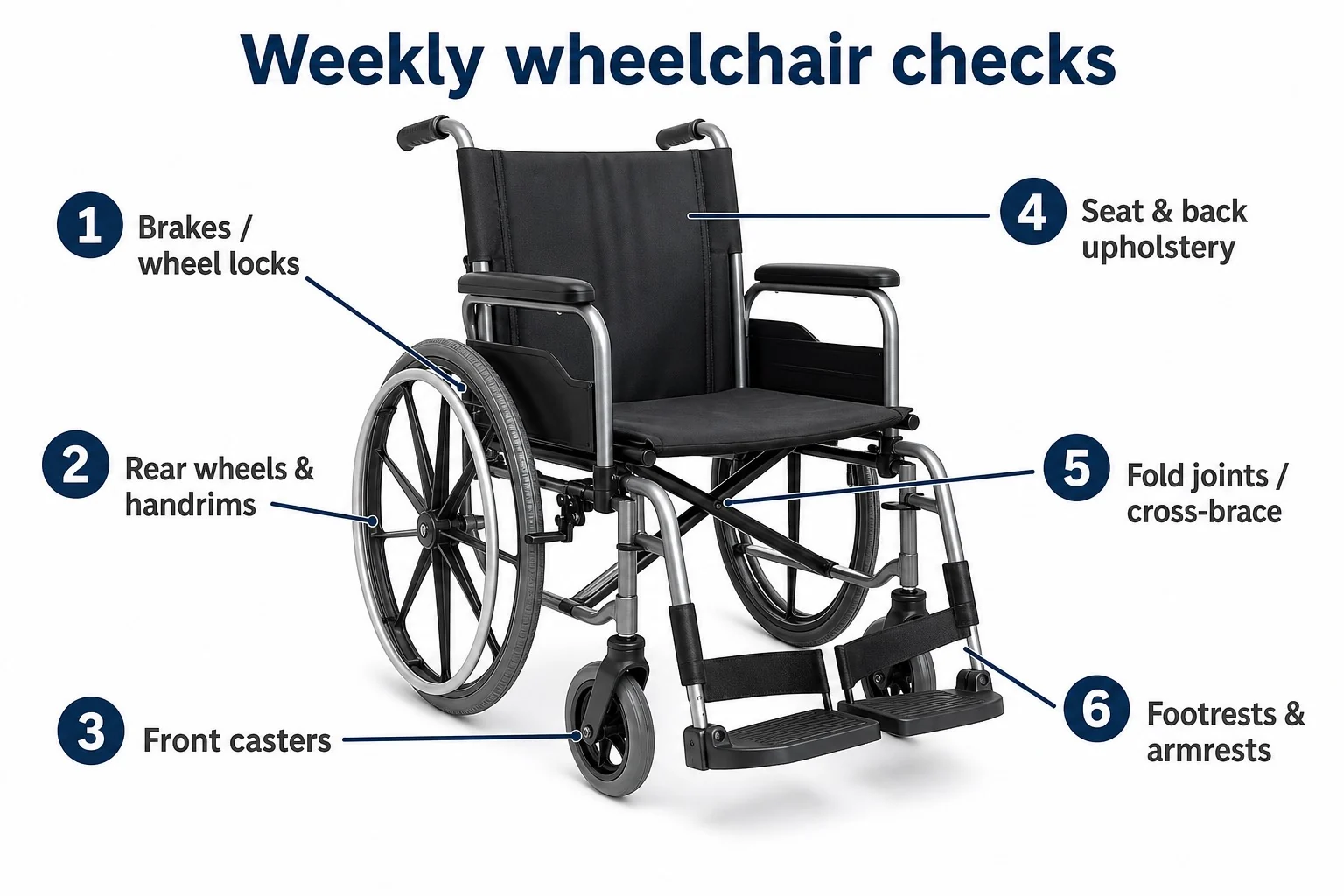
A labeled diagram can help staff identify the parts named in a maintenance log, such as brakes, wheels, casters, frame joints, seat, and footrests.
Hospitals and care facilities often manage multiple wheelchairs, models, and use patterns. Without a consistent record, it can be difficult to know which chair was checked, what was found, whether a fault was resolved, or whether a unit should be referred for service.
A structured maintenance log can support:
- Asset identification: Staff can link each record to the correct wheelchair.
- Inspection continuity: The next person can see what was checked previously.
- Repair follow-up: Open faults can be assigned and tracked rather than forgotten.
- Service planning: Teams can identify due dates and recurring problems.
- Supplier communication: Facilities can provide clearer details when requesting parts or technical support.
Maintenance checklists commonly call for recording the wheelchair's identity, inspection date, findings, parts replaced, unresolved issues, and sign-off. These are useful recordkeeping practices, but the specific inspection tasks and service intervals must come from the relevant product instructions and facility policy.
A maintenance log should not imply that a wheelchair is safe simply because a form has been completed. The inspection must be performed by an appropriately trained person, using the manufacturer's instructions and the facility's procedures.
A manufacturer can supply documentation that helps a facility identify, inspect, and maintain a wheelchair correctly. Buyers should request a documentation package that matches the exact model and configuration being purchased.
The user manual should identify the wheelchair, explain its intended use, and provide relevant care and maintenance guidance. It should distinguish routine checks from adjustments or repairs that require a trained technician or authorized service provider.
Manufacturers advise users to consult the manual for the particular wheelchair because maintenance requirements vary by model and component.
The manufacturer can provide a blank form or editable file that facility staff can adapt. It may be offered as a printable PDF, spreadsheet, or digital template, provided the information fields remain clear and usable.
The template should include:
- Facility or department.
- Wheelchair asset ID and serial or batch number, as applicable.
- Model and configuration.
- Inspection or service date.
- Name or identifier of the person performing the check.
- Checklist results and notes.
- Parts adjusted or replaced.
- Outstanding faults and their status.
- Action owner and target completion date.
- Sign-off and next review date, where defined by facility procedure.
A digital log may support reminders or searchable records, but the manufacturer should avoid implying that a particular software system is required unless that is part of the agreed service.
An exploded view or labeled parts diagram can help facility staff describe a component when reporting an issue. Useful diagrams may identify items such as wheels, casters, brakes, armrests, footrests, upholstery, frame parts, and push handles.
The diagram should match the purchased model and revision. If an image is generic, label it clearly so it is not mistaken for a complete service instruction.
Facility buyers can ask for a parts list or ordering guide that links the wheelchair model to the appropriate replacement components. Useful information includes part names, part numbers, compatible models or configurations, and the correct contact route for technical questions.
The manufacturer should also explain how buyers can report a fault and what information to provide—for example, the model, serial or batch identification, a description of the issue, and photographs when appropriate.
Hospitals may have established cleaning and infection-control procedures. The wheelchair manufacturer should provide product-specific guidance on compatible cleaning methods and any restrictions stated in the product instructions.
A general maintenance form should not invent disinfectant compatibility or cleaning frequencies. Those details need to be checked against the specific wheelchair documentation and the facility's infection-prevention policy.
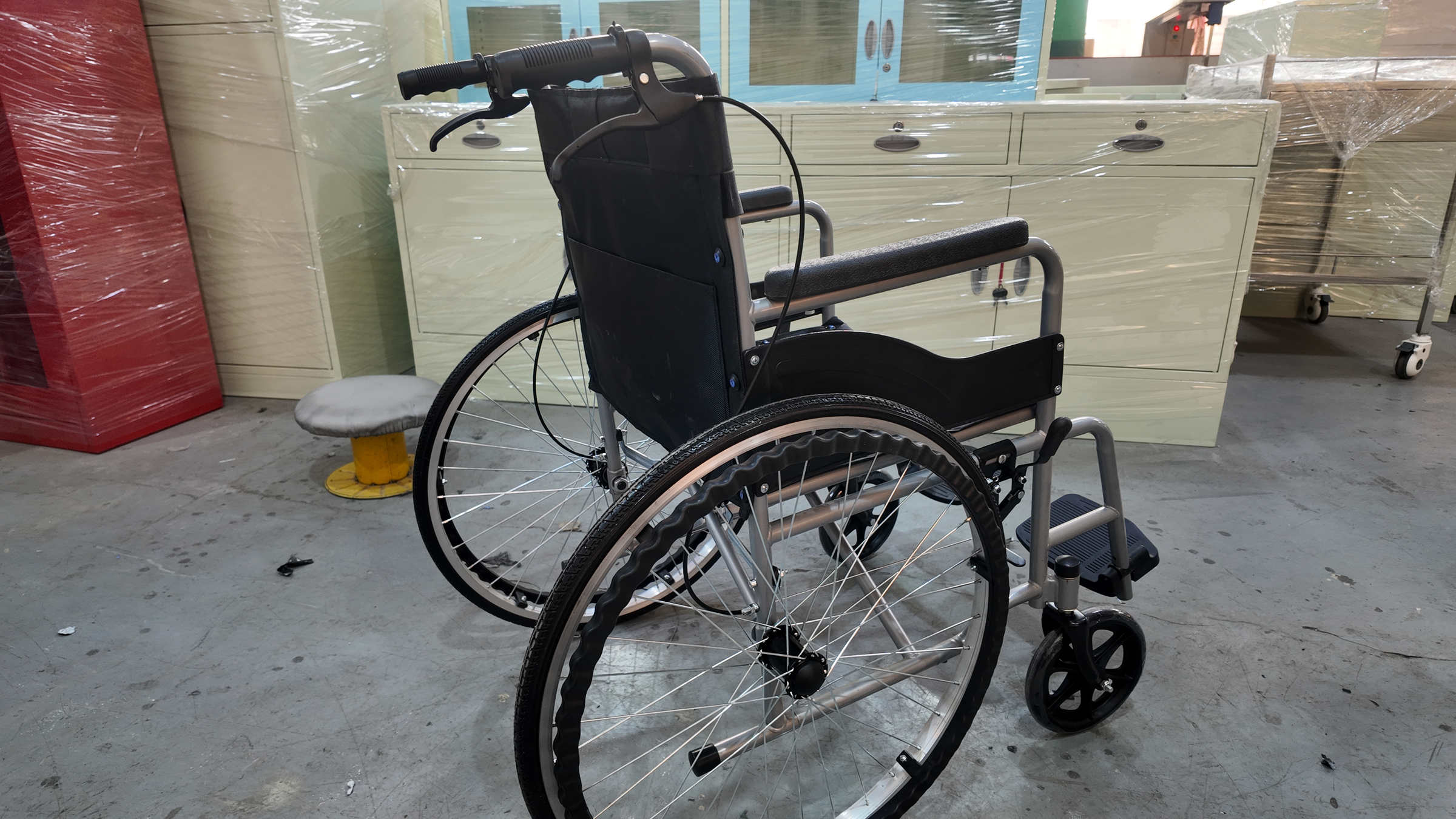
A practical log should make a record traceable, understandable, and actionable. The exact checks will differ between manual and powered wheelchairs and between models; the list below describes record fields, not a universal inspection protocol.
| Log section | Information to record | Why it helps |
|---|---|---|
| Asset identity | Asset ID, model, serial or batch number, location | Connects the entry to the right chair. |
| Inspection details | Date, inspector, inspection type or reason | Shows when and why the record was created. |
| Checks performed | Checklist items completed and results | Makes the scope of the inspection visible. |
| Findings | Fault description, location, severity or priority per facility policy | Helps direct the next action. |
| Work completed | Adjustment, cleaning, repair, or parts replaced | Preserves service history. |
| Open actions | Action owner, status, target date, escalation | Makes unresolved issues trackable. |
| Release or status | In service, restricted, or removed from use according to facility policy | Communicates the current disposition. |
| Sign-off | Staff name or identifier and completion confirmation | Supports accountability and handover. |
A good record distinguishes "checked and passed," "not checked," and "action required." A blank field should not be interpreted as a pass. If a fault has not been resolved, the record should show its status and the facility's next step.
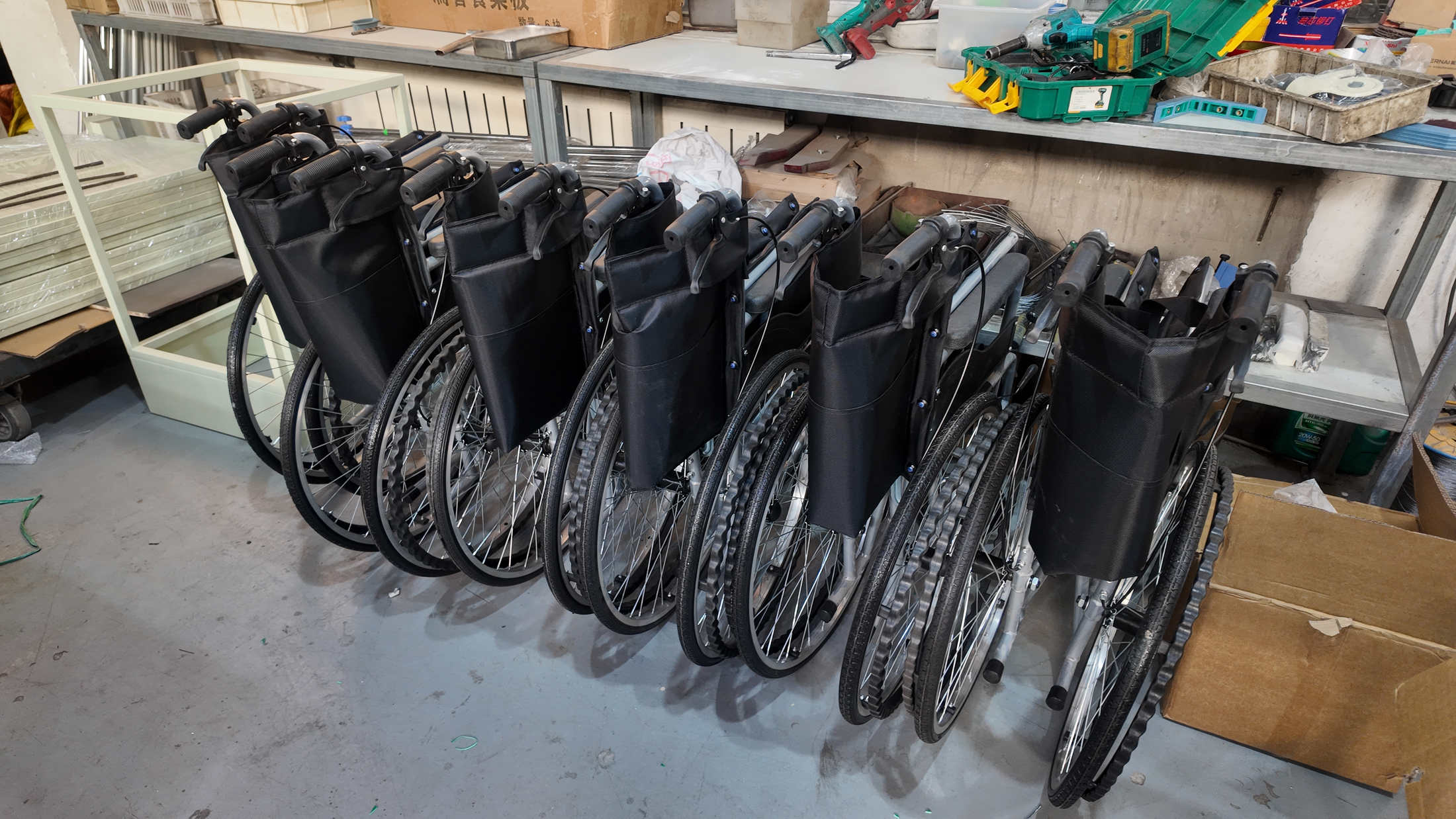
The manufacturer can help the facility translate the product manual into a usable checklist. The checklist should name the component, state the check to perform, and provide a place to record the outcome. It should not give unapproved repair instructions or replace service procedures.
Depending on the model and the manufacturer's instructions, checklist sections may cover:
- General condition: visible damage, loose components, or abnormal wear.
- Wheels and casters: condition, movement, and any specified checks.
- Wheel locks or brakes: condition and function according to the manual.
- Frame and folding components: visible damage and operation, where applicable.
- Seat, backrest, and upholstery: condition and attachment.
- Armrests and footrests: presence, attachment, and operation as applicable.
- Powered components: only for relevant powered models, following model-specific instructions and staff training requirements.
- Cleaning and readiness: completion under facility procedures.
These examples are not a substitute for the manufacturer's check procedure. For example, a wheelchair maintenance resource may identify tire condition, wheel locks, caster assemblies, and other parts for review, while the applicable checks and service guidance remain model-dependent.
A facility log should make clear which tasks are routine observations and which require a qualified service person. This distinction is important for repairs, adjustments, or component replacement that the user manual restricts to trained personnel.
A manufacturer can support this by using labels such as:
- Routine check: Follow the stated user or facility procedure.
- Refer for service: Do not attempt an adjustment beyond the documented scope.
- Report a fault: Provide the model and asset details through the stated support channel.
The exact wording should match the product manual and the buyer's service arrangement.
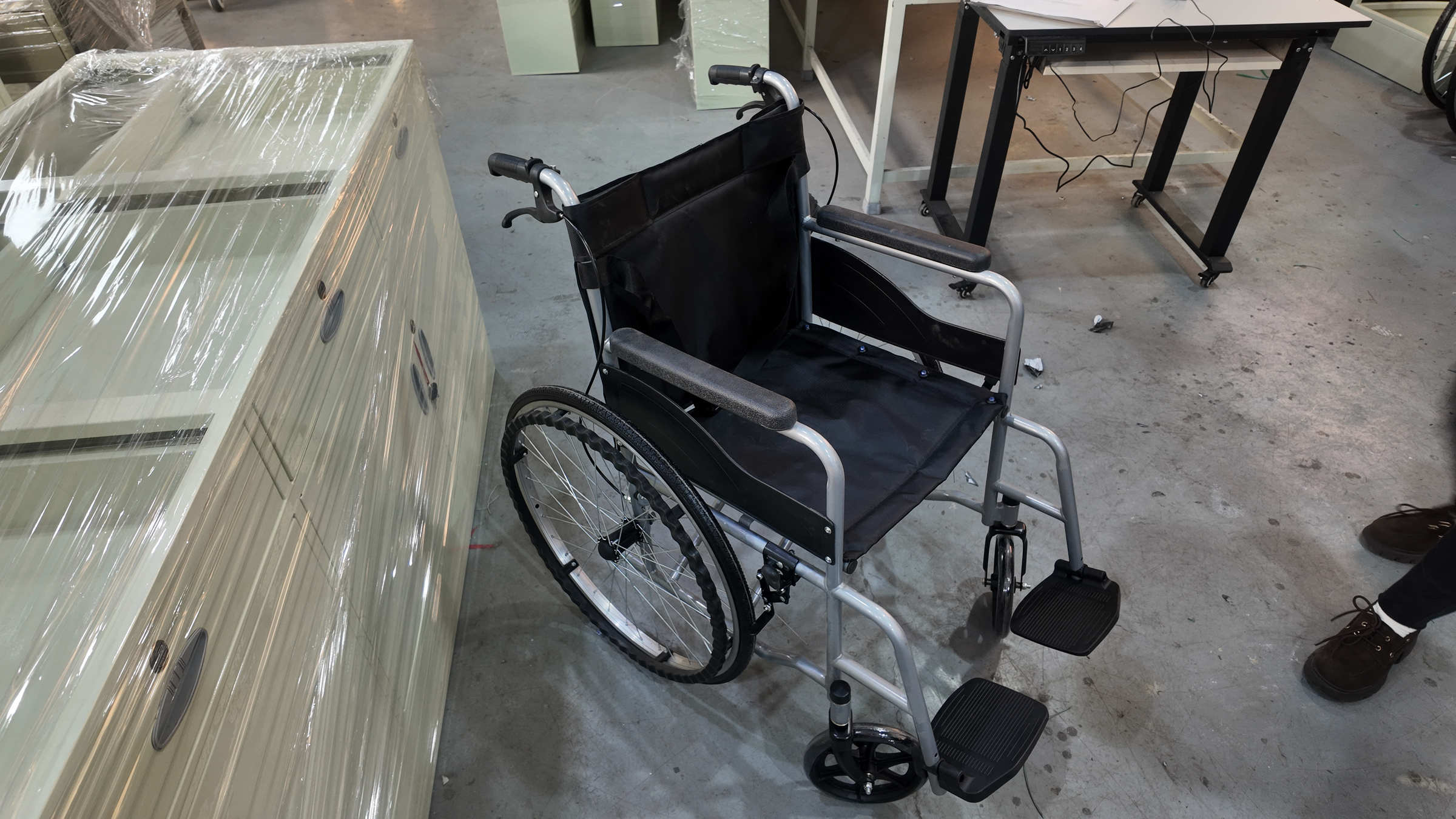
A maintenance log works best when it is part of a repeatable process, not an isolated form.
1. Identify the wheelchair. Confirm asset ID, model, and serial or batch information.
2. Consult the correct manual. Verify that it matches the chair and configuration.
3. Assign the inspection. Record who is responsible under facility policy.
4. Complete the applicable checklist. Use only the checks and intervals approved for that model and setting.
5. Record findings clearly. Describe what was observed; avoid vague notes such as "needs attention."
6. Escalate unresolved issues. Record the action owner and status according to facility procedure.
7. Document completed work. Include parts replaced or work performed where relevant.
8. Update the chair's status. Follow facility policy for release, restriction, or referral for service.
9. Retain the record. Store it in the facility's chosen asset or maintenance system.
Some digital checklist systems include asset details, photographs, assigned actions, and sign-off, illustrating how a log can connect an inspection to follow-up work. The system itself is optional; the essential point is that findings are not lost between inspection and action.
For overseas brands, wholesalers, and institutional buyers, maintenance documentation should be included in the product and packaging review. Before approving an OEM order, confirm:
- Model match: The manual and diagrams correspond to the supplied wheelchair.
- Language and market: Required languages and terminology are agreed.
- Revision control: Document numbers and revisions are visible.
- Maintenance boundaries: Routine checks are separated from technical service.
- Replacement parts: Part identification and ordering information are clear.
- Cleaning guidance: Instructions match the product and approved materials.
- Log format: The facility can print, edit, or transfer the template into its system.
- Change notification: Buyers know how documentation updates will be communicated.
- Support route: Warranty, service, and technical contacts are identified.
For private-label programs, the buyer and manufacturer should agree who approves translations, artwork, instructions, and changes. A document carrying a brand logo should still be technically accurate for the exact product supplied.
A maintenance record can help a facility and manufacturer identify patterns—but only when entries are sufficiently specific. Repeated reports of the same component issue, recurring repair requests, or frequent questions about a particular adjustment may indicate a need to review instructions, staff training, parts availability, or product design.
A useful review process can group records by:
- Wheelchair model and configuration
- Component or fault category
- Time in service
- Action taken
- Repeat occurrence
- Parts or support requested
These records can inform a quality or service discussion, but they do not establish the cause of a problem by themselves. Any suspected safety issue should be escalated through the facility's procedures and the manufacturer's appropriate reporting channel.
A simple graphic can show the process: identify the chair → inspect using model-specific instructions → record the result → assign follow-up → close the action. A short video could demonstrate how to locate the model and serial information, provided it does not substitute for the product manual.
2026-11-13
 |
|
- Using one checklist for every wheelchair: Models and components vary; match records to the product.
- Recording only "pass" or "fail": Add enough detail to identify the check and any follow-up.
- Leaving open faults without an owner: Assign responsibility and status under facility policy.
- Treating the log as the maintenance program: The form supports procedures; it does not define them.
- Providing generic instructions as model-specific guidance: Label generic templates clearly and link to the relevant manual.
- Failing to update documents after a product change: Ensure revised models have the correct manual, parts diagram, and log references.
It is a record of inspections, findings, service actions, parts replaced, and follow-up for an identified wheelchair. Facilities may use paper or digital records.
Requirements depend on the product, market, contract, and applicable regulations. Buyers can request a model-specific template and documentation package as part of OEM or institutional procurement.
There is no single interval appropriate for every model and facility. Follow the wheelchair's user manual and the facility's maintenance policy. Manufacturer guidance notes that maintenance frequency depends on the function and component.
A general template can provide common record fields, but inspection steps should reflect the particular model and its instructions. Keep model-specific procedures and components clearly identified.
Follow the facility's procedures and the manufacturer's instructions. Record the issue, communicate it to the responsible person, and document the disposition. Do not treat an unresolved fault as cleared simply because it has been entered in a log.
Yes, where available and appropriate. Asset and model identification help connect a service record to the correct wheelchair; recording replaced parts can support future troubleshooting and ordering.
A manufacturer and brand owner can agree on a branded template, but its content must match the supplied product, approved instructions, and target market. Translations and revisions should be reviewed before release.
A wheelchair maintenance log is most useful when it matches the chair, supports the facility's workflow, and points staff to the correct model-specific instructions. For OEM buyers, the key is to agree on the documentation package before shipment: manuals, maintenance record template, parts identification, cleaning guidance, revision control, and support contacts.
Tianjin Kangli Medical welcomes inquiries from international wheelchair brands, wholesalers, and facility suppliers about OEM documentation and product requirements. Share the target market, wheelchair models, branding and language needs, and preferred log format to begin a discussion about the documentation package for your project.
Contact Tianjin Kangli Medical to discuss an OEM wheelchair documentation package for your facility buyers.
Wheelchair Maintenance Checklist for Healthcare — InspectWrk — Example of asset identification, findings, follow-up actions, and sign-off fields for a healthcare maintenance checklist.
Wheelchair Maintenance — Sunrise Medical — Manufacturer guidance emphasizing the model-specific manual and maintenance needs.
Maintaining Your Manual Wheelchair — Sunrise Medical — General manufacturer information noting that maintenance depends on wheelchair model and use.
Maintaining Your Ride: Manual Wheelchair Maintenance — Permobil — Manufacturer maintenance discussion covering wheels, casters, and other manual wheelchair components.
Wheelchair Maintenance Checklist for Healthcare — InspectWrk — Digital checklist example including documentation and assigned follow-up tasks.


