
Views: 235 Author: Tianjin Kangli Publish Time: 2026-08-04 Origin: Site


Content Menu
● Why Hospital Beds Matter More Than Ever
● What Buyers Should Look for in Hospital Beds
>> 1. Safety and load capacity
>> 2. Material and frame quality
>> 3. Adjustability and ergonomics
>> 4. Cleaning and infection control
>> 5. Compliance and quality systems
● Why Tianjin Kangli Is a Strong OEM Partner
>> Manufacturer strengths that matter
● What Makes a Hospital Bed "Good" in Real Use
>> Practical performance indicators
● Industry Trend: Smarter and More Specialized Beds
>> Key trends shaping the market
● Expert View: How to Choose the Right Supplier
>> A simple supplier selection framework
● Why OEM Buyers Trust Long-Term Manufacturing Partners
● Why Choose Tianjin Kangli Medical Equipment Co., Ltd.
● FAQ
>> 1. What is the main advantage of Tianjin Kangli Medical Equipment Co., Ltd.?
>> 2. Can Tianjin Kangli provide OEM services for hospital beds?
>> 3. What types of hospital bed buyers does Kangli serve?
>> 4. Why are hospital beds becoming more advanced?
>> 5. What should buyers check before ordering hospital beds?
>> 6. How can I contact Tianjin Kangli?
When healthcare brands, distributors, and manufacturers search for reliable hospital beds, they are not simply looking for a product. They are looking for a long-term manufacturing partner who understands safety, comfort, compliance, and delivery consistency. That is exactly where Tianjin Kangli Medical Equipment Co., Ltd. has built its reputation.
Founded in 1998, Kangli has spent more than two decades focused on medical device R&D and manufacturing. With a 20,000 square meter factory, 50+ employees, and deep OEM experience, the company supports overseas brands, wholesalers, and producers with hospital bed solutions designed for real-world clinical use. In an industry where bed quality directly affects patient care and caregiver efficiency, this level of specialization matters.
For buyers comparing hospital bed suppliers, the most important question is not only "Who can make the bed?" but also "Who can deliver a bed that performs consistently in hospitals, clinics, long-term care centers, and high-volume healthcare environments?" That is the standard Kangli aims to meet.

Hospital beds are no longer basic furniture. They are clinical tools that support patient recovery, caregiver workflows, infection control, and safety. In modern healthcare settings, the demand for electric hospital beds, adjustable hospital beds, and smart hospital beds continues to rise as hospitals modernize and patient expectations increase.
Market reports show steady growth in the global hospital beds sector through 2026 and beyond, driven by aging populations, chronic disease management, expanding healthcare infrastructure, and increasing use of connected care equipment. At the same time, hospitals are paying more attention to patient positioning, pressure-injury prevention, mobility support, and operational efficiency.
From a manufacturing point of view, this means a hospital bed must do more than look durable. It must be engineered for:
- Structural strength
- Long-term stability
- Easy cleaning
- Safe patient positioning
- Caregiver convenience
- OEM customization flexibility
That is why manufacturers with deep technical experience are gaining more attention from global buyers.
Not all hospital beds are built for the same use case. A procurement team should evaluate more than price alone. In my experience, the best purchasing decisions start with performance, compliance, and after-sales reliability.
A high-quality hospital bed should support the expected patient weight safely and remain stable under repeated use. Industry guidance commonly places standard hospital beds around 180–200 kg, while ICU beds may require 250 kg or more depending on the application.
The frame should be strong, corrosion-resistant, and suitable for frequent disinfection. Steel structures, durable surface coating, and reliable welding quality all matter because hospital beds are used intensively.
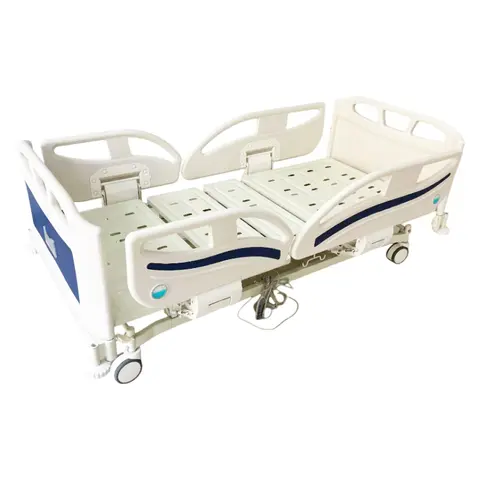
Beds with adjustable backrest, knee rest, height, and trendelenburg functions can improve patient comfort and reduce caregiver strain. In modern care environments, ease of positioning is a major purchasing factor.
Hospitals increasingly demand surfaces and components that are easy to clean and maintain. Smooth finishes, removable parts, and designs that reduce dirt accumulation are valuable in high-turnover environments.
Buyers should confirm whether the manufacturer works under relevant quality management systems and can support export requirements such as CE-related expectations, ISO-based processes, and healthcare procurement standards.
For overseas brands and distributors, OEM support is essential. The best suppliers can customize dimensions, accessories, colors, bed structures, packaging, and branding to fit the target market.
Tianjin Kangli Medical Equipment Co., Ltd. is not positioned as a general furniture maker. It is a specialized medical equipment manufacturer with a clear focus on hospital bed development and OEM supply.
- Founded in 1998, with long-term industry experience.
- 20,000 square meters of factory space, supporting scalable production.
- 50+ employees, enabling focused manufacturing and operational support.
- Strong emphasis on R&D and medical equipment manufacturing.
- OEM service capability for foreign brand owners, wholesalers, and producers.
- A product approach centered on durability, practicality, and clinical usability.
For buyers, that combination is important because hospital bed procurement is rarely a one-time transaction. Most brands need a supplier that can support repeat orders, product updates, and market-specific customization over time.
In addition, Tianjin Kangli's positioning as a China-based OEM supplier makes it attractive to international customers who want:
- Competitive manufacturing cost.
- Flexible customization.
- Faster adaptation to market requirements.
- Scalable export production.
A hospital bed should be judged by how it performs in daily operations, not only by the catalog page. During field use, the best beds share a few practical characteristics.
- Quiet operation when adjusting positions.
- Stable structure with minimal wobble.
- Reliable locking wheels for safe movement.
- Comfortable mattress compatibility.
- Easy assembly and maintenance.
- User-friendly side rails and controls.
- Strong resistance to wear and disinfectants.
Hospital staff care about speed and safety. Patients care about comfort and dignity. Procurement teams care about total cost of ownership. The right bed should satisfy all three.
A useful example: in high-throughput hospitals, a bed with better frame strength and easier cleaning often creates more value than a cheaper alternative that needs frequent maintenance or replacement. This is where manufacturing discipline becomes a competitive advantage.
One of the biggest changes in the hospital bed market is the move toward smart and specialized designs. Hospitals are no longer buying only one standard type of bed for every department. Instead, they are selecting beds based on clinical use, patient risk profile, and staff workflow.
- Electric adjustment systems are becoming more common.
- Patient safety features are increasingly important.
- Pressure injury prevention is a growing priority.
- Remote monitoring and connected care are gaining traction.
- ICU-specific and bariatric designs are expanding.
- Home healthcare and post-acute care beds are creating new demand.
For manufacturers, this means the future is not only about volume. It is about the ability to support more functional, more specialized, and more compliant products.
Tianjin Kangli's OEM model is well aligned with this direction because it allows buyers to adapt products to market trends without building manufacturing capability from scratch.
From an industry perspective, the strongest hospital bed suppliers usually excel in three areas: engineering, consistency, and communication.
1. Check technical capability: Does the supplier understand hospital use scenarios?
2. Review product structure: Are the beds durable, stable, and easy to maintain?
3. Confirm OEM depth: Can the supplier support branding and market customization?
4. Evaluate manufacturing scale: Is production large enough for repeat orders?
5. Assess responsiveness: Can the team communicate clearly and quickly?
6. Examine export readiness: Can the supplier support international buyers professionally?
This framework helps reduce risk. It also helps buyers compare suppliers based on value, not only unit price.
For brands expanding into new markets, the most reliable partner is often the one that can provide engineering support, responsive service, and consistent output at the same time.
OEM buyers are different from one-time retail buyers. They care about continuity. They need a supplier that can help them protect brand reputation and maintain product consistency across repeated shipments.
A strong OEM hospital bed partner should provide:
- Stable quality control
- Customization support
- Packaging and branding flexibility
- Consistent lead times
- Export-oriented service
- Fast communication for project changes
Tianjin Kangli's model is built around those expectations. That makes it especially relevant for companies that want to enter or expand in the medical furniture market without compromising product quality or brand identity.
If you are looking for a hospital bed manufacturer that combines experience, OEM flexibility, and medical manufacturing focus, Tianjin Kangli deserves serious consideration.
- Founded in 1998.
- 20,000 square meters of factory space.
- 50+ employees focused on medical equipment manufacturing.
- OEM service for global brands, wholesalers, and manufacturers.
- Strong alignment with the needs of modern hospital bed buyers.
- Practical experience in building products for reliable clinical use.
In a competitive market, the best supplier is not the one who promises the most. It is the one who can deliver consistently, communicate clearly, and help your business grow with confidence.
If your business needs a dependable hospital bed OEM partner, Tianjin Kangli Medical Equipment Co., Ltd. is ready to support your next project.
Company: Tianjin Kangli Medical Equipment Co., Ltd.
Website: https://www.klmedbed.com
Email: yukili90@tjkangli.com
Phone / WhatsApp: +86 136 5207 7555
CTA: Contact us today to discuss your hospital bed OEM requirements, request a product catalog, or start a customized project.
Tianjin Kangli combines long manufacturing experience, OEM capability, and a dedicated medical equipment focus, making it suitable for overseas buyers who need stable hospital bed supply.
Yes. The company supports OEM services for foreign brand owners, wholesalers, and manufacturers who need customized hospital bed solutions.
Kangli mainly serves international brands, distributors, wholesalers, and production partners looking for reliable medical bed manufacturing support.
Hospital beds are evolving because healthcare systems need better patient safety, easier caregiver workflows, improved comfort, and smarter clinical functionality.
Buyers should review load capacity, frame quality, adjustability, cleaning design, compliance support, customization ability, and the supplier's manufacturing consistency.
You can visit the official website, send an email to yukili90@tjkangli.com, or contact the team by phone/WhatsApp at +86 136 5207 7555.
1. Global hospital beds market growth and forecast trends
https://www.thebusinessresearchcompany.com/report/hospital-beds-global-market-report
2. Hospital beds market outlook and growth drivers
https://www.marketresearchfuture.com/reports/hospital-beds-market-6441
3. Hospital beds manufacturing and compliance overview
https://www.hospitalbeds.com/
4. Tianjin Kangli Medical Equipment Co., Ltd. official website
https://www.klmedbed.com
5. Tianjin Kangli company profile / product information
https://www.medicalexpo.com/
Hot Tags: China, Global, OEM, private label, manufacturers, factory, suppliers, manufacturing company


