
 English English

Views: 648 Author: kangli Publish Time: 2026-09-11 Origin: Site


Content Menu
● Five-Function vs. Ten-Function ICU Beds: How to Choose by Project Requirements
● What Do "Five-Function" and "Ten-Function" ICU Beds Mean?
>> Typical Five-Function ICU Bed Configuration
>> Typical Ten-Function ICU Bed Configuration
● Five-Function vs. Ten-Function ICU Beds: Main Differences
● How to Choose Based on Patient Acuity and Clinical Workflow
>> Five-Function Beds May Be Suitable When:
>> Ten-Function Beds May Be Suitable When:
● Which ICU Bed Functions Should Buyers Examine Closely?
>> 2. Backrest and Knee-Rest Adjustment
>> 3. Trendelenburg and Reverse Trendelenburg
>> 5. Integrated Patient Weighing
● A Practical Project-Selection Matrix
● Technical Questions to Ask an ICU Bed Manufacturer
● Why OEM Buyers Need a Detailed Technical Specification
● Infection Control and Cleanability Should Be Procurement Criteria
● Five-Function or Ten-Function: A Simple Decision Rule
● Why Work with Tianjin Kangli Medical Device for OEM ICU Beds?
>> 1. Is a ten-function ICU bed always better than a five-function model?
>> 2. What are the standard functions of a five-function ICU bed?
>> 3. Does a ten-function ICU bed include patient weighing?
>> 4. Which ICU bed is better for a budget-sensitive hospital project?
>> 5. What should an OEM buyer include in the purchase contract?
>> 6. Can a five-function ICU bed be customized?
>> 7. How should buyers compare quotations from different manufacturers?
How can I start an OEM partnership with your factory?
We recommend an initial technical consultation to review your design specifications. Please contact our dedicated B2B team at [Yukili90@tjkangli.com] to discuss your product requirements.
Let’s build excellence together. Whether you need a quote for a large-scale project or want to explore private labeling opportunities for our 5-function medical bed series, we are here to support your success. Click here www.klmedbed.com to connect with our B2B team and start your customized manufacturing journey today.
Choosing between a five-function ICU bed and a ten-function ICU bed is not simply a question of selecting more features. The right decision depends on the clinical workflow, patient acuity, nursing requirements, hospital infrastructure, budget, maintenance capability, and target-market regulations.
For international medical brands, wholesalers, distributors, and healthcare-equipment manufacturers, a successful ICU bed project should begin with a clear technical specification—not a catalog comparison. A five-function bed may be the most practical choice for a general ICU, step-down unit, or budget-sensitive project. A ten-function ICU bed may be more suitable for advanced critical care, high-acuity patients, bariatric applications, or hospitals that need integrated weighing and positioning functions.
At Tianjin Kangli Medical Device, we provide OEM and private-label ICU bed manufacturing services for overseas brands, distributors, wholesalers, and medical-equipment companies. This guide explains how to compare five-function and ten-function ICU beds and how to select the correct configuration for a real procurement project.
> Medical disclaimer: This article provides procurement guidance, not clinical treatment advice. Final specifications should be confirmed by the hospital's clinical engineering, nursing, infection-control, and regulatory teams.

The term "function" normally refers to an independently adjustable bed movement or integrated operating feature. However, manufacturers do not always count functions in the same way.
One supplier may count Trendelenburg and reverse Trendelenburg as two separate functions. Another may describe them as one tilt system. Some suppliers count a manual CPR release as a function, while others list it separately as a safety feature.
Therefore, buyers should never compare only the numbers "5" and "10." Request a function-by-function list.
A five-function electric ICU bed commonly includes:
1. Electric backrest adjustment
2. Electric knee-rest or leg-rest adjustment
3. Electric height adjustment
4. Trendelenburg positioning
5. Reverse Trendelenburg positioning
Depending on the manufacturer, the same bed may also include:
- Manual CPR release
- Four-section mattress platform
- Protective side rails
- Central-locking casters
- IV pole sockets
- Bumpers
- Nurse-control panel
- Battery backup
- X-ray-accessible back section
These accessories and safety features should be listed separately in the quotation.
A ten-function ICU bed may include the five functions above plus additional capabilities such as:
- Electric lateral tilt
- Integrated patient weighing
- Cardiac-chair positioning
- Automatic contour positioning
- Electric calf or foot adjustment
- Bed extension
- Integrated CPR positioning
- Additional nurse-control functions
- Advanced accessory or equipment rails
The exact configuration varies by model. The important point is that a ten-function bed should deliver measurable clinical or operational value—not merely a higher feature count.
---
| Evaluation factor | Five-function ICU bed | Ten-function ICU bed |
|---|---|---|
| Initial purchase cost | Usually lower | Usually higher |
| Operating complexity | Easier to learn and maintain | Requires more training |
| Clinical positioning | Covers essential movements | Supports more advanced positioning |
| Patient weighing | Usually external or unavailable | May be integrated |
| Lateral positioning | Often unavailable | May be available |
| Nursing workflow | Suitable for standard care | Better for complex critical-care workflows |
| Maintenance requirements | Relatively simple | More motors, sensors, and control systems |
| Training needs | Lower | Higher |
| Best fit | General ICU, step-down, public procurement | Advanced ICU, high-acuity, specialist projects |
| Procurement risk | Lower specification complexity | Requires stronger validation and service support |
A five-function ICU bed is not automatically a basic or low-quality product. If it is well designed, it may provide all the positioning functions required by the project.
Likewise, a ten-function ICU bed is not automatically the better investment. Additional mechanisms can increase cost, maintenance requirements, training time, and the number of components that require inspection.

The first question should be:
> What type of patient care will this bed support every day?
- The unit provides general intensive care.
- The hospital needs essential electric positioning.
- The project has a strict budget.
- Staff need simple and reliable controls.
- Local maintenance resources are limited.
- Integrated weighing is not essential.
- The procurement specification emphasizes core functions.
- The hospital operates a step-down or high-dependency unit.
- The beds will be used as a standardized fleet.
A five-function model can be especially practical for hospital groups purchasing large quantities. Standardizing one reliable model may simplify staff training, spare-parts management, and maintenance.
- Patients require frequent repositioning.
- The ICU treats complex or unstable cases.
- Lateral tilt supports the clinical workflow.
- Continuous weight monitoring is required.
- Cardiac-chair positioning is regularly used.
- The hospital has trained biomedical engineers.
- The facility can maintain sensors and electric actuators.
- The project includes advanced critical-care departments.
- The procurement specification requests integrated positioning features.
A ten-function model is more likely to justify its cost when each additional function is connected to a clearly defined clinical or operational requirement.
A wide height range helps healthcare workers position the bed for patient care, transfers, procedures, and cleaning.
Ask for:
- Minimum platform height
- Maximum platform height
- Adjustment speed
- Noise level
- Safe operation under load
- Emergency lowering capability
- Motor duty cycle
Do not evaluate height adjustment only by maximum height. The minimum height may be just as important for patient access and fall-risk management.
Independent adjustment can support patient comfort and clinical positioning.
Verify:
- Backrest angle
- Knee-rest angle
- Movement speed
- Anti-pinch protection
- Mechanical stability
- Control-panel operation
- Emergency override
These functions tilt the mattress platform head-down or head-up. Their availability and operating range should be confirmed in the technical datasheet.
Ask:
- What is the maximum angle?
- Is the function electric or manual?
- Can it be operated from the nurse panel?
- Is there an emergency return function?
- Does the bed remain stable with accessories installed?
- Can the movement be performed safely under the rated load?
Lateral tilt can be valuable in advanced ICU workflows, but its usefulness depends on hospital protocols and staff training.
Confirm:
- Left and right tilt range
- Maximum permitted patient weight
- Accessory clearance
- Side-rail behavior
- Mattress compatibility
- Emergency reset
- Risk-control instructions
A lateral-tilt feature should be tested with the actual mattress, side rails, IV poles, monitors, and other accessories used by the hospital.
A weighing system may reduce the need to transfer a patient to a separate scale. However, the procurement team should examine accuracy, calibration, operating conditions, and data display.
Ask:
- What is the weighing range?
- What is the accuracy or tolerance?
- Does the system compensate for accessories?
- How is it calibrated?
- What happens when the battery is low?
- Can the display be locked?
- Are service tools required?
- Is the weighing function documented for the target market?
Do not assume that an integrated weighing function is suitable for every clinical purpose. The hospital's clinical engineering team should determine whether the accuracy meets its intended use.

Use a scoring system before requesting quotations.
| Requirement | Weight | Five-function score | Ten-function score |
|---|---|---|---|
| Core electric positioning | High | Strong | Strong |
| Integrated weighing | High | Limited or unavailable | Stronger |
| Lateral positioning | Medium/High | Usually unavailable | May be available |
| Simple operation | High | Strong | Moderate |
| Low purchase cost | High | Strong | Moderate |
| Advanced ICU workflow | High | Moderate | Strong |
| Local service capability | High | Easier | More demanding |
| Spare-parts simplicity | Medium | Strong | Moderate |
| Long-term total cost | High | Often predictable | Depends on service quality |
The score should be completed by representatives from:
- Intensive-care nursing
- Physicians
- Biomedical engineering
- Procurement
- Infection control
- Finance
- Regulatory or quality management
- Facilities and logistics
This approach prevents the purchasing decision from being based only on a sales brochure.
Before requesting a final quotation, ask the manufacturer to answer these questions in writing.
- What exact functions are included?
- Which functions are electric and which are manual?
- What is the safe working load?
- Is the bed suitable for adult ICU patients?
- What mattress dimensions are required?
- Is the platform radiolucent or X-ray compatible?
- Are the side rails split, full-length, or four-section?
- Is a CPR release available?
- Is a cardiac-chair position included?
- What voltage and frequency does the bed support?
- Which plug type will be supplied?
- What is the motor brand and rated load?
- Is battery backup included?
- How long can the battery operate under normal use?
- Is there overload protection?
- Is an emergency mechanical release available?
- What ingress-protection rating applies to electrical components?
- Can the controls be locked?
- Is there an emergency-stop function?
- Are there anti-pinch features?
- Are the brakes centralized?
- What is the caster diameter?
- Does the bed include corner bumpers?
- Are there audible or visual alarms?
- Can accessories be installed without reducing stability?
- Is the factory certified to ISO 13485?
- What inspections are performed before shipment?
- Are load and endurance tests documented?
- How are changes controlled?
- How are nonconforming beds handled?
- Can you provide a user manual and service manual?
- Are spare parts available for several years?
- What is the warranty period?
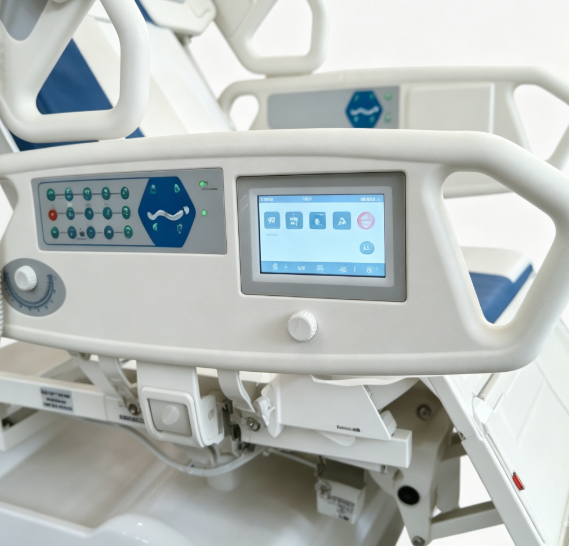
For overseas brands and distributors, a vague quotation creates risks. The product may be manufactured according to the supplier's standard instead of the buyer's intended specification.
A proper OEM specification should identify:
- Exact bed model
- Function list
- Dimensions and tolerances
- Load rating
- Electrical requirements
- Materials and surface treatment
- Accessories
- Packaging requirements
- Labeling and branding
- Inspection criteria
- Warranty terms
- Spare-parts requirements
- Delivery conditions
- Change-approval procedure
Before mass production:
1. Approve a complete sample.
2. Record the exact functions.
3. Confirm materials and colors.
4. Test the controls and emergency features.
5. Confirm packaging.
6. Sign the inspection standard.
7. Use the approved sample as the production reference.
This process is particularly important for private-label projects where the hospital bed will carry the buyer's brand.
---
ICU beds have many surfaces that are touched, cleaned, and disinfected repeatedly. Buyers should evaluate cleanability as part of product design.
Check:
- Smooth mattress-platform surfaces
- Rounded corners
- Protected electrical connections
- Limited dirt-collecting gaps
- Removable mattress sections
- Easy-to-clean side rails
- Sealed or protected actuators
- Chemical-resistant coatings
- Accessible caster housings
Ask the supplier for cleaning instructions and compatible disinfectants. The hospital should confirm whether the bed materials are compatible with its actual cleaning protocols.
> Visual recommendation: Add a close-up product image showing side rails, control panels, casters, mattress-platform joints, and cleaning-access areas. A short cleaning demonstration video would improve user understanding.
---
Choose a five-function ICU bed when:
- Essential electric positioning is sufficient.
- Budget and simplicity are priorities.
- The hospital has limited technical-service capacity.
- The project requires large-scale standardization.
- Advanced weighing and lateral tilt are not needed.
Choose a ten-function ICU bed when:
- The clinical workflow requires advanced positioning.
- Integrated weighing provides real operational value.
- Lateral tilt or cardiac-chair positioning is needed.
- The hospital can support additional maintenance and training.
- The project specification requires advanced ICU functionality.
The best option is the bed that satisfies the project's real requirements with the lowest reasonable complexity—not necessarily the bed with the highest function count.
---
For international brands, distributors, and manufacturers, OEM cooperation should include more than product supply.
A qualified OEM partner should support:
- Product configuration
- Technical drawings
- Sample development
- Private-label branding
- Packaging customization
- Quality inspection
- Export documentation
- Spare-parts planning
- Production scheduling
- After-sales communication
At Tianjin Kangli Medical Device, we work with overseas customers to define the required ICU bed configuration before production. Buyers can discuss five-function or ten-function models, accessories, branding, packaging, electrical requirements, and project-specific inspection criteria.
Contact our team with your target market, quantity, required functions, and technical specifications to receive a project-oriented OEM recommendation.

No. A ten-function bed offers more features, but the additional functions may not be necessary for every ICU. The best choice depends on clinical workflow, patient acuity, budget, service capacity, and regulatory requirements.
A typical five-function ICU bed includes backrest adjustment, knee-rest adjustment, height adjustment, Trendelenburg, and reverse Trendelenburg. The exact definition varies by manufacturer, so buyers should request a complete function list.
It may, but not always. Integrated weighing is a common advanced feature, yet buyers must confirm the weighing range, accuracy, calibration process, and documentation for the specific model.
A five-function ICU bed is often more suitable when the hospital needs essential positioning, simple operation, lower purchase cost, and easier maintenance. The decision should still be based on a complete technical evaluation.
The contract should include the exact model, function list, load capacity, dimensions, materials, electrical specifications, accessories, packaging, inspection criteria, warranty, spare parts, delivery terms, and change-control requirements.
Yes. Depending on the manufacturer, buyers may customize colors, branding, side rails, casters, mattresses, control panels, accessories, packaging, electrical plugs, and other project requirements.
Compare function-by-function specifications rather than product names. Also compare load capacity, mattress dimensions, motor system, warranty, documentation, packaging, spare parts, service response, and total ownership cost.
---
U.S. Food and Drug Administration — Quality Management System Regulation (QMSR)
https://www.fda.gov/medical-devices/postmarket-requirements-devices/quality-management-system-regulation-qmsr
U.S. Food and Drug Administration — Medical Device Quality Systems and Quality Management Requirements
https://www.fda.gov/medical-devices
International Organization for Standardization — ISO 13485:2016 Medical Devices Quality Management Systems
https://www.iso.org/standard/59752.html
World Health Organization — Medical Devices and Health Technology
https://www.who.int/health-topics/medical-devices
United Poly — ICU Bed Buying Guide
https://www.unitedpoly.com/icu-bed-buying-guide-10-features-every-hospital-should-consider
Tianjin Kangli Medical Device — Five-Function ICU Electric Hospital Bed Product Information
https://www.hospitalbedscn.com/icu-electric-hospital-bed
Source note: Product functions, specifications, and procurement recommendations can vary by manufacturer and model. Buyers should verify all technical, clinical, and regulatory claims against the final product documentation and destination-market requirements.
---


