

Views: 639 Author: kangli Publish Time: 2026-09-14 Origin: Site


Content Menu
● 5-Function ICU Bed with Weighing Scale: Complete RFQ and Tender Specification Checklist
● What Is a 5-Function ICU Bed with Weighing Scale?
>> Why the Weighing Scale Matters
● Why a Detailed RFQ Is Essential
● Complete RFQ Checklist for a 5-Function ICU Bed
● 1. Supplier and Manufacturer Information
● 2. General Bed Construction Requirements
● 3. Five Electric Functions to Specify
>> Reverse Trendelenburg Position
● 4. Integrated Weighing-Scale Requirements
>> Essential Weighing Specifications
>> Weighing-System Acceptance Test
● 7. Materials, Hygiene, and Cleanability
● 8. Documentation Required in the RFQ
● How to Compare Supplier Quotations Fairly
● Recommended Sample and Pre-Shipment Approval Process
>> Step 3: Create a Golden Sample
>> Step 4: Conduct Pre-Shipment Inspection
>> Step 5: Approve Changes in Writing
● OEM and Private-Label Considerations for International Buyers
● How Tianjin Kangli Medical Device Can Support Your Project
● FAQ: 5-Function ICU Bed with Weighing Scale
>> 1. What are the five functions of a five-function ICU bed?
>> 2. Is the weighing scale included in every five-function ICU bed?
>> 3. What is more important: weighing range or accuracy?
>> 4. Should the ICU bed include a battery backup?
>> 5. How should buyers compare two ICU bed quotations?
>> 6. Is ISO 13485 certification sufficient for purchasing an ICU bed?
>> 7. Can a five-function ICU bed be customized for OEM projects?
How can I start an OEM partnership with your factory?
We recommend an initial technical consultation to review your design specifications. Please contact our dedicated B2B team at [Yukili90@tjkangli.com] to discuss your product requirements.
Let’s build excellence together. Whether you need a quote for a large-scale project or want to explore private labeling opportunities for our 5-function medical bed series, we are here to support your success. Click here www.klmedbed.com to connect with our B2B team and start your customized manufacturing journey today.
A 5-function ICU bed with weighing scale combines essential electric positioning with integrated patient-weight monitoring. For hospitals, distributors, international brands, and medical-equipment companies, selecting the correct model requires more than reviewing a product photograph or comparing unit prices.
A complete RFQ and tender specification should define the bed's functions, weighing accuracy, safe working load, electrical system, safety features, documentation, testing, delivery, warranty, and after-sales support. If these requirements are unclear, suppliers may quote products that appear similar but differ significantly in performance and compliance.
At Tianjin Kangli Medical Device, we provide OEM and private-label ICU bed manufacturing services for overseas brands, wholesalers, distributors, and hospital-equipment companies. This guide offers a practical checklist for preparing an RFQ, comparing quotations, and evaluating a 5-function electric ICU bed with integrated weighing scale.
> Important: This article is a procurement and specification guide, not a substitute for clinical, biomedical-engineering, or regulatory review. Final requirements should be approved by the hospital's clinical, technical, quality, and procurement teams.

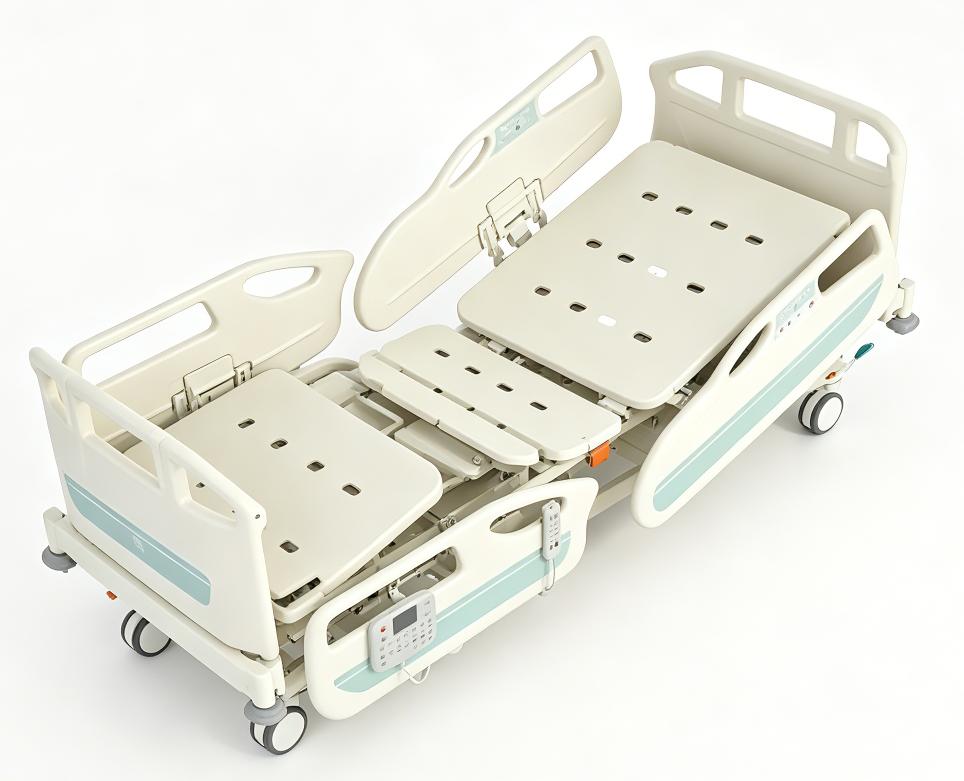
A typical five-function ICU bed provides essential electric positioning. The exact definition varies by manufacturer, so the RFQ should list every function separately.
A common configuration includes:
1. Electric backrest adjustment
2. Electric knee-rest adjustment
3. Electric height adjustment
4. Electric Trendelenburg positioning
5. Electric reverse Trendelenburg positioning
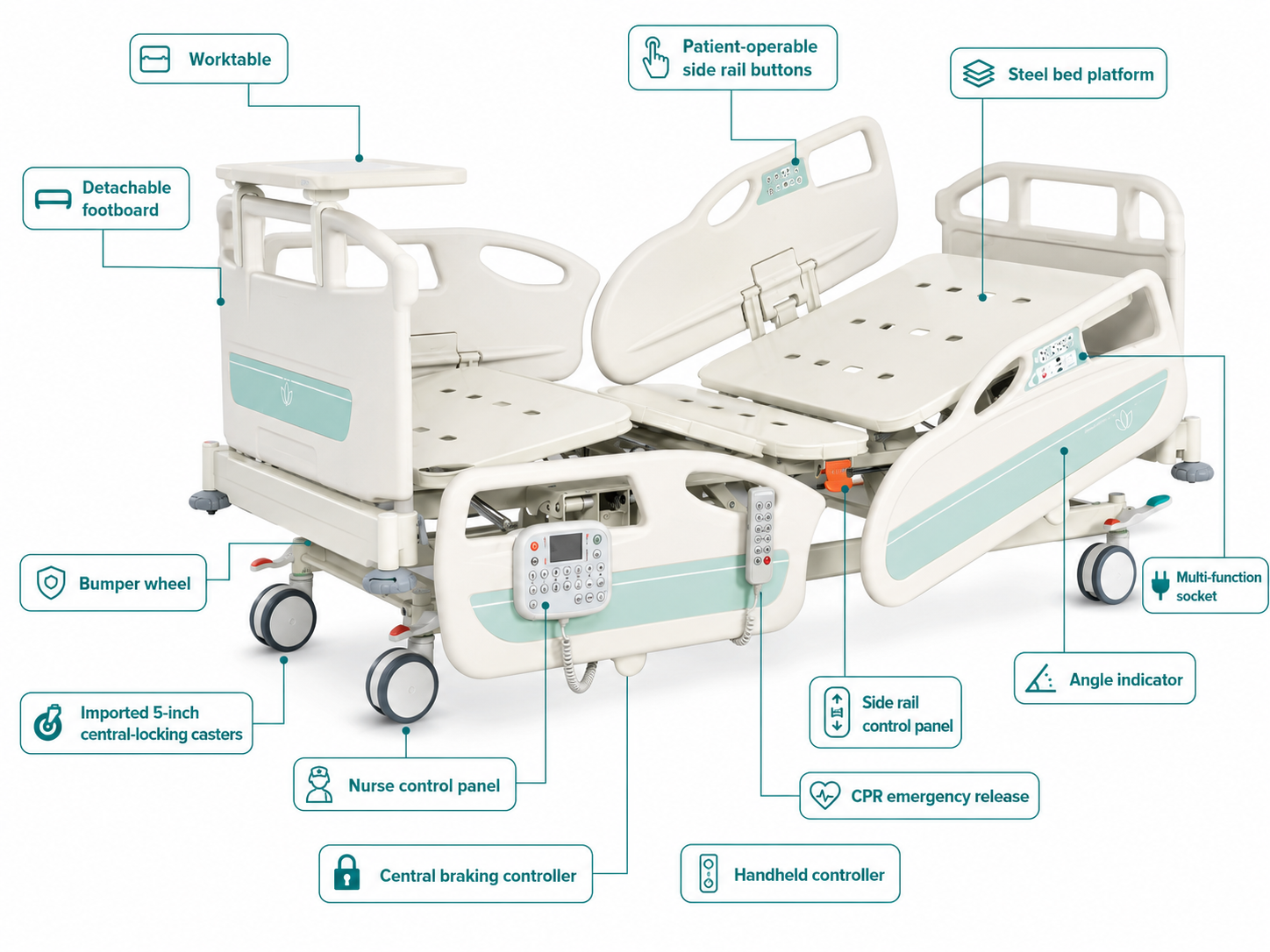
The bed may also include:
- Integrated patient weighing scale
- Manual or electric CPR release
- Central-locking casters
- Protective side rails
- Nurse-control panel
- Patient handset
- Battery backup
- IV-pole sockets
- Drainage-bag hooks
- Oxygen-cylinder holder
- Corner bumpers
- X-ray-accessible backrest
- Mattress platform extension
These additional features should not be assumed. Each must be clearly identified as standard, optional, or excluded.
In critical care, patient weight can influence clinical decisions, fluid management, nutrition planning, medication calculations, and monitoring of changes over time. An integrated weighing system may reduce the need to move or transfer a patient to a separate scale.
However, an integrated scale should not be judged only by its presence. Buyers must verify:
- Weighing range
- Accuracy or tolerance
- Resolution
- Calibration method
- Zeroing and tare functions
- Display location
- Accessory compensation
- Battery behavior
- Operating conditions
- Test documentation
A weak RFQ may say:
> "Please quote a five-function ICU bed with weighing function."
This description is not sufficiently precise. Different manufacturers may interpret it differently. One supplier may include an integrated weighing system; another may offer a bed with only a separate scale accessory. One may quote a fully electric CPR position; another may include a manual emergency release.
A strong RFQ helps buyers:
- Compare equivalent products
- Reduce specification gaps
- Control project cost
- Avoid unexpected options
- Establish acceptance criteria
- Protect the hospital's operational needs
- Support regulatory documentation
- Create a clear basis for contract performance
The most important principle is simple: if a requirement matters, write it into the RFQ and tender documents.
Request the following information from each bidder:
- Legal company name
- Factory address
- Manufacturing-site address
- Contact person and technical representative
- Export experience
- Main export markets
- Production capacity
- Quality-management certifications
- Product liability arrangements
- OEM and private-label experience
- Warranty-service organization
- Local distributor or service partner, if applicable
If the bidder is a trading company, ask it to identify the actual manufacturer. The contract should clearly state who is responsible for:
- Product quality
- Regulatory documents
- Warranty service
- Spare parts
- Technical support
- Software or control-system updates
- Product changes
Ask whether the manufacturer operates an ISO 13485-certified quality management system. Request:
- Current certificate
- Certificate number
- Certification body
- Certified site address
- Scope of certification
- Validity dates
ISO 13485 supports controlled processes for production, inspection, documentation, training, supplier management, corrective action, and complaint handling. However, certification alone does not prove that a specific ICU bed meets every requirement in the destination market.
The RFQ should define the basic physical design.
| Specification item | Requirement to state |
|---|---|
| Bed type | Adult ICU bed, electric, five-function |
| Mattress platform | Number of sections and material |
| Overall dimensions | Length, width, and tolerance |
| Mattress size | Required mattress dimensions |
| Height range | Minimum and maximum platform height |
| Safe working load | Patient, mattress, bedding, and accessories included |
| Maximum patient weight | State separately from safe working load |
| Bed weight | With and without accessories |
| Castors | Diameter, material, swivel, and locking system |
| Side rails | Configuration, material, folding or split design |
| Headboard/footboard | Removable, lockable, and cleanable |
| Surface treatment | Coating, corrosion protection, and cleanability |
| Accessories | Standard and optional items listed separately |
Avoid ambiguous terms such as "heavy-duty," "premium," or "hospital quality." Replace them with measurable requirements.
---
Define:
- Adjustment angle
- Electric or manual operation
- Control location
- Movement speed
- Emergency release
- Anti-pinch protection
- Maximum rated load
Specify:
- Angle range
- Independent or linked movement
- Control method
- Mechanical stability
- Emergency operation
Request:
- Lowest platform height
- Highest platform height
- Adjustment speed
- Noise level
- Operation under rated load
- Battery operation capability
A low minimum height may support safer patient access, while a higher maximum height can assist nursing procedures and cleaning.
Specify:
- Maximum angle
- Electric operation
- Control-panel access
- Emergency return
- Stability with accessories installed
Specify:
- Maximum angle
- Electric operation
- Control location
- Safety interlock
- Mattress compatibility
- Test method
Some suppliers count Trendelenburg and reverse Trendelenburg as one "tilt" function. To avoid confusion, list both positions independently in the tender.
---
The weighing system is often the most technically sensitive part of the RFQ.
Include:
- Minimum weighing capacity
- Maximum weighing capacity
- Resolution
- Accuracy or permissible error
- Display unit
- Zeroing function
- Tare function
- Calibration procedure
- Overload indication
- Low-battery indication
- Power-failure behavior
- Accessory compensation
- Data retention or memory
- Display location
- Service and calibration requirements
The scale should explain how the system handles the weight of:
- Mattress
- Bed sheets
- Pillows
- Side-rail pads
- IV poles
- Drainage bags
- Oxygen holders
- Monitors
- Other installed accessories
Ask whether these items can be removed from the measurement through a tare function. The procedure should be described in the user manual and demonstrated during inspection.
The tender should define a practical test:
Include:
- Rated voltage
- Frequency
- Plug type
- Motor voltage
- Battery type
- Battery capacity
- Charging time
- Battery operating cycles
- Battery replacement interval
- Ingress-protection information
- Fuse or overload protection
- Leakage-current test requirements
- Emergency operation during power failure
- Control-panel protection
- Cable-management requirements
Ask whether the bed can complete essential movements during a power outage. Confirm which functions remain available on battery power and whether the battery condition is displayed to the operator.
For international OEM projects, the power specification must be confirmed before production. A mismatch in voltage, plug, labeling, or user documentation can delay shipment or create installation problems.

The hospital bed should be designed for routine cleaning and disinfection.
Specify requirements for:
- Smooth mattress-platform surfaces
- Rounded edges
- Sealed or protected joints
- Corrosion-resistant components
- Removable headboard and footboard
- Easy-to-clean side rails
- Protected electrical connectors
- Drainage-bag hooks
- Wheel housings
- Coating resistance
Request:
- Cleaning instructions
- Compatible disinfectants
- Material declarations
- Corrosion-resistance information
- Surface-treatment details
- Recommended maintenance schedule
A manufacturer should not simply state that the bed is "easy to clean." The buyer should assess corners, joints, cables, handles, rails, and mechanisms where dirt or liquid may accumulate.
---
A complete tender submission should include:
- Technical datasheet
- Product drawings
- User manual
- Service manual
- Installation guide
- Maintenance schedule
- Risk-management summary, when applicable
- Declaration of conformity
- Product test reports
- Electrical-safety test reports
- Load-test records
- Weighing-system calibration information
- Packing list
- Spare-parts list
- Warranty statement
- Training plan
- Complaint-handling procedure
- Change-notification policy
The required regulatory documents depend on the target market. The buyer should identify whether the bed is regulated as a medical device, what classification applies, and which conformity-assessment route is required.

Do not compare only the unit price. Use a weighted evaluation model.
| Evaluation category | Suggested importance |
|---|---|
| Technical compliance | 25% |
| Weighing-system performance | 15% |
| Safety and quality documentation | 15% |
| Supplier experience and production capability | 10% |
| Warranty and after-sales service | 10% |
| Delivery and packaging | 10% |
| Total cost of ownership | 10% |
| OEM flexibility | 5% |
- Purchase price
- Freight and insurance
- Installation
- Staff training
- Preventive maintenance
- Battery replacement
- Actuator replacement
- Scale calibration
- Spare parts
- Warranty exclusions
- Local service charges
- Downtime risk
A cheaper bed may become more expensive if it needs frequent service or has limited access to spare parts.
---
For a serious hospital or distributor project, approve a sample before mass production.
Check:
- Technical drawing
- Function list
- Electrical specifications
- Weighing specifications
- Accessories
- Packaging
- Labeling
Verify:
- Bed movements
- Load stability
- Brake operation
- Side-rail locking
- CPR release
- Battery backup
- Weighing accuracy
- Cleaning access
- Noise and vibration
The approved sample should be photographed and recorded. It becomes the reference for:
- Production
- Final inspection
- OEM branding
- Packaging
- Future change control
Inspect a defined sample size before shipment. Confirm:
- Functions
- Dimensions
- Appearance
- Labels
- Accessories
- Packaging
- Documentation
- Weighing-system performance
The supplier should not change:
- Motors
- Load cells
- Control panels
- Materials
- Wheels
- Side rails
- Power systems
- Packaging
- Critical suppliers
without written approval when the change may affect safety, performance, regulatory status, or interchangeability.
---
For overseas brands and distributors, the RFQ should also define:
- Logo placement
- Product color
- Brand name
- Model number
- Serial-number format
- Language requirements
- User-manual artwork
- Carton design
- Label content
- Barcode or QR code
- Warranty card
- Spare-parts packaging
- Minimum order quantity
- Tooling or development fees
- Intellectual-property ownership
At Tianjin Kangli Medical Device, we recommend finalizing the technical specification before artwork and packaging. This reduces the risk of printing incorrect claims or labeling a product before the final configuration is approved.

A buyer can use the following checklist before requesting a quotation:
- [ ] Five electric functions listed individually
- [ ] Integrated weighing scale included or excluded
- [ ] Weighing range and accuracy defined
- [ ] Tare and calibration procedures requested
- [ ] Safe working load specified
- [ ] Mattress dimensions confirmed
- [ ] Electrical voltage and plug defined
- [ ] Battery backup specified
- [ ] CPR release and emergency operation defined
- [ ] Side-rail and caster requirements stated
- [ ] Applicable standards identified
- [ ] ISO 13485 certificate requested
- [ ] Test reports and user manuals requested
- [ ] Inspection and acceptance criteria agreed
- [ ] Warranty and spare-parts terms defined
- [ ] OEM branding and packaging requirements stated
- [ ] Delivery terms and lead time confirmed
- [ ] Change-control procedure included
---
For an international ICU-bed project, a suitable OEM partner should be able to support more than production.
You may require:
- Technical specification review
- Product customization
- Private-label branding
- Sample development
- Function and load testing
- Weighing-system verification
- Export packaging
- Documentation support
- Pre-shipment inspection
- Spare-parts planning
- Warranty coordination
- Production-change management
If you are preparing an RFQ or hospital tender, send your target specifications, quantity, destination market, required functions, branding requirements, and delivery schedule to Tianjin Kangli Medical Device.
Request a technical quotation and specification review before placing your order. A detailed RFQ helps us recommend the most suitable configuration and identify potential cost, compliance, and delivery risks early.
---
A typical configuration includes electric backrest adjustment, electric knee-rest adjustment, electric height adjustment, Trendelenburg positioning, and reverse Trendelenburg positioning. The exact configuration should always be confirmed in the supplier's technical datasheet.
No. Some beds include an integrated weighing system, while others offer it as an option or do not support it. The RFQ must specify the weighing range, accuracy, display, calibration, and tare requirements.
Both matter. The weighing range defines the applicable patient and accessory load, while accuracy determines how closely the displayed value represents the actual load. The hospital should select requirements based on clinical use and approved biomedical procedures.
Battery backup is strongly recommended for electric ICU beds, especially where uninterrupted positioning or emergency movement may be required. The RFQ should state which functions must remain available during a power failure.
Compare the complete technical configuration, not just the price. Review functions, weighing performance, safe working load, electrical system, documentation, warranty, spare parts, delivery terms, and total cost of ownership.
No. ISO 13485 indicates a structured medical-device quality-management system, but buyers must still evaluate the specific bed, applicable standards, testing, documentation, intended use, and destination-market requirements.
Yes, depending on the manufacturer. Common customization options include branding, color, accessories, side rails, mattress specifications, control labels, packaging, user manuals, and electrical configurations.
---
U.S. Food and Drug Administration — Medical Device Standards and Conformity Assessment
Information on medical-device standards, conformity assessment, and relevant bed-system safety considerations:
https://www.fda.gov/medical-devices/medical-device-regulatory-science-research-programs-conducted-oc/medical-device-standards-and-conformity-assessment
U.S. Food and Drug Administration — Hospital Bed System Dimensional and Assessment Guidance
Reference material concerning hospital-bed system safety and patient-entrapment risks:
https://www.fda.gov/medical-devices/medical-device-safety/hospital-bed-system-dimensional-and-assessment-guidance-reduce-entrapment
International Organization for Standardization — ISO 13485:2016
Medical devices quality-management-system requirements for regulatory purposes:
https://www.iso.org/standard/59752.html
International Electrotechnical Commission — IEC 60601-2-52
Particular requirements for the basic safety and essential performance of medical beds:
https://webstore.iec.ch/en/publication/2635
International Organization for Standardization — ISO 14971:2019
Medical-device risk-management principles and processes:
https://www.iso.org/standard/72704.html
ICC Incoterms® Rules
General reference for international trade terms and allocation of responsibilities:
https://iccwbo.org/business-solutions/incoterms-rules/


